Worker Retention at Zappos

Tony Hsieh, chief executive of Zappos, spoke at a recent y-combinator event (two great organizations we have mentioned before).

Facebook and Zappos’s Different Views on Worker Retention

“We actually want our employees stay with the company for a long time, for 10 years, maybe their entire life.”

“We now provide mentorship and training so employees can join at the entry level and, over a period of five to seven years, have the opportunity and training to become senior leaders in the company,” he said. “Constant growth is what will keep them in the company for a very long time.”

Hsieh said he wants Zappos to have a higher purpose than just driving profits and that if employees buy into it, it is easier to have great customer service and for employees to want to stay at the company. He’s outlined that in core values that the company uses to guide itself.

“For your employees, if you can inspire them through your vision, that’s not just about profits or being number one in the market,” Hsieh said. “I like to say the best businesses are the ones that figure out how to combine profits, passion and purpose and the vision and culture to do that.”

Great stuff. I must admit I would not find spending $700 million on an internet shoe and apparel retailer was a great idea for Amazon if it were not Zappos. I am happy to own a small portion of Zappos with such inspired leadership. The contrast in the respect for people Hsieh shows and so many other unethical CEO’s is amazing and inspiring. We need more such leadership examples to follow.

Related: Paying New Employees to QuitZappos and Amazon Sitting in a Tree…People are Our Most Important AssetBuilding a Great Workforce

Posted in Creativity, Deming, Fun, Management, Psychology, Respect, Systems thinking | Tagged , , , , , , | 2 Comments

Communicating with the Visual Display of Data

graphs showing data sets with different looks even though some statistical characteristics are the same
Anscombe’s quartet: all four sets are identical when examined statistically, but vary considerably when graphed. Image via Wikipedia.

___________________
Anscombe’s quartet comprises four datasets that have identical simple statistical properties, yet are revealed to be very different when inspected graphically. Each dataset consists of eleven (x,y) points. They were constructed in 1973 by the statistician F.J. Anscombe to demonstrate the importance of graphing data before analyzing it, and of the effect of outliers on the statistical properties of a dataset.

Of course we also have to be careful of drawing incorrect conclusions from visual displays.

For all four datasets:

Property Value
Mean of each x variable 9.0
Variance of each x variable 10.0
Mean of each y variable 7.5
Variance of each y variable 3.75
Correlation between each x and y variable 0.816
Linear regression line y = 3 + 0.5x

Edward Tufte uses the quartet to emphasize the importance of looking at one’s data before analyzing it in the first page of the first chapter of his book, The Visual Display of Quantitative Information.

Related: Great ChartsSimpson’s ParadoxSeeing Patterns Where None ExistsVisible DataControl ChartsEdward Tufte’s: Beautiful Evidence

Posted in Data, Quality tools, Statistics | Tagged , , , , | 1 Comment

Management Improvement Carnival #79

Mark Graban is hosting Management Improvement Carnival #79 on the lean blog, highlights include:

  • A Natural Match (Deborah Dolezal, Lean Healthcare Grand Rounds): “As a healthcare worker and an implementer of lean, I am often struck by the similarity of the human body and the lean methodologies.”
  • Kaizen Corner — for lack of a battery (Paul Levy, Running a Hospital): “The idea is to keep asking why (the 5 why’s) until they discover the root cause, which is defined as that level of understanding that will permit development of a countermeasure that will prevent the problem from occurring again.”
  • Put Down That Tool (Jamie Flinchbaugh): “Use the simplest tool possible. When you start to use tools that are more complicated than they need to be, we add unnecessary waste and bureaucracy to the process of improvement.”
  • How NUMMI Changed Its Culture (John Shook, Lean.org): “What I learned was most powerful at NUMMI was to start with the behaviors, with what we do.”

Related: Management Improvement Carnival #62Management Improvement Carnival #40Management Improvement Carnival #29

Posted in Carnival | Tagged , | 1 Comment

Managing to Test Result Instead of Customer Value

Computer hardware and software creators use benchmarks as one tool to compare the performance of alternative products. At times this can be very useful. You can learn what software of hardware is faster and that may be a very valuable factor. However, any measure is determined by the operational definitions used in collecting the measure. And if people have incentives to improve the measured number they often will do just that (improving the measure) rather than improving the system (the measure is meant to serve as a proxy for some function of that system).

Information technology people actually understand this much better than most mangers (who also rely on measures for many things like return on equity, profit growth, productivity of various plants…) – so actually I find they are not nearly as fooled by measures compared to managers. On Reddit there is an interesting discussion on coding the product to provide good benchmark results [in this context benchmarking has to do with measured results on standard performance tests – not TQM style benchmarking). The technical details in this case don’t matter so much to my point, which is just that when people treat the measure as the true value instead of a proxy for the true value it is risky.

Technology companies compete fiercely and claiming the software or hardware is faster is one big area of competition. And the comment on Reddit is claiming one competitor changed some code only to get a better measure (that provides no benefit to customers). The problem with such actions, is they provide no actual value: all they do is make the measure less meaningful as a proxy.

Now it is also perfectly understandable why it would be done – when you are focused on improving the number, it might well be easier to distort the system to provide a better number (used by to measure performance) instead of actual improve the performance. It is easy to see why a company would do this if they want to have marketing claim their products are the fastest.
Continue reading

Posted in Creativity, IT, Management, Software Development, Systems thinking | Tagged , , , , , | 7 Comments

2009 Deming Prize

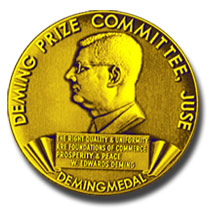
image of the Deming Prize medal

The Union Japanese Scientists and Engineers (JUSE) has awarded Niigata Diamond Electric (Japan) and Siam White Cement Company (Thailand) the Deming prize.

Organizations receiving the Deming Prize since 2000 by country (prior to that almost all winners were from Japan):

Country Prizes
India 15
Thailand 9
Japan 5
USA 1
Singapore 1

The 2009 Deming Prize for Individuals went to Dr. Hiroshi Osada, Professor, Graduate School of Innovation Management, Tokyo Institute of Technology. Previous recipients include: Kaoru Ishikawa, Genichi Taguchi, Shoichiro Toyoda, Hitoshi Kume and Noriaki Kano.

The 2009 Deming Distinguished Service Award for Dissemination and Promotion went to Gregory H. Watson, Chairman and Managing Partner, Business Excellence Solutions

Related: 2008 Deming Prize: Tata SteelDeming Prize 20072006 Deming Prize2006 Deming Medal presented to Peter R. Scholtes
Continue reading

Posted in Deming, Management | Tagged , , , , | 4 Comments

Management Improvement Carnival #78

The Curious Cat Management Improvement Carnival provides links to recent blog posts for those interesting in improving management of organizations.

  • Journey from Agile To Lean by Kenji Hiranabe – “Agile is a connector between business and software engineering…. From the business perspective, IT or software development is just one activity in the value stream of a company.”
  • Planning Managerial Capacity by Dan Markovitz – “While it’s very easy to take on more projects and responsibilities, it’s *stopping* work that’s critical to getting out of the office and meetings, and into the gemba where the learning happens.”
  • The Problem With Planning by Kelly Waters – “Rather than a detailed plan, I prefer to see a strong vision, a strategy, goals, and a roadmap (high level outline plan). The tactics to achieve this, for example the precise features and all the tasks to deliver them, can vary along the way and are best not articulated up-front.”
  • Enterprise Methods: Stop Tampering with the System of People by Marc Hersch – “Give everyone the job of systematically improving methods constantly so that all can experience joy and pride in workmanship.”
  • Lean thinker Paul O’Neill by Jamie Flinchbaugh – “to understand why you have a problem, you must understand the process or the means. Bad systems beat good people – manage the system.”
  • Innovation Is as Innovation Does? by Mark Graban – “More than rewarding “experimentation” (which is necessary for ‘kaizen’ or continuous improvement), does your organization manage to not punish ‘failure?'”
  • How to Be Lean in a Batch Production Industry by Jon Miller – “Engage people. This is really a basic condition for whatever lean and continuous improvement system you apply within a process industry. If you do nothing else, do this.”
  • Production Planning: What is it, and why should I care? by Connor Shea – “Establish a set time (weekly?) to go through Production Planning steps and to implement countermeasures when necessary. Creating a set time will ensure it becomes a regular part of your role and isn’t slowly displaced by the tyranny of the urgent.”
  • Level 5 Leadership by Ron Pereira – “be humble while holding fast to the path you feel is best for the organization no matter how difficult it may be”

Related: Curious Cat Economics and Investing CarnivalCurious Cat Management Books

Posted in Carnival | 1 Comment

Management Improvement Carnival #77

The Curious Cat Management Improvement Carnival provide links to recent blog posts for those interesting in improving management of organizations.

  • A lesson in strategy, taught by a Cat by Mark Hurst – “Without direction, we’re presenting our flipcharts and our powerpoints to the Cheshire Cat. And he just griiiiiiins.”
  • Respect for People, Underutilized People, and Waste by Pete Abilla – “Worldview and Values matter – those dictate the behaviors of everybody in the company. When ‘tools’ don’t work, that is because the values don’t support the ‘tools’. Focus on Worldview and Behavior – then the rest will follow.”
  • Top Ten Things Programmers Hate About Agile by Damon Poole – “If you want Agile to succeed, you need to point out, and be sincere about it, that Agile will affect the whole organization, management included.”
  • AT&T, I’m Begging You to Take My Money! by Kevin Meyer – “I’ve had automatic bill pay for three years so every payment was on time, with the iPhone being one of their more expensive plans… But she couldn’t authorize the credit for me to get a FREE phone.”
  • Why is asking “why” so important? by Tracey Richardson – “the next time you are at the GEMBA remember a few of these rules to effectively getting to root cause and past a symptom. This will not only help your team members but effect cost and productivity as well.”
  • The Importance of Going to the Gemba by Tim McMahon – “You can’t solve problems at your desk. Going to the Gemba is a great way to get the entire team involved in identifying and solving problems. It is grounded in fact finding using actual conditions from the actual workers who perform the work”
  • Genchi Genbutsu on the Retail Floor Jon Miller – “The facts that will transform our businesses don’t come from the boardrooms but from the floor (sales, production, hospital, etc.). We need to go see how customers are actually using our products and services in order to improve. Often there are unexpected differences between the design of the product, service or process and how customers use them.”
  • After Lehman: How Innovation Thrives In a Crisis by Scott D. Anthony – “Today, a company that enters the S&P 500 index will stay on it for less than 20 years… Increasingly, companies that buck the trend and last 30 or more years will do so only by mastering the ability to perpetually transform themselves.”
  • Key Measurements in Implementing Andon by Jamie Flinchbaugh – “no measure or indicator will tell you half as much as being on the floor, in the process, observing how people are using the system. You need to test people’s understanding and use of the processes. You need to see the responders methods and capability.”
  • Continue reading

Posted in Carnival, Lean thinking, Management | Tagged , , | 2 Comments

Five Managerial Fallacies Concerning Layoffs

The Top Five Managerial Fallacies Concerning Layoff Survivors by David Noer, author of Healing the Wounds: Overcoming the Trauma of Layoffs and Revitalizing Downsized Organizations.

The overwhelming consensus of downsizing research is that layoffs do not achieve their going in productivity goals. Survivors of most organizations are angry, depressed, anxious and fearful. They are not able or willing to take risks or focus on increasing customer service. At the very time organizations need them to be the most creative and energetic; they hunker down in the trenches, absorbed in their own toxic survivor symptoms.

Leadership in the post-layoff environment is a helping, not a controlling relationship, and requires reaching out, not closing down and hiding behind a facade of toughness and control. Organizations that have successfully helped employees rebound from the trauma of layoffs have required their managers to learn and apply basic helping skills.

Read the full post, for more good points by David Noer. Obviously when managements failures result in layoffs it is a huge blow to respect for people. It is very challenging to maintain lean thinking or Deming based improvement efforts when layoffs are needed. And if that failure isn’t addressed and explained and details provided on why the leadership failed and what is being done to fix those problems with the management system, the challenges grow.

I am very disappointed in management that resorts to layoffs as the easy solution to their failed leadership. Most of the time layoffs are an indication management does not respect people in any way, no matter what they say. Now, I do believe, it is possible that a company has been failed by past leadership and gotten into a position where layoffs are the right choice, but most companies choose layoffs as just another MBA spreadsheet “management” exercise and those companies pay a heavy price for such poor management.

Related: posts on layoffs and reducing staffHonda has Never had Layoffs and has been Profitable Every YearCreating Jobs

Posted in Deming, Management, Psychology, Respect | Tagged , , , , | 2 Comments

Credit Card Company Tries Providing Value

Most credit card issues seem to use business models based on tricking customers into paying high fees. PartnersFirst is focusing on providing value to customers. A Different Kind of Credit-Card Company

PartnersFirst is a different kind of credit-card company. Started in 2007 with funding from Western Alliance Bancorp (WAL), the fledgling firm has three key tenets: keep rates steady, eliminate fees, and rigorously evaluate the risk of potential customers. PartnersFirst mainly makes money from the interest it charges borrowers, whereas most credit-card companies also rake in huge fees. “I realized that there was an opportunity to give cardholders a square deal and still make a profit,”

Credit-card companies have made billions on affinity cards over the years – but regulators and lawmakers worry that consumers get raw deals. Critics say colleges put their financial interests ahead of those of their students, encouraging them to rack up high-cost debt. “Affinity cards started simply as a product that alumni associations could offer members, but alumni boards realized they could bargain for more cash up front,”

The companies involved in banking and credit cards in the USA have been hostile to customers for quite some time. I have been waiting for someone to decide to provide value to customers and take a fair profit. Hopefully PartnersFirst will continue this model, though I am suspicious, if they succeed they will be bought by another financial firm that is too-big-to-fail in order to once again restrict competition via their standard practice of buying any competitors instead of providing value to customers.

Related: How to protect yourself from your credit card companyDon’t Let the Credit Card Companies Play You for a FoolRetail Credit Card Fees Much Higher in the USA

Posted in Customer focus | Tagged , | Comments Off on Credit Card Company Tries Providing Value

Extrinsic Incentives Kill Creativity

If you read this blog, you know I believe extrinsic motivation is a poor strategy. This TED webcast Dan Pink discusses studies showing extrinsic rewards failing. This is a great webcast, definitely worth 20 minutes of your time.

  • “you’ve got an incentive designed to sharpen thinking and accelerate creativity and it does just the opposite. It dulls thinking and blocks creativity… This has been replicated over and over and over again for nearly 40 years. These contingent motivators, if you do this then you get that, work in some circumstances but in a lot of tasks they actually either don’t work or, often, they do harm.”
  • there is a mismatch between what science knows and what business does
  • “This is a fact.”

What does Dan Pink recommend based on the research? Management should focus on providing workplaces where people have autonomy, mastery and purpose to build on intrinsic motivation.

via: Everything You Think about Pay for Performance Could Be Wrong [the broken link was removed]

Related: Righter IncentivizationWhat’s the Value of a Big Bonus?Dangers of Extrinsic MotivationMotivate or Eliminate De-MotivationGreat Marissa Mayer Webcast on Google Innovation

Posted in Creativity, Deming, Management, Performance Appraisal, Psychology, quote, Science | Tagged , , , , , , , , , , , | 5 Comments