
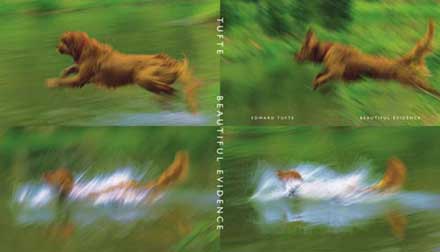
Beautiful Evidence by Edward Tufte is now available. Beautiful is the right word. Tufte’s books are an example of what can be created when someone truly loves what they do and takes pride in every detail of their work. His books are excellent.
In Beautiful Evidence, Tufte explores how to best display evidence looking at: mapped pictures; sparklines; links and causal arrows; words, numbers and pictures together; the fundamental principles of analytical design; corruption of evidence; and more.
Other Tufte Books:
- The Visual Display of Quantitative Information by Edward R. Tufte, 1983. The source for learning about displaying information. An excellent book for anyone who must use data to make decisions, convince others and educate others.
- Visual Explanations: Images and Quantities, Evidence and Narrative by Edward R. Tufte, 1997. Visual Explanations centers on dynamic data – information that changes over time. It is Tufte’s 3rd book. Another excellent book.
- Envisioning Information by Edward R. Tufte, 1990. “The most design-oriented of Edward Tufte’s books, Envisioning Information shows maps, charts, scientific presentations, diagrams, computer interfaces, statistical graphics and tables, stereo photographs, guidebooks, courtroom exhibits, timetables…”
For some reason his web site is not nearly as well designed as I would imagine for him. Partially he really loves the printed books and I isn’t as found of the limited resolution available on computers compared to print. The does contain useful and interesting information – including forums on visual display of information.
See also: Great Charts

Pingback: Metrics and Software Development
Pingback: CuriousCat » Data Visualization
Pingback: Curious Cat Science and Engineering Blog » The Value of Displaying Data Well