Checklists in Software Development

Verify your work with checklists

WHO has recently shown that surgical deaths can be reduced by a third when hospitals follow their Surgical Safety Checklist. The checklist is very low tech. It includes questions like whether the patient has been properly identified, whether the proper tools are available, and whether everyone knows what kind of procedure is about to be done.

If a checklist so simple can save so many lives, I thought the technique could surely help us do better as well. So after reading about this study and their checklist, I’ve been pushing us to create checklists for all the common procedures at 37signals.

We now have checklists in Backpack for confirming that a feature is complete, we have a checklist for preparing the feature for deployment and for executing the deployment, and finally for verifying that the feature is working as expected in the wild.

It’s the kind of stuff that we all know, but that we’ll often forget if we’re not being reminded about it in the moment. Thinking back to the mistakes we’ve made in the past, there are plenty of those that could have been avoided or caught much earlier if we had been using checklists.

This is a great reminder of two things: using checklists and adopting good ideas. Checklists are a simple and effective quality management tool. We use them for our software development (I have been a bit slow at getting them in place but we have been making progress recently). Also this shows how management improvement should work. You get good ideas from others and adapt them for use in your systems. Copying what others do, doesn’t work well. But understanding the concepts they use to improve performance and then adapting those concepts to your organization is the path to improved performance.

Related: Checklists Save LivesFind Joy and Success in BusinessLean, Toyota and Deming for Software DevelopmentThe Power of a ChecklistMost Meetings are Muda

Posted in Deming, IT, Management, Process improvement, Quality tools, Software Development | Tagged , , , | 3 Comments

Another Year of CEO’s Taking Hugely Excessive Pay

I continue to do my part to publicize the abusive CEO pay packages that the current crop of unethical CEO’s, and those sitting on corporate boards have supported (Tilting at Ludicrous CEO Pay 20082007 post on CEO pay abuses). It does seem there is more anger now at the looting these corrupt CEOs have engaged in; though far too many people seem to think the corruption is some isolated few CEO’s. The widespread failure of ethical standards by an enormous number CEO’s (those taking from corporate treasuries as though it was their own personal bank account) is the problem (not a few individuals). The looters certainly have littered their “courts” with apologists for their egregious behavior. Even with the large amounts they pay such lackeys I am surprised they find such willing apologists, in such large numbers.

2007 pay
rank
Company CEO 2008 Pay 2007 Pay CEO % of 2008 Earnings total employees
1 Motorola Sanjay Jha $104,400,000 company lost $4.2 billion 64,000
2 Oracle Lawrence Ellison $84,600,000 $61,200,000 1.5% 86,600
3 Walt Disney Robert Iger $51,100,000 $27,700,000 1.2% 150,000
4 American Express Kenneth Chenault $42,800,000 $50,100,000 1.6% 66,000
5 Citigroup Vikram Pandit $38,200,000 company lost $27.7 billion 322,800
6 Hewlett-Packard Mark Hurd $34,000,000 $26,000,000 7.4% 6,200
7 Calpine Jack A. Fusco $32,700,000 327% 2,000

This executive pay data is for 2008, from the New York Times article, Pay at the Top. Earnings and employee data for 2008 from Google Finance. I would not pay any of these guys 1% of what they were paid if I owned the company, myself.

These guys and their friends have created a culture where their looting is as accepted as the clothes the emperor is not wearing. We need to wake up and stop letting these people steal the bounty created by the employees, customers, community, suppliers, investors… They want a world where they can behave like nobility – taking whatever they want from the value created by others. And lately they have succeeded in creating such a world. They leave in their wake very weakened companies and societies.
Continue reading

Posted in Economics, Management, Management Articles | Tagged , , , , , , , | 6 Comments

The Importance of Making Problems Visible

Great, short, presentation webcast by Jason Yip showing the importance of making problems visible. Anyone interested in software development should watch this, and it is valuable for everyone else, also. Great visuals.

Related: Future Directions for Agile ManagementAgile Software Development SlideshowLeading Lean: Missed OpportunityInformation Technology and ManagementCurious Cat Micro-financiersposts on project managementToyota Institute for Managers

Posted in IT, Lean thinking, Management, Software Development | Tagged , , , , , , , | 2 Comments

Management Improvement Carnival #59

Nicole Radziwill is hosting the Management Improvement Carnival #59 on the Quality and Innovation blog, highlights include:

  • June Holley, talking about self-organizing to achieve systems-level innovation. She notes that because theory is lacking, this process might be protracted, but to get to the point of understanding theory we need some more “real life” examples and case studies of how we self-organize in our organizations well – and not so well.
  • Small is the new big. Sustainable is the new growth. Trust is the new competitive advantage. All of the rules of business have changed, and the seismic shift is both electrifying and frightening. But there are opportunities to be embraced, and many of them are summed up in this HBS blog article entitled, Why Small Companies Will Win in This Economy
  • And did you know that neuroscience may provide some insights into how to stage your process improvement efforts and your initiatives that focus on innovation?

Submit suggestions for the management improvement carnival.

Posted in Carnival, Management | Tagged , | Comments Off on Management Improvement Carnival #59

Out of the Crisis Seminar

I will be co-presenting an Out of the Crisis seminar for the W. Edwards Deming Institute next month, April 20-22, in Philadelphia.

Companies around the world are on the brink of destruction. When they get bailed out, or economies improve, they won’t survive if they continue to make products and provide services the same way as before, with the same style of management. They need to change.

It was the ideas of an American, W. Edwards Deming, that transformed Japanese industry after the devastation wrought by World War II. More than fifty years later, American businesses and much of the rest of the world find themselves in a somewhat similar position. Isn’t it time for American industry to wake up? Management practices need to change!

This seminar will help you work on transformation of management practices at your organization. It will show how current governance practice leads to the heaviest losses, how inconsistencies between policy and strategy create sub-optimal outcomes, how mismanagement of people leads to unethical and ineffective behavior. You will learn how to overcome these problems and focus on creating a system of continual improvement, just as Toyota and other Japanese firms did some fifty years ago.

You may find more information and register online. I hope to see you there.

Related: Deming Institute Conference: Tom NolanLouisville Slugger – Deming PracticesCurious Cat Management Improvement Calendar6 Leadership CompetenciesDeming Conference 2005

Posted in Career, Deming, Management | Tagged , , , , | 1 Comment

Management Blog Posts From December 2005

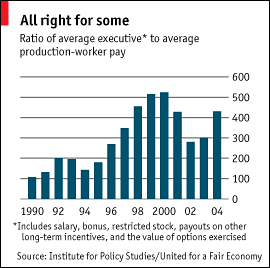
chart of executive pay 1990-2005

The executive pay excesses are so great now they will force companies to choose to:

  1. take huge risks to justify such pay and then go bankrupt when such risks fail (and some will succeed making it appear that the pay was deserved rather than just the random chance of taking a large risk and getting lucky).
  2. make it impossible to compete with companies that don’t allow such excesses and slowly go out of business to those companies that don’t act so irresponsibly.
  3. hope that competitors adopt your bad practice of excessive pay (this does have potential as most people are corrupted by power, even across cultural boundaries). However, my expectation is the competitive forces of capitalism going forward are going to make such a hope unrealistic. People will see the opportunity provided by such poor management and compete with them.

As long as the pay packages were merely large, and didn’t effect the ability of a company to prosper, that could continue (slicing up the benefits between the stakeholders is not an exact science). The excesses recently have become so obscene as to become unsustainable.

  • Innovate or Avoid Risk – “There are many reasons why avoiding risks is smart and should be encouraged. But when avoiding risks stifles innovation the risks to the organization are huge.”
  • Quality, SPC and Your Career – “I believe far too often we look for the newest ideas and miss all the great ideas that have been known for decades but are not practiced widely. The key to success is applying good ideas well – not just applying new ideas.”
  • America’s Manufacturing Future – “The best hope, as I see it, for retaining manufacturing leadership in the USA is through increasing the adoption of management improvement methods including lean manufacturing.”
  • Ford’s Wrong Turn – “The biggest change needed is an improvement in management. Other things would also help greatly, such as improving the health care system.”
Posted in Management, Management Articles | Tagged , , | Comments Off on Management Blog Posts From December 2005

Jeff Bezos Spends a Week Working in Amazon’s Kentucky Distribution Center

Photo of Jeff Bezos, Amazon CEOPhoto of Jeff Bezos during the 2005 O’Reilly Emerging Technology Conference by James Duncan.

Jeff Bezos, Amazon CEO, is working for a week in Amazon’s Kentucky distribution center. I hope, and based on his past, I believe, that he is going to the gemba (Genchi Genbutsu) to learn more about how Amazon operates. That would be great.

He worked on wall street and understands the fake constraints they attempt to put companies (you must focus on short term profits, you must focus on pleasing wall street analysts not customers…). He understood the importance of managing cash flow and the unimportance of short term profits. And he understands the importance of customer focus. He understands lean thinking. We need more CEO’s like him.

Amazon CEO comes to Lexington

“Thanks so much for your interest in speaking with our CEO Jeff Bezos,” said spokeswoman Patty Smith. “Unfortunately, I’m not going to be able to arrange any interviews or photos this week while he is in Lexington.

“He is there to work,” Smith said, “and, unfortunately, we are just not scheduling any interviews while he is in town.”

Local Amazon employees say Bezos is working in the warehouse with the company’s hourly employees to see what they do and hear their comments about their work. Most CEOs would benefit from spending a few days on the shop floor.

Once again his actions indicate he is the type of CEO I want to invest in.

via: Jeff Bezos Works In Kentucky Distribution Center For A Week

Related: Jeff Bezos and Root Cause AnalysisManagement by Walking AroundAmazon InnovationAmazon’s Amazing AchievementLouisville Slugger, Deming PracticesManagement Excellence

Posted in Books, Creativity, Customer focus, Deming, Lean thinking, Management, Process improvement, Psychology, quote, Respect, Systems thinking | Tagged , , , , , | 5 Comments

Combinatorial Testing for Software

Combinatorial testing of software is very similar to the design of experiments work my father was involved in, and which I have a special interest in. Combinatorial testing looks at binary interaction effects (success or failure), since it is seeking to find bugs in software, while design of experiments captures the magnitude of interaction effects on performance. In the last several years my brother, Justin Hunter, has been working on using combinatorial testing to improve software development practices. He visited me this week and we discussed the potential value of increasing the adoption of combinatorial testing, which is similar to the value of increasing the adoption of the use of design of experiments: both offer great opportunities for large improvements in current practices.

Automated Combinatorial Testing for Software

Software developers frequently encounter failures that occur only as the result of an interaction between two components. Testers often use pairwise testing – all pairs of parameter values – to detect such interactions. Combinatorial testing beyond pairwise is rarely used because good algorithms for higher strength combinations (e.g., 4-way or more) have not been available, but empirical evidence shows that some errors are triggered only by the interaction of three, four, or more parameters

Practical Combinatorial Testing: Beyond Pairwise by Rick Kuhn, US National Institute of Standards and Technology; Yu Lei, University of Texas, Arlington; and Raghu Kacker, US National Institute of Standards and Technology.

the detection rate increased rapidly with interaction strength. Within the NASA database application, for example, 67 percent of the failures were triggered by only a single parameter value, 93 percent by two-way combinations, and 98 percent by three-way combinations.2 The detection-rate curves for the other applications studied are similar, reaching 100 percent detection with four- to six-way interactions.
These results are not conclusive, but they suggest that the degree of interaction involved in faults is relatively low, even though pairwise testing is insufficient. Testing all four- to six-way combinations might therefore provide reasonably high assurance.

Related: Future Directions for Agile ManagementThe Defect Black MarketMetrics and Software DevelopmentFull and Fractional Factorial Test DesignGoogle Website Optimizer

Posted in Design of Experiments, Process improvement, Quality tools, Software Development | Tagged , , , , , | 9 Comments

How to Create a Control Chart for Seasonal or Trending Data

Lynda Finn, President of Statistical Insight, has written an article on how to create a control chart for seasonal or trending data (where there is an underlying structural variation in the data). Essentially you need to account for the structural variation to create the control limits for the control chart. She also provides a Minitab project file. Both are available for download from the Curious Cat Management Improvement Library.

Related: Control Charts in Health CareCommon Cause VariationManaging with Control ChartsMeasurement and Data CollectionFourth Generation Management

Posted in Data, Deming, Management, Process improvement, Quality tools, Science, Statistics | Tagged , , , , , , | 3 Comments

Knowledge, Imagination, Innovation and Risk

A consumer can seldom say today what new product or new service would be desirable and useful to him three years from now, or a decade from now. New product and new types of service are generated, not by asking the consumer, but by knowledge, imagination, innovation, risk, trial and error on the part of the producer, backed by enough capital to develop the product or service and to stay in business during the lean months of introduction.

W. Edwards Deming
Page 182, Out of the Crisis
More of Deming on Innovation

Related: Innovation Thinking with Clayton ChristensenEngineering InnovationManaging InnovationGary Hamel on Management Innovation

Posted in Books, Creativity, Customer focus, Deming, Innovation, Management | Tagged , , | Comments Off on Knowledge, Imagination, Innovation and Risk