More Reasons to Avoid Layoffs

Lay Off the Layoffs by Jeffrey Pfeffer

As its former head of human resources once told me: “If people are your most important assets, why would you get rid of them?”

In fact, there is a growing body of academic research suggesting that firms incur big costs when they cut workers. Some of these costs are obvious, such as the direct costs of severance and outplacement, and some are intuitive, such as the toll on morale and productivity as anxiety (“Will I be next?”) infects remaining workers.

research paints a fairly consistent picture: layoffs don’t work. And for good reason. In Responsible Restructuring, University of Colorado professor Wayne Cascio lists the direct and indirect costs of layoffs: severance pay; paying out accrued vacation and sick pay; outplacement costs; higher unemployment-insurance taxes; the cost of rehiring employees when business improves; low morale and risk-averse survivors; potential lawsuits, sabotage, or even workplace violence from aggrieved employees or former employees; loss of institutional memory and knowledge; diminished trust in management; and reduced productivity.

As bad as the effects of layoffs are on companies and the economy, perhaps the biggest damage is done to the people themselves. Here the consequences are, not surprisingly, devastating. Layoffs literally kill people. In the United States, when you lose your job, you lose your health insurance, unless you can afford to temporarily maintain it under the pricey COBRA provisions. Studies consistently show a connection between not having health insurance and individual mortality rates.

Related: Five Managerial Fallacies Concerning LayoffsHonda has Never had Layoffs and has been Profitable Every YearThe Trouble with Performance Reviews by Jeffrey PfefferCutting Hours Instead of PeopleFiring Workers Isn’t Fixing Problems

Posted in Deming, Health care, Lean thinking, Management, Management Articles, Psychology, Respect | Tagged , , , , , , , | 1 Comment

Circle of Influence

In, The Seven Habits of Highly Effective People, Steven Covey discusses the circle of control, circle of influence and circle of concern. This provides a good framework from which to view issues as you look for improvement strategies.

Within your circle of control you have much more autonomy and have less need to win others over to your plan. However, in practice, even here, you benefit from winning over those who are involved (for example you are their boss).

Our circle of concern covers those things we worry about. Often, we believe because we worry we should find solutions. Problems that fall into this category (but outside our circle of influence) however often prove difficult to tackle. And often people don’t understand why they get frustrated in this case. You can save your energy for more productive activities by seeing some things are outside your influence and avoid wasting your energy on them.

A problem with this, I see in practice however, is that if you are creative many things that people think are beyond their influence are not. With some imagination you can find ways to have influence. Good ideas are powerful. And often that is all that is needed for influence is offering a good idea.

Understanding to what extent an issue is within your control or influence can help a great deal in determining good strategies. Where you have a good chance to influence the process you can focus on strategies that may require much more of your participation to be successfully adopted. As you have less influence such a strategy is likely a poor one.

You should remember, that there is a temporal component to your circle of influence. On some current issue, I may have a very low chance of success for getting the organization to adopt an improvement I think is best. But certain actions can build the understanding that will allow me later to have more influence. This can even be completely separate from how people normally think of circle of influence. By building an organization that moves toward data based decision making and therefore reduces HiPPO (Highest Paid Person’s Opinion) decision making I increase my ability to influence decision making in the future.

Long term thinking is a very powerful, and much under-practiced, strategy. Your influence within an organization is limited today but has great potential to expand, if you act wisely.

Thinking about the extent a current issue falls within your sphere of influence is important it determining the best strategies. But the most valuable insight is to understand how import your sphere of influence is. It determines what strategies you can pursue. And building your sphere of influence should be part of your decision making process.

By taking the long view you can put yourself in good positions to have influence on decisions. There are many ways to do this. My preferred method is fairly boring. Prove yourself to be valuable and you will gain influence. Help people solve their problems. They will be inclined to listen to your ideas. Provide people useful management tools and help them apply them successfully. Help get people, that you know are good, opportunities to succeed. Often this gains you two allies (the person you helped gain the opportunity for and the person that was looking for someone to step in). Work hard and deliver what is important. It isn’t some secret sauce for quick success but if you make those around you successful you grow your circle of influence.

Related: How to ImproveHelping Employees ImproveOperational ExcellenceManagement Advice FailuresManagement Improvement

Posted in Career, Creativity, Deming, Management, Popular, Psychology, quote, Respect, Systems thinking | Tagged , , , , , , , , , | 9 Comments

Observations of a New Googler

Some interesting thoughts from a new Google engineer, Things I’ve learned at Google so far

I would describe Google’s culture as “creative chaos”. There was some confusion about where I was supposed to be when I started. This resulted in the following phone call, “Hello?”, “Hello Ben, this is Conner (that’s my new manager), where are you?” “Mountain View.” “Why are you there?” “Because this is where the recruiter said to go.” “Good answer! Nice of them to tell me. Enjoy your week!” This caused me to ask an experienced Googler, “Is it always this chaotic?” The response I got was, “Yes! Isn’t it wonderful?” That response sums up a lot about Google’s culture. If you’re unable to enjoy that kind of environment, then Google isn’t the place for you.

Paul Buchheit was a software engineer at Google. He didn’t need permission to write something like gmail. Corporate culture says that if you need something like that, you just go ahead and do it. In fact this is enshrined as an official corporate policy – engineers get 20% of their time to do with pretty much as they please, and are judged in part on how they use that time. I found a speech claiming that over half of Google’s applications started as a 20% project. (I’m surprised that the figure is so low.) To get a sense of how much stuff people just do, visit Google Labs. No corporate decision. No central planning.

Sick day policy. Don’t show up when you’re sick and tell people why you’re not showing up. Note what’s missing. There is no limit to how much sick time you get if you need it.

I think he overestimates the lack of central planning, still it is another interesting view of Google.

Related: Eric Schmidt on Management at GoogleGoogle: Ten Golden RulesThe Myth of the Genius Programmer

Posted in Creativity, Google, Innovation, IT, Management, Software Development | Tagged , , , , | 2 Comments

Understanding Psychology: Slogans – Risky Tools

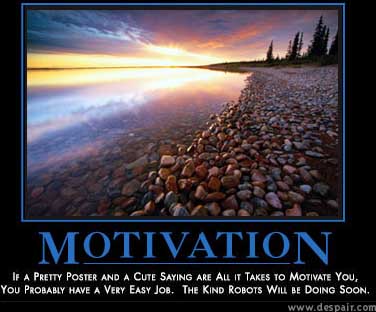
De-motivation Poster

Slogans mainly are bad. But like most things they can be used in ways that help or hurt. The main problem is when they substitute for a method to achieve the aim (most of the time). If the slogan serves like a mission statement to focus people on something useful to focus on and it is one minor part of a system to achieve a result it can be fine and even useful.

The issue, to me, is not so much that slogans are innately horrible. It is that, in practice, slogan are used in harmful ways most often (especially outside of sports). They tend to substitute for system improvement. The main work of shifting psychology (we do expect to win now, we do expect a focus on reducing bugs in our code…) after years of creating a different culture has to be in changing methods, priorities, values… Slogans, if done right, can be a way of focusing on the change. Or they can be a real reminder of values. But the slogan only provides value as part of a system confirming the aim they emphasis.

Unfortunately, they also to be used as a way to focus criticisms on individuals. Don’t you know/care that our slogan says zero defects? Can’t you read? Jeez, I even put up a huge poster with our slogan saying zero defects and you can’t even do what it says in this beautiful poster? Well, I will give you a bad performance review now, you can’t say you don’t have that coming after you failed to do what our slogan told you to do.

A slogan by itself has negative value. Take any wonderful slogan and move it somewhere else it will do more harm than good. As a minor part of a system though it can tap into how we people think and act (psychology) and provide value. Be careful though, it is much easier to do harm with slogans than to provide value.

If the slogan emphasizes what is being practiced every day, it can be a helpful reinforcer. If it conflicts with what is done every day it breeds cynicism and shows disrespect for people. This which is a huge problem. And managers have to know it is very easy for people to see the lack of cloths on the emperor slogan. Dilbert does a great job showing the risks of using slogans. Those you are targeting the slogan to are more likely to think like Dilbert than the they are to think like the pointy haired boss (and if you are the one pushing the slogan that means you are well on your way to being the phb – so be careful).

Slogans clearly fall under Deming’s understanding psychology area of management. To use them effectively you need to make sure the value provided, exceeds the cost and risk. I see no better way to evaluate slogans than through the lens of Deming’s system of management, interdependent components of: psychology, systems thinking, understanding variation and theory of knowledge. If the slogan is not supported by the system of management within the organization the slogan will do harm.

In response to: Are Slogans Always Bad or Can They Inspire?

Related: Deming on eliminating slogans and motivational postersEliminate SlogansToyota Targets 50% Reduction in Maintenance Wasteposts on psychologyHow to ImproveStop Demotivating Employees

Posted in Deming, Management, Psychology, Quality tools, quote, Respect | Tagged , , , , , , , , | 2 Comments

Management Improvement Carnival #87

The Curious Cat Management Improvement Carnival provides links to recent articles to help managers improve the performance organization.

  • Lean in Sweden: Tools < Thinking by Mark Graban – “Tools have some value, but only in context of lean thinking and the lean management philosophy. Tools aren’t value-less, but thinking is better.”
  • Manufacturing starts to come home by Dan Markovitz – “NCR sees domestic manufacturing as key to increasing sales as well. It enables them to make higher value-added products that their customers want.”
  • Correlation or Causation? Interceptions and the Playoffs by Jeff Hajek – “this is a classic case of confusing correlation with causation. If this data truly was a cause and effect relationship, meaning interceptions caused losses, fixing the problem would be simple… If you never threw the ball, you could win nearly four out of five times.”
  • Learning from Toyota’s Stumble by Steven Spear – “But as we are now sadly seeing, the capacity for developing people can be overstretched. It was not recognizing this and succumbing to the temptation to make growth its first priority that led to Toyota’s current problems.”
  • When in doubt, timebox it by Mark Imbriaco – “If we can solve the compatibility problems in those 30 minutes, it will be a nice win and we can make use of the plugin that we want to. On the flip side, we already have a known solution to the problem.”
  • Be Proactive – Prevent your problems! by Sonja Hughes – “Monitoring process performance through statistical process control or other performance measures allows us to detect changes or trends so we can take appropriate action before problems occur.”
  • Continue reading

Posted in Carnival, Management | Tagged , , , | Comments Off on Management Improvement Carnival #87

The Trouble with Incentives: They Work

Gipsie B. Ranney has a great new article – The Trouble with Incentives: They Work

I have wondered whether the escalation of pay, perks and parachutes for CEOs actually tends to attract individuals who are primarily extrinsically motivated, rather than individuals who are seriously interested in creating value. Several recent examples appear to be consistent with this view.

An important issue with regard to incentives is possible effects on teamwork and cooperation. If the incentive system is set up as a zero-sum game, then for me to win, you have to lose. This is a very effective way to ensure that there is little or no teamwork or cooperation. Interactions between individuals and groups are likely to become negative, to the detriment of the organization as a whole. When incentives are based on narrow functional objectives, achieving those objectives may guarantee that the system as a whole will be suboptimized.

the Mayo Clinic, “which is among the highest-quality, lowest-cost healthcare systems in the country.” He reports that “decades ago Mayo recognized that the first thing it needed to do was eliminate the financial barriers. It pooled all the money the doctors and the hospital system received and began paying everyone a salary, so that the doctors’ goal in patient care couldn’t be increasing their income. Mayo promoted leaders who focused first on what was best for patients, and then on how to make this financially possible.” He goes on to say, “the core tenet of the Mayo Clinic is ‘The needs of the patient come first’ – not the convenience of the doctors, not their revenues. The doctors and nurses, and even the janitors, sat in meetings almost weekly, working on ideas to make the service and the care better, not to get more money out of patients.”

Could it be that physicians, insurers, drug companies, and patients are simply acting rational to the system? The players are incentivized to behave as they do. The system delivers what it is designed to deliver.

She sums it up very well:

There may be cases in which incentives work only as intended, but I suspect they are relatively rare. The trouble is that we are usually dealing with complex systems (people and organizations) that may behave not at all like our myths would predict. The best policy may be to avoid incentives altogether and focus instead on creating systems in which intrinsic motivation, cooperation, ethical behavior, trust, creativity, and joy in work can flourish.

Find more articles on management improvement in the Curious Cat Management Improvement Library, including: An Interim Report on Motivation in the Workplace by Gipsie Ranney, Remembering NUMMI by Gipsie Ranney and Improving Problem Solving by Ian Bradbury and Gipsie Ranney.

When you can’t prevent arbitrary targets and rewards based on meeting them the strategy I attempt to put in place is figure out how the system will be distorted in order to meet those targets and then put in measures that will discourage such distortions. It isn’t perfect but can help prevent some of the worst distortions (and degradation of system-wide performance they cause).

Related: Righter IncentivizationThe Defect Black MarketDr. Deming on the problems with managing with targets (and incentives based on them)Extrinsic Incentives Kill Creativity

Posted in Competition, Deming, Management, Management Articles, Performance Appraisal, Psychology, Systems thinking | Tagged , , , , , , , , | 8 Comments

Toyota Stops Lines – Lots of Lines

The practice of stopping (either the machine automatically detecting a problem and stopping or a person stopping) the line when a problem is detected is part of Jidoka. Jidoka is also highlighting and making problems visible. Jidoka and Just in Time are the two pillars of the Toyota Production System. Today Toyota practiced Jidoka on a large scale: Toyota Halts Sales of Eight Models After Recall [the broken link was removed]

Toyota Motor, still struggling to resolve a problem with accelerator pedals, said Tuesday it would temporarily stop selling and building eight models in the American market, including the popular Camry and Corolla sedans

“This action is necessary until a remedy is finalized,” Robert S. Carter, a Toyota group vice president, said in a statement. “We’re making every effort to address this situation for our customers as quickly as possible.”

Toyota said it would immediately stop selling the Camry, Corolla and Avalon sedans, Matrix wagon, RAV4 crossover, Tundra pickup, and Highlander and Sequoia sport utility vehicles. It will also stop building those models the week of Feb. 1. All of the vehicles are assembled in the United States or Canada, at a total of five plants.

The models affected accounted for more than a million sales in 2009, 57 percent of Toyota’s American total for the year.

The most recent recalls follow what Toyota insisted was a companywide effort to improve quality that was started by Katsuaki Watanabe, who served as its president before he was replaced last year by Akio Toyoda, grandson of the company’s founder.

My guess is there are quite a few people in Toyota that are getting a frustrated that they continue to have problems that they have been unable to successfully address. This strikes is as the kind of action initiated near the top of the organization chart to remind the organization that problems must be addressed immediately. It is not ok to continue business as usually when problems have not been addressed in the Toyota Production System. Toyota is capable of failing to live up to the principles of lean manufacturing. But they also seem to understand this risk and continue to strive to improve. To succeed though they need to improve results – intentions alone are not enough.

Related: Cease Mass Inspection for QualityRecalls at Toyota and SonyReacting to Product ProblemsWorkplace Management by Taiichi Ohno

Posted in Lean thinking, Management, Manufacturing, Toyota Production System (TPS) | Tagged , , , , | 3 Comments

Prophet Unheard: Dr. W. Edwards Deming – 1992

[embedded webcast links removed because they have been removed from YouTube. To see video with W. Edwards Deming see the Deming Institute YouTube channel.]

This is an interesting video on Deming and American management (by the BBC in 1992): Prophet Unheard. It includes some nice old footage of Deming in Japan. The importance of respect for people is clear and the video also touches on the idea the danger of relying on data (when you do not understand variation and that many important matters and unmeasurable). The video features many snippets of Dr. Deming speaking and includes Don Peterson, Ford CEO; Clare Crawford Mason, If Japan Can, Why Can’t We producer; and Myron Tribus.

Related: Dr. Deming Webcast on the 5 Deadly DiseasesRed Bead Experiment WebcastPerformance without Appraisalmanagement webcasts

Part two of the documentary explores the Deming Prize, understanding data and the PDSA cycle: [removed]

Part 3 explores the efforts at Florida Power and Light, the first USA Deming Prize winner: [removed]

Posted in Data, Deming, Management, Manufacturing, Quality tools, Respect | Tagged , , , , , , , | 1 Comment

Management Improvement Carnival #86

The collection of posts from 10 blogs that made up the 2009 annual management blog are counted as Management Improvement Carnival #85, making this post #86.

  • Are Slogans Always Bad or Can They Inspire? by Mark Graban – “Why are slogans bad? Dr. Deming writes, in part, ‘They are directed at the wrong people. They arise from management’s supposition that the production workers could, by putting their backs into the job, accomplish zero defects, improve quality, improve productivity, and all else that is desirable.””
  • Fail, Learn, Lead by Jamie Flinchbaugh – “we don’t want to encourage people to make mistakes, but what do we want? We want people to surface mistakes or errors as they occur. We want them to own them and fix them. And we do want them to learn from them when they do occur”
  • Five Change Management Errors that Make You Wish You’d Read this Article Sooner by Jon Miller – “it’s best to spend most of the time debating the guiding principles and values of lean in order to gain deep alignment, and then let the tools and specific solutions follow from that.”
  • Joy, hope, and lean by Karen Wilhelm – “I think it’s joy and hope that propel continuous improvement. We’re just humans, with primitive brains that run on emotions more often than on facts and figures.”
  • Motiv’s Scott Wilbur Teaches Brunswick a Lesson by Kevin Meyer – “Brunswick moved a bowling ball factory from Michigan to Mexico to chase cheap labor… and paid for it in quality. Meanwhile Scott Wilbur decided to stay behind, started Motiv, and became profitable making bowling balls in Michigan.”
  • Continue reading

Posted in Carnival, Management | Tagged | 1 Comment

Hospital Providing Better Health Care While Reducing Costs

Business Week has a good article on the strides one hospital has been able to make at reducing costs and improving quality. Hospitals: Radical Cost Surgery [the broken link was removed]

Walk into Providence Regional Medical Center, in Everett, Wash., and you will see a hospital trying something different: It brings the equipment to the patient. In 2003, Providence opened one of the few “single stay” wards in the nation. After heart surgery, cardiac patients remain in one room throughout their recovery; only the gear and staff are in motion. As the patient’s condition stabilizes, the beeping machines of intensive care are removed and physical therapy equipment is added. Testing gear is wheeled to the patient, not the other way around. Patient satisfaction with the “single stay” ward has soared, and the average length of a hospital stay has dropped by a day or more.

High quality at a low price. Every other industry strives for that combination, but a hospital that does both is all too rare. Providence and its cost-efficient brethren demonstrate that quality care can be delivered at an affordable price, provided hospitals can be persuaded to rethink decades-old practices.

The crazy world of hospital economics does not offer a lot of incentives to change. Both Medicare and private insurers reimburse on a piecework basis – known as fee-for-service – that encourages hospitals to treat more, prescribe more, and test more.

Providence has also published data showing that infections, lengths of stay, and surgical complications have dropped since starting its own program.

But hospitalists are still controversial in many communities, because primary care physicians are wary of giving up control of their patients, along with their share of inpatient fees. Dr. Joanne C. Roberts, one of the first hospitalists at Providence, has not seen this conflict in Everett, possibly because most of the hospitalists and primary care doctors are associates at one large medical practice, Everett Clinic. That’s not true everywhere, she says. “In another community where I worked, independent doctors were pretty hostile. Everyone was trying to grab part of the money. That just doesn’t happen here.”

In a study of 2,531 operations at Providence, Brevig reported that the incidence of transfusions was reduced to just 18% in 2007, from 43% in 2003, while the average patient stay was reduced by half a day. The changes have saved Providence an estimated $4.5 million.

Brevig has been proselytizing for his plasma practices at medical meetings, but to little avail. Only some 200 U.S. hospitals have a blood conservation program. Since patients are billed the cost of the plasma, doctors aren’t motivated to change their habits.

There are many more great examples of positive actions being taken in health care. But all you have to do is look at the overwhelming evidence of how amazingly poorly the health care system in the United States is doing to know that it is, overall, an enormous failure. For decades the enormous cost of supporting special interest groups that benefit from the current broken system have forced the rest of society to pay for their unwillingness to improve. We can no longer afford to accept the poor performance. We need to adopt the new ideas much more quickly and eliminate the taxes on the rest of society to support those that want to take an every increasing amount from society to support their outdated, failed policies.

Related: Community Medical Care SuccessesCEOs Want Health-Care ReformUSA Spends Record $2.3 trillion ($7,681 Per Person) on Health Care in 2008Health Care: Lessons for the USA from Switzerland

Posted in Creativity, Health care, Innovation, Management | Tagged , , , | Comments Off on Hospital Providing Better Health Care While Reducing Costs