It Just Works

Does Your Product Or Service “Just Work”? By Jim Kukral

That’s it. It’s the highest compliment you can get. “It just works” is a very powerful phrase in this day and age

There is truth to that statement. I think largely due to how bad so many products are – that they don’t actually work. The Kano model of customer satisfaction is an excellent way to view customer expectations.

The Kano model states that you have expected quality – it just does what it needs to (what is expected). Then more is better type – give me more at the same price and I am happier. But where you really want to get as a company is products and services that delight customers.

When you are delighted you are not easy prey to other companies. When you are satisfied you are ready for offers that say we will give it to you a bit cheaper or give you a bit more. But if you are delighted you don’t want to leave and instead are telling everyone you know how great this product or service is.

I think it might be that in many cases now people are delighted if things just work. Perhaps they have become so disillusioned that something actually working is delightful – I think there is real truth here. Which shows how much room there is to improve. It is such a huge bother to deal with junk that doesn’t work and the thought of dealing with the lousy service on such failures is enough to drive them to tears.

Related: What Job Does Your Product Do?Quality Customer FocusRitz Carlton and Home DepotGood Customer Service ExampleSeven Steps to Remarkable Customer ServiceMore Bad Customer Service Examples 🙁

Posted in Customer focus, Management, Quality tools | 2 Comments

Management Improvement Carnival #26

Please submit your favorite management posts to the carnival. Read the previous management carnivals.

  • Lean and waiting by Aza Badurdeen – “Carefully mapping and identifying the value stream will make it possible to identify wastes in the office (or in your service). When these are identified we can remove these wastes from the system.”
  • Happy Employees Create Value by Kevin Meyer – People have creativity, knowledge, experience, and ideas that can create value that doesn’t land on a traditional P&L. Hotelier Joie de Vivre does understand that oft-hidden but still real value.
  • Everything You Will Ever Need To Know About Business – “Also included is a personal note: ‘I’ve included an additional FREE book by the same author. Thanks for your order.’ I smile.
  • Womack on Respect for People by Mark Graban – “For anyone who thought ‘respect for people’ meant ‘being nice all the time,’ I hope Jim’s letter helps clarify the true difference.” (Curious Cat on respect for people circa 2006)
  • Ten Things Our Sensei Told Us by Kiki Risyandi – “Lean is about managing the value that your deliver to your customers so that all the elements of delivering that value work together in a seamless, coordinated fashion and driving through the organization horizontally instead of vertically.”
  • Sports ‘randomination’? by Mark J. Anderson – “From the knowledge gained from this experiment and other strategic moves, our team of techies went on to win our Class D league the following season.”
  • Continue reading

Posted in Carnival, Management | Comments Off on Management Improvement Carnival #26

Communicating Change

Response to: Sales Compensation Plan Changes [the broken link has been removed]

I believe the best way to communicate such changes is to explain how they tie into the long term vision of the organization. This requires that such a vision actually exists (which is often not the case). Then all strategies are communicated based on how they support and integrate with that vision. In addition that communication strategy incorporates an understanding about what weaknesses with past practices are addressed by this new strategy. And how this strategy is based upon what we have learned in strategies we have attempted recently.

That is the communication plan shows how using the PDSA improvement cycle has driven the new strategy. This has at least 2 benefits. First it forces management (well ok not quite, it forces them to frame the decision with PDSA but it encourages them to) actually use the PDSA cycle to make decisions which will result in better decisions. Which will also mean, when possible they will have piloted the change on a small scale prior to adopting it widely (avoiding major mistakes and allowing for more rapid experimentation). And secondly it reinforces that everyone should be using PDSA for those changes they are responsible for.

Most often there is no continuity or rigorous examination of past attempts in communicating change. In such situations I see no reason to be surprised that most people just see random changes by whoever is in charge that just must be survived until the next random change.

Free, Perfect and Now is a great book by a CEO at Marshall Industries that eliminated sales commissions as an integrated strategy to improve the performance of the entire organization. I think it is a great book on this topic.

Maybe I should also say that this isn’t a particularly easy way to communicate change (having to actually examine evidence prior to making decisions, then explain how new strategies support…). But I am not looking for the easiest way to communicate change but the most effective way to continually improve. Communication change is important as a supporting process within the systemic goal of continuous improvement. The easiest communication strategy is not important. The most effective methods for the entire system are. That is sub optimize the ease of communication for the benefit of the whole. If you want an easy communication strategy just send an email that says this is how we will do things from now on.

Related: Making Changes and Taking Risks in the Sales ForceCorporate Communication Through BloggingImproving CommunicationStop Demotivating Me!

Posted in Deming, Management, Systems thinking | Tagged , , , , | 5 Comments

Carnival of Human Resources #23

Carnival of Human Resources #23 by Ann Bares:

The purpose of performance management, according to my favorite definition, is to create an environment where successful performance is a high probability outcome. What could be more important? And, yet, is there any program that poses greater challenges to Human Resources? For this reason, I am always grateful for the wisdom and insights of those both within and outside the field of HR on this topic. HR Thoughts reminds us of the importance of preparation and honesty in this process with the post A strong performance evaluation does not just happen. To help us keep perspective and representing the opinion of many, John Hunter of Curious Cat Management Improvement Blog quotes Deming and shares the results of a British study in his post Performance appraisals are worse than a waste of time

Related: posts on performance appraisalThe Joy of WorkHiring the Right WorkersStop Demotivating Employees

Posted in Carnival, Management | Comments Off on Carnival of Human Resources #23

Bigger Impact: 15 to 18 mpg or 50 to 100 mpg?

This is a pretty counter-intuitive statement, I believe:

You save more fuel switching from a 15 to 18 mpg car than switching from a 50 to 100 mpg car.

But some simple math shows it is true. If you drive 10,000 miles you would use: 667 gallons, 556 gallons, 200 gallons and 100 gallons. Amazing. I must admit, when I first read the quote I thought that it must be an wrong. But there is the math. You save 111 gallons improving from 15 mpg to 18 mpg and just 100 improving from 50 to 100 mpg. Other than those of you who automatically guess that whatever seems wrong must be the answer when you see a title like this I can’t believe anyone thinks 15 to 18 mpg is the change that has the bigger impact. It is great how a little understanding of math can help you see the errors in your initial beliefs. Via: 18 Is Enough.

It also illustrates that the way the data is presented makes a difference. You can also view 100 mpg as 1/100 gallon per mile, 2/100 gallons per mile, 5.6/100 gpm and 6.7 gpm. That way most everyone sees that the 6.7 to 5.6 gpm saves more fuel than 2 to 1 gpm does. Mathematics and scientific thinking are great – if you are willing to think you can learn to better understand the world we live in every day.

Related: Statistics Don’t Lie, But People Can be FooledUnderstanding DataSeeing Patterns Where None ExistsOptical Illusions and Other Illusions1=2: A Proof

Posted in Data, Psychology, Science, Statistics | 3 Comments

Management Improvement Carnival #25

Please submit your favorite management posts to the carnival. Read the previous management carnivals.

  • Some theoretical thinking by John Dowd – “Deming was fond of saying, ‘management is prediction‘ and, in this, I think he was exactly right. Management never takes action or makes decision to affect what happened yesterday, but rather to bring about what is hoped to be a desirable outcome tomorrow.”
  • TPM Excellence: Visual Equipment Management by Mike Gardner – Visual aids must be clear to be useful, but they do not have to be fancy. You can see this gauge was effectively marked with a red marker–effective and cheap.
  • A3–Its about the Thinking by Lee Fried – “the A3 is a tool and without the process and thinking behind it nothing really changes.”
  • Lean Enterprise Rules of Three by Jon Miller “Like any good system of continuous improvement, Lean should be used to nurture people, profit and the planet (let’s expand our thinking off-planet after we confirm that our impact beyond it is significant). This is sometimes called the ‘triple bottom line.'”
  • Why Sham Employee Participation Is Worse Than No Participation at All by Bob Sutton – “Hire the least expensive and least disruptive consultant you can find; if you aren’t going to listen to them anyway, you might as well waste as little money and time as possible.”
  • Meeting Rules by David Maister – “1) Do not call meetings when some other form of information sharing is possible. 2) Since most people can read ten times faster than a presenter can speak, send material ahead. 3) Meetings need to have concrete goals” (previous curiouscat post: Most Meetings are Muda)
  • Poppendieck: Should Lean be top-down or bottom-up? by Peter Abilla – “At its heart, Lean is a management philosophy based on deep respect for people and relentless elimination of waste from the delivery of value to customers to return sustainable prosperity for the organization.”
  • No Standards No Kaizen by Ron Pereira – “Once you have the steps documented ask someone who does the same or similar job to review the steps to see if they agree with them. If they don’t, and many times they won’t, discuss it with them and see if you can mutually agree on the best way to do this task.”
  • Continue reading

Posted in Carnival, Management | 1 Comment

Deming Companies

I get asked for examples of Deming managed companies fairly often. And recently I have had a number of such requests. So I figured I would provide an answer as a blog post. First, Dr. Deming would respond to such questions by referring to the theory of knowledge and the fallacy of trying to learn via examples. So remember to read up on why learning from examples is dangerous before taking to much from this.

I see Toyota as the best example of a Deming company. Dr. Deming did not propose a cookbook to follow. Instead he proposed a theory that requires learning and application within the specific institution. Toyota has created a management system that is based on Dr. Deming’s ideas and then they have evolved that over 60 years into something that is consistent with Deming’s management philosophy and has new ideas Deming did not mention. As odd as it may sound that very act of developing new concepts that were not mentioned by Dr. Deming is exactly what makes them the company that most exemplifies Deming’s management system.

Other companies that have also done a great job applying his ideas. Peaker Services has done great things. Ian Bradbury is the President and a friend. He spoke at a seminar I co-presented and I included links to a couple documents of his in a blog post. He worked at GM Power System when Dr. Deming was working with GM. Richard R. Steele founder and also serves on the Deming Institute board of trustees.

Hillerich & Bradsby Company has been following Dr. Deming’s ideas since 1984. John A. Hillerich is President and Chairman of the Board of Hillerich & Bradsby Company and serves on the Deming Institute board of trustees. The companies brands include: Louisville Slugger and Powerbuilt.

A couple of good books explore companies adopting Dr. Deming’s ideas: Free, Perfect and Now by Robert Rodin (a great book by the CEO of Marshall Industries), highly recommended). Unfortunately the company was bought by a larger company and I do not believe the Deming philosophy is alive and well (but I could be wrong). Always Think Big by Jim McIngvale is by the CEO. Mattress Mack: One man, one store, one of a kind.

Omnilingua has had amazing success applying Dr. Deming’s idea and I am proud to call Eric Christiansen their president a friend. Lean Blog Podcast with Eric Christiansen “A Deming Company”. In a previous post I recapped another example: Dr. Deming’s Ideas at Markey’s Audio Visual.

Companies awarded the Deming prize can also provide good examples. Four subsidiaries of the Rane Group in India has received awards in the last few years. Numerous people have done great things within companies – creating pockets of Deming practice. Some great examples include Steven Prevette – see some of his articles on Deming. David Anderson has incorporated Deming ideas within Microsoft and then Corbis – see his Agile Management Blog. William Bellows has a long term effort at Boeing’s Rocketdyne Propulsion & Power business unit. They offer conference call study sessions on Deming’s ideas for those within Boeing and also allow outside participation. He is also a member of the Deming Institute board of trustees.

This is just off the top of my head so I am sure I have left off many good examples. Also, for me the company needs to have an understanding what they are doing evolved from Dr. Deming’s ideas to list them (many companies have practices which are Deming based but they do not have an appreciation for Deming’s system of management – I think that appreciation is needed to be a “Deming company”). Many companies that truly and deeply practice lean manufacturing are applying many of Deming’s ideas. However to me if they do not understand the roots of the ideas from Dr. Deming I don’t consider that a “Deming company.” But that label is not all that meaningful anyway – so this just explains my thinking.

Feel free to add your suggestions in the comments.

Related: The Purpose of an OrganizationDeming management blog posts

Posted in Deming, Management, Popular, Toyota Production System (TPS) | Tagged , , | 7 Comments

Great Visual Instruction Example

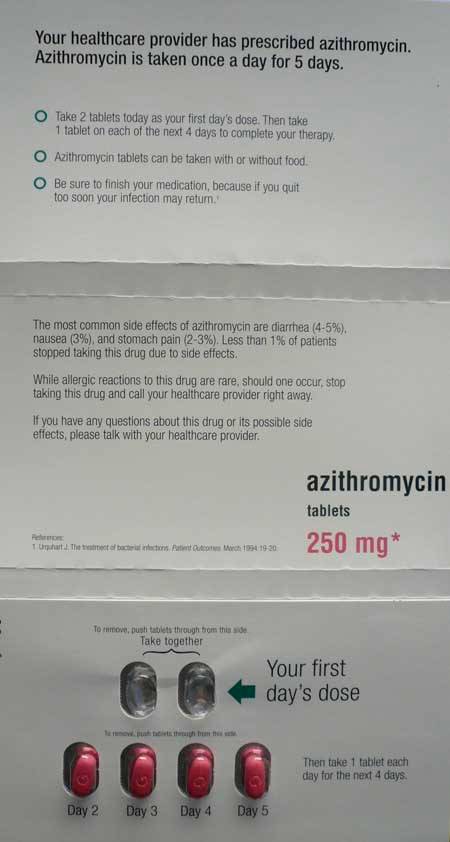
antibiotic visual instructions

This does a great job of explaining what you need to know clearly. While this presentation for Azithromycin doesn’t prevent a mistake it sure makes it much more likely that the process can be completed successfully. We need more effort in creating such clear instructions.

Visual clarity is more important than lots of words. Applying that concept is not as easy as it sounds but it is a very important idea for instructions to end use and instructions for processes in your organization. Expecting people to read much is just setting yourself up for failure when they don’t bother (you should consider psychology, and how people will actually use your instructions not how you want them to).

via: Prescription UI

Related: Using Design to Reduce Medical ErrorsVisual Instructions ExampleVisual Work InstructionsStandardized Work InstructionsHealth Care Pictographs5sEdward Tufte’s: Envisioning Information

Posted in Health care, Management, Psychology, Quality tools | Tagged , , , , | Comments Off on Great Visual Instruction Example

Performance Appraisals are Worse Than a Waste of Time

Appraisals are a waste of Time

Most British workers will certainly leave their appraisal fired up and motivated, but only to look for a new job, new research from workplace and HR body Investors in People has concluded. Nearly half of those who had an appraisal did not trust their managers to be honest during it, with a third dismissing the annual chat as a waste of time and a fifth leaving it feeling they had been unfairly treated.

The poll of nearly 3,000 workers also found a quarter who had had an appraisal suspected their managers simply saw the annual review as a “tick-box” exercise. And a fifth complained managers rarely prepared for the meeting in advance – a key bit of advice you’ll always get in appraisal training – and did not even think about it until they were actually sat down in the room.

That is just a start on the problems with annual rating of people. On page 101 of Out of the Crisis Dr. W. Edwards Deming states the following as one of the seven deadly diseases:

Evaluation of performance, merit rating, or annual review… The idea of a merit rating is alluring. the sound of the words captivates the imagination: pay for what you get; get what you pay for; motivate people to do their best, for their own good. The effect is exactly the opposite of what the words promise.

Related: Dr. Deming on performance appraisalContinuous, Constructive FeedbackPerformance without AppraisalRighter Performance AppraisalThe Leader’s Handbook

Posted in Deming, Management, Performance Appraisal, Psychology, Respect | Tagged , , , , | 4 Comments

Dr. Deming 4 Day Seminar

The W. Edwards Deming Institute is sponsoring a 4 day seminar using videos of Dr. Deming’s seminars and facilitated by Ed Baker, Dave Nave, and Joyce Orsini: Quality, Productivity, and Competitive Position. Ed Baker was the person at Ford responsible for helping Ford apply Dr. Deming’s ideas.

Hear and watch Dr. W. Edwards Deming identify faulty management practices. He will describe how, as better practices are introduced, quality of products and services increases, costs decline, and you create a globally competitive advantage for your organization.

Built on archive videos of Dr. Deming, this seminar blends footage of Dr. Deming presenting his theories with live facilitation by Ed Baker, Dave Nave, and Joyce Orsini to create an interactive learning environment. Facilitated discussion following each film segment will provide opportunity to deepen your understanding of the concepts, and interpret what these ideas might mean for your organization.

This seminar explores simple and powerful principles for anyone who manages people, or holds an executive responsibility in an organization. For more details see: Quality, Productivity, and Competitive Position.

Related: Scoring a Whole in One by Dr. Ed Baker – Deming on ManagementCurious Cat Management CalendarDeming Institute Conference (2006)Deming Seminar UpdateInvestors Business Daily on DemingWhere to Start Improvement

Posted in Career, Deming, Education, Management, Systems thinking | Comments Off on Dr. Deming 4 Day Seminar