
Gary Hamel’s Idea Hatchery

Gary Hamel’s Idea Hatchery [the broken link was removed] by Whitney Sparks:

Q: So how do you hope to change the standard approach to management?
A:
Sometimes innovation is about creating a whole new class structure. Hierarchies are not very good at getting the best out of people. Communities are where people are most likely to give their gifts, bound not by economic dependency but [with] dreams.

I’d like to make business more humane. How do you create organizations where people can bring all of their humanity?

I advocate a system in which executives have to re-earn their power, [in which] their ideas have to compete with everybody else’s ideas. [Not based upon] outdated Henry Ford attitudes. Work life has not become more interesting or compelling over the past few decades.

I don’t think he is talking about lean manufacturing ideas of Henry Ford (I hope not).

I admire his desire to learn where management is headed and to improve management education. I do think our management education needs to improve.

Gary Hamel articles and books

Posted in Books, Creativity, Education, Innovation | Tagged | 1 Comment

Excessive Executive Pay

Topic: Management Improvement

Via Christian Sarkar [the broken link was removed], Too Many Turkeys, The Economist:

Executive compensation in America – already far ahead of the rest of the world, despite the best efforts of overseas managers to catch up – is now rising inexorably again. In fiscal year 2004 the total compensation of the median American company boss rose in every industry… according to a new report by the Conference Board, a research organisation. In the big companies that comprise the S&P 500 index, median total chief-executive compensation increased by 30.2% last year, to $6m, compared with a 15% rise in 2003

Christian Sarkar asks, can we outsource the CEO to a low-cost country? That is exactly what will happen at the ludicrous levels pay has risen to. If the United States were to lock into a payscale that is unsustainable globally US companies will not be able to compete. My guess is plenty of people in the USA will be glad to compete against the brooks brothers bureaucrats but if not, others will.

The excesses are so great now they will either force companies to:

Continue reading

Posted in Management, Psychology, Respect | Tagged , , , , , , | 18 Comments

Landscaping Firm Following Deming

Building a landscaping firm Brickman by Brickman [the broken link was removed] by Steve Berberich

Each Brickman branch operates with a standard production model that the company developed in the late 1970s with consultant and renowned statistician W. Edwards Deming, who is best known for helping Japanese manufacturing recover from World War II and improving U.S. productivity during the war. Scott Brickman said the model emphasizes continuous improvements in communication with its nearly 10,000 commercial customers and education and cultivation of its employees to learn and advance within the company.

The article doesn’t talk much directly about the management practice at the company but might be of some interest.

Posted in Deming | Tagged , | Comments Off on Landscaping Firm Following Deming

IQ and Muda: Information Quality Eliminates Waste

IQ and Muda: Information Quality Eliminates Waste [the broken link was removed] by Larry English

The article provides an explanation of each of these 9 types of muda and relates them to information quality:

There are nine types of muda in information quality:

  • Muda of overproduction
  • Muda of inventory
  • Muda of repair/rejects
  • Muda of motion
  • Muda of processing
  • Muda of transport
  • Muda of waiting
  • Muda of process failure caused by defective information
  • Muda of wrong or suboptimized decisions caused by defective information

The first seven types are described by Masaaki Imai in his book Gemba Kaizen. We will examine each type of muda, why it is muda and how it wastes the other resources of the enterprise.

The real problem with poor quality information is not the poor quality information itself. It is about the costs of the waste caused by poor quality and about customer alienation and lost customer lifetime value. The real business case for information is to be found in measuring the costs of poor quality information and improving processes to prevent the defective information and the muda and costs associated with it.

Does your information quality function address muda elimination for the muda caused by defective information processes and defective information? If not, should it?

Posted in Books, IT, Management | Tagged , | Comments Off on IQ and Muda: Information Quality Eliminates Waste

Firefox 1.5 and Rollyo

The new Firefox 1.5 web browser is available. It is a great browser I have been using for at least a year. It is free, secure and has great features.

You can also try a search “roll” I have setup for the various curiouscat.com sites (via Rollyo) [that no longer works but I have setup similar customized search via Google]. This allows you to search those sites I have included in the “roll” and only those sites.

I have also setup a management “roll” which includes some of my favorite management sites. This is a great tool that lets you search a predefined list of sites (including blogs). You can also setup your own “rolls.” I think this is a very nice feature, let me know what you think.

You can add these search rolls to your Firefox search box (so you can select to search using Google, Yahoo… or one of these search rolls).

Also, if you have not looked at Open Office yet, take a look at it also (previous post: OpenOffice 2.0). We also have a page with some of the freeware we think is worthwhile [the broken link was removed].

Posted in curiouscat.com, Fun | Tagged , , | 2 Comments

Toyota Production System in Indiana

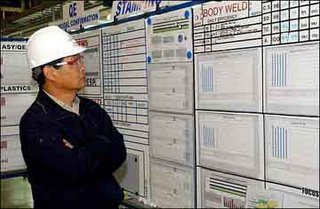
photo in a Toyota plant
Photo by Daniel R. Patmore

Via Evolving Excellence [the broken link was removed], Indiana plant president passes on lessons [newspaper also broke link so I removed it too]:

Q. Is it different teaching the Toyota Production System to American team members than it is to teach it to Japanese?

A. It’s not so different. Americans are eager to learn. American team members are more serious about job security, so their motivation is higher than that of the Japanese.

The Japanese are more obedient to the boss. Americans show more individual initiative. Once they understand why we have to continue kaizen, we get a much better result than you’d expect.

Q. What are the biggest misconceptions about the Toyota Production System?

A. Sometimes it’s misunderstood as a management tool to bring cost down. Or that it’s effective even if only a portion of TPS is introduced, such as kanban. (Kanban is inventory replenishment.) That’s not the Toyota Production System.

Kanban is easy to introduce as a logistics system, but its purpose is not to reduce logistics costs. It’s a tool to bring problems to the surface. Not many people understand that. As we reduce inventory, all problems come to the surface, and that way you solve problems and your system gets stronger.

Posted in Lean thinking, Management Articles, Toyota Production System (TPS) | Tagged , , , | Comments Off on Toyota Production System in Indiana

Toyota Manufacturing Powerhouse

Great required reading [the broken link was removed] via Evolving Excellence, Relentless [the broken link was removed], Detroit News:

As Toyota expands rapidly, it is also grappling with a shortage of skilled managers and engineers. When it decided in June to build its seventh North American assembly plant in Woodstock, Ontario, officials said one reason they chose that site was because the new factory could be overseen by the team running its nearby Cambridge plant.

Last month, the normally acquisition-shy Toyota bought nearly half of GM’s 20 percent stake in Fuji Heavy Industries Ltd., in part to bolster its ranks of researchers and engineers.

Now, some Toyota executives in fast-growing regions are coaxing former managers out of retirement. Less than a year after Ed Ohlin retired, the 21-year company veteran and former head of its Mexican sales operations is back on the payroll, helping his former boss Yoshimi Inaba build a sales network in China.

“He was looking for someone who understood the Toyota culture and had brought it to another country. I’d done that,” said Ohlin, who now works in Beijing

Continue reading

Posted in Lean thinking, Management Articles, Manufacturing, Psychology, Respect, Toyota Production System (TPS) | Tagged , , | 3 Comments

Toyota Chairman Comments on India and Thailand

Toyota Chief Comments on India, Thai Cos. [the broken link was removed]

The chairman of Toyota Motor Corp. said Monday that auto companies in India and Thailand may soon overtake those in Japan because of their increasing focus on quality.

While this might be a bit of an exaggeration part of what keeps Toyota improving is that they do not rest on their past success. They are continually looking to improve.

He said no Japanese firm has won the Deming prize in recent years as they are not showing interest in winning this coveted prize, whereas Indian companies such as motorcycle and scooter maker, TVS Motor Co. and Rane TRW Steering Systems Ltd. have won the Deming prize.

More news on Okuda Hiroshi’s visit to India, Japan sees India shining

Toyota Motor Corporation chairman Okuda Hiroshi, who heads Japanese trade body Nippon Keidanren, will lead a high-powered mission to India from November 27-30.

The delegation is likely to meet Prime Minister Manmohan Singh, finance minister P Chidambaram and commerce minister Kamal Nath.

Related Posts:

Posted in India, Management Articles, Manufacturing | Tagged | 2 Comments

Management Improvement Flavors

Lean Manufacturing Visionary Jim Womack On Frontiers Of Lean Thinking [broken link has been removed], webcast and additional questions and answers:

Question: For a firm seeking to improve — what comes first? Six Sigma quality or lean implementation?

James Womack: Agh! These are all the same thing. You need to start with the value stream for every product, draw a map of its current state, and ask about each step: Is it valuable? Is it capable? Is it available? Is it adequate? Is it flexible? Then ask whether each step flows smoothly to the next but only at the pull of the customer as the process approaches perfection. Doing this simple exercise wraps together everything you need to know about TQM, TPM, TPS, Six Sigma, TOC, etc

I believe while they are similar to varying degree they are not the same thing. They may have similar goals – they are largely focused at improving performance of the organization (but even how they would measure success is different). And when implemented well each of these methods have value. However what is done in an organization focused on six sigma is different than one focused on lean thinking.

Continue reading

Posted in Deming, Lean thinking, Management, Popular, quote, Six sigma, Toyota Production System (TPS) | Tagged , , , , , , , | 6 Comments

Not the End of Process

The End of Process by Ross Mayfield

If a knowledge worker has the organization’s information in a social context at their finger tips, and the organization is sufficiently connected to tap experts and form groups instantly to resolve exceptions — is there a role for business process as we know it?

Yes. There are some interesting comments spurring by this post but essentially I think the post is in no way a compelling argument that process management is not a very good management practice.

In a response to the original post, Nicholas Carr wrote an excellent post, Process Matters [the broken link was removed]:

Structured, well-thought-out processes are also essential to most knowledge work, from product development to financial analysis to software engineering to sales and marketing. And the more complex the effort, the greater the need for clear processes. Far from making business less effective and agile, the increasing attention to process has increased effectiveness and agility.

Related post:

Posted in Deming, Innovation, Management Articles, Process improvement | Tagged , | Comments Off on Not the End of Process