
Toyota IT Overview

What’s Driving Toyota? by Mel Duvall is an interesting, long article discussing Toyota overall and focusing on Toyota’s Information Technology systems.

Technology does not drive business processes at Toyota. The Toyota Production System does. However, technology plays a critical role by supporting, enabling and bringing to life on a mass scale the processes derived by adhering to TPS.

“What strikes me about Toyota is, if you were to ask them if they have a technology strategy, they would probably say no, we have a business strategy,” says Philip Evans, a senior vice president at the Boston Consulting Group who has studied Toyota. “They have a very clear understanding of the role technology plays in supporting the business.”

This is such a simple point but so hard for many to truly adopt. IT is a support function. IT is a means to an end.

As with almost all of its technology implementations, Toyota started small, carefully rolling out the portal to its Lexus dealers as a test. While it worked out the bugs, it continually expanded the offering, eventually making it available to all 1,200 of its U.S. Lexus and Toyota dealers.

Great way to deploy software: nice use of PDSA methodology.

Related posts: Toyota IT for KaizenPlanet KaizenToyota Robotsmanagement blog posts on information technology
Continue reading

Posted in IT, Management, Popular, quote, Toyota Production System (TPS) | 9 Comments

Housing and the Economy

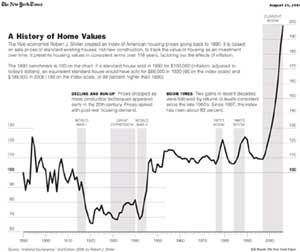
Graph of home prices

Chart of home values from 1890 through 2006 (the chart is a misleading because it crops the lower end at 60 (not 0). The values go from 60-200 (it is an index showing the cost of the standard house in thousands of 2006 $s. House prices have ranged from $66,000-200,000 for the standard house from 1890 to 2006, and never above $130,000 until 2001. Larger view of the graph (via the New York Times) and the data set from Robert Shiller. Graph source: Irrational Exuberance, 2nd Edition, 2006.

Home prices certainly seem like a bubble there doesn’t it? Many news stories now talk about the bursting housing market bubble: The housing collapse heard round the world, Fighting Inflation and Housing Bubbles, Pop Goes the Real Estate Bubble, Bubble Blog, Once bubble bursts, cities feel the pain, Housing bubble has burst, Housing bubble is finally at bursting point

I wrote about the housing bubble in April of 2005:

I doubt we are at the end of the bubble. However, financial bubbles are very difficult to time. My guess is the bubble will continue for over a year for most, if not all locations in the USA. And unless the bubble continues and prices reach levels much higher than they are now, the end of the bubble will not be a dramatic decline of prices (say an drop in prices of over 25%) in most locations.

I am not convinced that we are seeing a bursting bubble. Certain location are at a risk to experience such declines (most of those areas went up more than 100% in the last 5 years so they still would have large gains over the last few years). The market certainly has moved to the point where a transition to a bursting bubble is much closer than it was a year ago. Even several years ago many proclaimed the bubble was ready to burst, in the face of continuing rapid increases in prices. Today we are essentially at a flat market but the momentum is all toward a decline in prices. So it is certainly possible this post will look foolish in 6 months or a year but I’ll take that chance.
Continue reading

Posted in Economics, Investing | 2 Comments

Quality Technology and Innovation

The Future of Quality Technology: From a Manufacturing to a Knowledge Economy and From Defects to Innovations [sadly the link to ASQ fails, sigh, http://www.asqstatdiv.org/documents/newsletters/Winter06StatDiv.pdf] by Soren Bisgaard:

we need to be good at both breakthrough and incremental innovation. Not either/or, but both! And this is where the quality profession comes in. Much of what quality technology is applied to can broadly be
characterized as incremental innovation.

This article does a good job of explaining why “quality/lean…” should not be viewed as just process improvement, and innovation as something separate. I agree, as discussed in: Quality and Innovation. Many quality and lean tools are focused on process improvement. But those tools are part of a system that requires customer focused innovation (including breakthrough innovation).

Also in this issue of the ASQ statistics division newsletter, is the acceptance speech by the most recent Hunter Award (named for my father) winner: Douglas M. Hawkins.

Related: Curious Cat Management Improvement LibrarySoren Bisgaard 2002 Hunter Award speechDeming on InnovationBetter and DifferentInnovation at ToyotaSix Keys to Building New Markets by Unleashing Disruptive InnovationGlobal Manufacturing Data by CountryManufacturing Jobs Data: USA and China

Posted in Innovation, Management, Manufacturing, Statistics | 2 Comments

More Lean Manufacturing Podcasts

Another resource is providing worthwhile lean manufacturing podcasts. The first of an eight video podcast series by Gary Conner [the broken link was removed] is available now. He is author of Lean Manufacturing for the Small Shop (Shingo Prize – winner [the broken link was removed]) is a good introduction to lean manufacturing ideas.

Related: blog posts on management improvement webcastsGoogle Videocasts on Customer FocusLean Podcast: Bodek
Lean Blog: Liker

Gary Conner also wrote Six Sigma and Other Continuous Improvement Tools for the Small Shop

Posted in Books, Lean thinking, Management Articles, webcast | Tagged | Comments Off on More Lean Manufacturing Podcasts

Permanent Innovation

Langdon Morris has written a new book: Permanent Innovation [the broken link was removed]. There is a blog [the broken link was removed] and web site too. The book builds upon his article, Business Model Warfare:

Furthermore, the core of the innovation value proposition need not be built around a technology per se. In the examples cited above – Toyota, Honda, Nissan, Nike, Visa, Dell, Fedex, Home Depot, Southwest Airlines, and Ford (in the early days) – proprietary technologies play a part in the company’s success, but there is always much more. The key to success is a focus not on technology itself, but technology applied in a business process to optimize the relationship between the company and its customers. In today’s environment nearly any technology can be, has been, and will be copied, so the important competitive advantage is knowing how to use technology in a way that adds the greatest value for customers.
Posted in Books, Innovation, Systems thinking | Comments Off on Permanent Innovation

Complicating Simplicity

Complicating simplicity:

Gah! Trying to read about the “Simplicity: The Art of Complexity” (er, what?) conference. But the description at the conference site is the exact opposite of simple, clear writing:

An investigation of the essence of simplicity must necessarily get involved with the psychology of human-machine interaction. Why do we display such a strong proclivity to regarding technology as an externally imposed authority, to condemning or venerating it?…If we merely equate simplicity with simplification and reduction, simply let the technology become “invisible”, we not only manifest our inability to even recognize the type and extent of the technological deployment

This post on the excellent signal vs. noise blog illustrates how one can lose their way when trying to simplify. Lean and other management improvement folks can learn a lot about eliminating non-value added steps, clean design, simplifying systems to improve performance… from this blog. The examples are mainly relating to software development from a true understanding of lean thinking (though I don’t have any evidence they are familiar with the Toyota Production System or lean tools/concepts).
Continue reading

Posted in Creativity, Management, quote, Software Development | Tagged , , , , | 1 Comment

Graban Interviews Liker

Another excellent podcast from the Lean Blog: Dr. Jeffrey Liker.

Dr. Liker discusses the subtleties of doing actually doing lean versus talking about doing lean. Dr. Liker has authored: The Toyota Way, The Toyota Way Fieldbook and The Toyota Product Development System: Integrating People, Process And Technology. His consulting firm is: Optiprise.

True lean management is not instant pudding. The more knowledgeable people are about lean practices the less they focus on quick fixes and the more they talk about deep changes. And yet some quick gains are possible. The challenge is to use early gains to build the capacity of the organization for the truly remarkable possible long term gains.

Posted in Books, Deming, Lean thinking, Management, Toyota Production System (TPS), webcast | Comments Off on Graban Interviews Liker

Toyota Targets 50% Reduction in Maintenance Waste

Inside the Toyota Maintenance Reduction 50 Percent by Paul V. Arnold (sadly the site broke the link, so I removed it):

First, it is Maintenance Reduction 50 Percent, not Cost Reduction 50 Percent or Employee Reduction 50 Percent.

“The goal is to reduce maintenance activities and the maintenance that you perform on a machine by 50 percent. That goal covers every machine and every activity,” says TMMK facilities control manager David Absher.

This is not about arbitrarily chopping budgets or personnel. It’s a game plan that balances today’s corporate wants and needs with long-term implications and vision.

I think this is another example of how potentially dangerous targets or goals can be used within a excellent management system effectively. Still such target can be dangerous, even in an excellent management system – so it is a tool to be used with great care (especially when the management system does not embody many principles of management improvement). Continue reading

Posted in Data, Deming, Lean thinking, Management, Management Articles, Process improvement, Toyota Production System (TPS) | Tagged , , , | 4 Comments

Senge and Deming

Jeff Sutherland quoting Dr. Deming‘s response to Peter Senge request for a comment on his book, The Fifth Discipline:

“Our prevailing system of management has destroyed our people. People are born with intrinsic motivation, self-respect, dignity, curiosity to learn, joy in learning. The forces of destruction begin with toddlers—a prize for the best halloween costume, grades in school, gold stars—and on up through the university. On the job, people, teams, and divisions are ranked, rewarded for the top, punished for the bottom. Management by Objectives, quotas, incentive pay, business plans, put together separately, division by division, cause further
loss, unknown and unknowable.”

See page 125 of New Economics, by W. Edwards Deming on the Forces of Destruction.

Related: Deming on Managementunknown and unknowable figuresDangers of Extrinsic MotivationProblems with BonusesFailed Personnel Practice: Forced Ranking

Posted in Deming, Management, Psychology, Respect, Systems thinking | Tagged , , , | Comments Off on Senge and Deming

Lean Leaders

Lean leaders [the broken link was removed] by April Terreri:

Tim Corcoran, vice president of ZF Sales & Services, NA, LLC, that re-manufactures automotive transmissions and steering systems in Vernon Hills, IL. “We had a number of false starts by implementing tools like kaizen, value stream mapping and the 5Ss,” he admits. “We found it’s really about the thinking and how we approach work.” Once he and his first-line managers participated in a lean workshop at Lean Learning Center, everything began to click. “We learned to identify problems, analyze them and develop processes to solve them the same way every time.”

The tools are very helpful but the change in mindset is critical. Without the change in the way business is viewed the tools may be able to help but often can prove of limited value. Once an organization starts truly adopting principles like surfacing problems so the system can be fixed instead of hiding problems so the individual doesn’t get blamed then the tools are critical to provide results that will encourage those who are skeptical to at least try this new way of looking at things.

Smith discovered some workers were hiding scrap. “They were afraid; but I told them the only thing I care about is how to prevent it from happening again,” he says. Scrap has since dropped dramatically–about 50 percent over the last few years.

Exactly!

Posted in Deming, Lean thinking, Management, Management Articles, Psychology, Quality tools | Tagged , , , | Comments Off on Lean Leaders