The Contradictions That Drive Toyota’s Success

An interesting article in this month’s Harvard Business Review looks at the seeming contradictions at Toyota – The Contradictions That Drive Toyota’s Success by Hirotaka Takeuchi, Emi Osono, and Norihiko Shimizu

Many of Toyota’s goals are purposely vague, allowing employees to channel their energies in different directions and forcing specialists from different functions to collaborate across the rigid silos in which they usually work. For example, Watanabe has said that his goal is to build a car that makes the air cleaner, prevents accidents, makes people healthier and happier when they drive it, and gets you from coast to coast on one tank of gas… Zenji Yasuda, a former Toyota senior managing director, points out the wisdom of painting with broad strokes. “If he makes [the goal] more concrete, employees won’t be able to exercise their full potential. The vague nature of this goal confers freedom to researchers to open new avenues of exploration; procurement to look for new and unknown suppliers who possess needed technology; and sales to consider the next steps needed to sell such products.”

A good explanation of how Toyota avoids the trap of arbitrary numerical goals (Innovation at Toyota).

Toyota’s eagerness to experiment helps it clear the hurdles that stand in the way of achieving near-impossible goals. People test hypotheses and learn from the consequent successes and failures. By encouraging employees to experiment, Toyota moves out of its comfort zone and into uncharted territory.

This is another key point often overlooked. Experimentation is key to gaining knowledge and improving. And they have steadily improved their method of experimentation building on the PDSA/PDCA cycle:

Toyota organizes experiments using strict routines, as is widely known. It has refined Plan-Do-Check-Act (PDCA), the continuous-improvement process used throughout the business world, into the Toyota Business Practices (TBP) process. The eight-step TBP lays out a path for employees to challenge the status quo: clarify the problem; break down the problem; set a target; analyze the root cause; develop countermeasures; see countermeasures through; monitor both results and processes; and standardize successful processes. Similarly, the A3 report… forces employees to capture the most essential information needed to solve a problem on a single sheet that they can disseminate widely.
Continue reading

Posted in Management, Process improvement, Systems thinking, Toyota Production System (TPS) | Tagged , , | Comments Off on The Contradictions That Drive Toyota’s Success

Zipcar Innovation

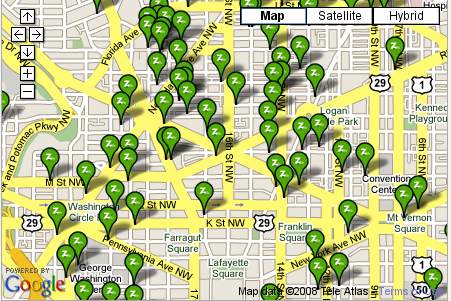
map of zip cars near the White House

Zipcar is an intriguing idea where you rent cars by the hour. The whole process is a significant change from the previous rental model (gas, parking and insurance included). Zipcar makes deals with local governments to secure zipcar parking near public transportation. They also have deals with universities, apartment buildings and businesses all of which provides a new level of easy customer access with cars available in many locations. The internet is used to schedule and provide up to date information. It is a great idea for those in cities where you can design your life so a car is rarely needed. But having access to a car in those times can be very convenient.

The images show zipcars available near the White House in Washington DC. The White House is in the middle of the bottom of the image (Lafayette Square is immediately north of the White House).

The rates are not cheap when you look at per hour costs. But when you look at replacing the need for a car the savings can be large (if you do not drive too much). And for those that doing without a car is not realistic zipcar can be used for any needs for a second car. It is still a pretty large change in mindset. To try and help people give the idea a try Zipcar is trying the Zipcar Low-Car Diet challenge.

You agree to keep your car keys in your junk drawer for just one month, from July 21st through August 15th. In return, you get a loaded public transit pass, a free 1-year Zipcar membership, some driving time and more goodies that we’ll tell you about a little later.

During the month, we’ll ask that you check in and let us know how your diet’s going. You can send us emails, even video clips, to share your thoughts and stories. We’ll post excerpts on our website to help keep everyone motivated!

Related: Traffic Congestion Non-SolutionAirfare Innovation ExampleUrban PlanningDeming on Innovation Continue reading

Posted in Creativity, Customer focus, Deming, Innovation, Lean thinking, Management, Systems thinking | 4 Comments

Hustle and Flow

There are actually examples of good management by airlines: CEO Flight AttendantEngineering the Boarding of Airplanes. Here is another one: Hustle & Flow

Moving customers from frustration to relief–in a fraction of the time–has been at the root of Alaska Airlines’ Airport of the Future project. The carrier has spent more than a decade designing a better way to get customers through airport check-in, debuting the first iteration in its Anchorage terminal in 2004. Last October, the $3.3 billion carrier began rolling out its redesign in Seattle, where Alaska and its sister airline, Horizon, have almost 50% market share. The project, to be completed in May, has already reduced wait times and increased agent productivity. “People come to the airport expecting to stand in line,” says Ed White, Alaska’s VP of corporate real estate, who ran the project. “It’s an indictment of our industry.”

Alaska’s embrace of the future came out of necessity. By the mid-1990s, it was running out of space to handle its Seattle passengers. “If you came here on a busy day, it was jammed,” White says. A new terminal, though, would have cost around $500 million. Alaska tried self-serve kiosks, but technology alone wasn’t the answer. Kiosks were pushed against the ticket counter, which only further stagnated the flow of passengers.

White assembled a team of employees from across the company to design a better system. It visited theme parks, hospitals, and retailers to see what it could learn. It found less confusion and shorter waits at places where employees were available to direct customers. “Disneyland is great at this,” says Jeff Anderson, a member of White’s skunk works. “They have their people in all the right places.”

Ok, it is a bit hard to understand the “spent more than a decade” line but still there are good ideas here. The article includes several examples of lean thinking, such as:
Continue reading

Posted in Lean thinking, Management, Process improvement, Systems thinking | Tagged | Comments Off on Hustle and Flow

Management Improvement Carnival #37

Ron Pereira is hosting Management Improvement Carnival #37 on the LSS Academy blog, some of the highlights include:

  • Are we Cowboys or Not? by Mark Graban – “Anyway, I’m not trying to start a Liker v Bodek battle, but it’s an interesting contrast in perspectives.”
  • Numb3rs by Sue Kozlowski – “Now, part of the reason for this hyperbole is that exciting headlines get more people to buy the paper, and so you may think that the exaggeration is just a way to get people to read the accompanying story.”
  • Necessary but Insufficient by Pete Abilla – “Motorola (MOT), the inventor of Six Sigma, is in big trouble. Even though it invented Six Sigma, this is a clear example that shows how Lean or Six Sigma are not a cure-all for corporate woes…”
  • Eight Reasons Your Lean/Six Sigma Could Fail by Ron Pereira – “Programs, by definition, end. Conversely, the ancient origin of the word philosophy (philosophía) means ‘love of knowledge’ or ‘love of wisdom’. And true love, as the good book tells us, never ends.”
Posted in Carnival, Management | Comments Off on Management Improvement Carnival #37

Photos of Forest Glen Preserve in Illinois

Photos from my hike in Forest Glen Preserve, Illinois 2 years ago.

photo of purple flower

Other photos: Kentucky TravelogueMetropolitan Museum of ArtNorth Cascades National Park
Continue reading

Posted in curiouscat.com, Travel photos | Tagged | Comments Off on Photos of Forest Glen Preserve in Illinois

Respect for Employees at Southwest Airlines

“You have to treat your employees like customers”

“We’ve never had layoffs,” he told me the day before the annual meeting, sitting on the couch of the single messiest executive office I’ve ever seen. “We could have made more money if we furloughed people. But we don’t do that. And we honor them constantly. Our people know that if they are sick, we will take care of them. If there are occasions or grief or joy, we will be there with them. They know that we value them as people, not just cogs in a machine…”

“There isn’t any customer satisfaction without employee satisfaction,” said Gordon Bethune, the former chief executive of Continental Airlines, and an old friend of Mr. Kelleher’s. “He recognized that good employee relations would affect the bottom line. He knew that having employees who wanted to do a good job would drive revenue and lower costs.

Well said. Related: Focus on Customers and EmployeesAirline QualityRespect for PeopleCurious Cat Management Improvement Dictionary

Posted in Customer focus, Deming, Management, Psychology, Respect, Systems thinking | Comments Off on Respect for Employees at Southwest Airlines

Continual Improvement

Dr. Deming used the term continual improvement (rather than continuous improvement) later in his life because that would include continuous and dis-continuous improvement (innovation, etc.). I use continual improvement for that reason also. I think the improvement process

  • must be never ending
  • must focus daily on how any process can be improved
  • must focus on adopting improvement systemically (not just locally, by one person or team)
  • must focus on discontinuous improvement which could include high energy kaizen events and dramatic innovation
  • must include a study phase (PDSA) where the improvements are evaluated to determine whether they actually achieved the predicted results
  • and must include improvement of the improvement process itself

To me, continual improvement encompasses both continuous and discontinuous improvement.

Reflecting on: Continuous Improvement vs. Continual Improvement [the broken link was removed]

Related: Process Improvement and InnovationBetter and DifferentKaizen the Toyota WayChange is not ImprovementThink Long Term Act DailyEncourage Improvement Action by Everyone

Posted in Deming, Innovation, Management, Process improvement, quote | Tagged , , , | 19 Comments

Fairness Matters

Sense of Fairness Affects Outlook, Decisions

Burnout has been long associated with being overworked and underpaid, but psychologists Christina Maslach and Michael Leiter found that these were not the crucial factors. The single biggest difference between employees who suffered burnout and those who did not was the whether they thought that they were being treated unfairly or fairly.

Their research on fairness dovetails with work by other researchers showing that humans care a great deal about how they are being treated relative to others. In many ways, fairness seems to matter more than absolute measures of how well they are faring — people seem willing to endure tough times if they have the sense the burden is being shared equally, but they quickly become resentful if they feel they are being singled out for poor treatment.

If the sum is $100, for example, the first person might offer to give away $25 and keep $75 for himself. If the second person agrees, the money is divided accordingly. But if the second person rejects the deal, neither one gets anything.

If people cared only about absolute rewards, then Person B ought to accept whatever Person A offers, because getting even $1 is better than nothing. But experiments show that many people will reject the deal if they feel the first person is dividing the money unfairly.

Related: Obscene CEO PayRespect for People and Understanding PsychologyWhy Pay Taxes or be HonestThe Illusion of UnderstandingThe Psychology of Too Much Choice

Posted in Management Articles, Psychology, Respect, Science | Tagged , , | 1 Comment

Internships Increasing

Hard to find a job, but not an internship

The bullish market for interns is good news for those in college, who find that internships are increasingly required for landing that first job. The summer posts allow students to bolster their resumes, learn more about their field of choice and meet executives who could hire them for full-time positions one day. And they often pay a good wage: on average, $16.33 an hour, or $7,850 over 12 weeks, Luckenbaugh said.

“Students are looking for internships even after their first year,” said Sheila Curran, executive director of Duke University’s career center, noting that 88% of Duke students graduate with at least one internship under their belts. “It’s become expected that you’d have at least one internship during college.”

Universities are also recognizing the increased importance of internships and are working harder to secure spots for their students, said Richard Bottner, founder of Intern Bridge, a college recruiting research and consulting firm. Some colleges are even requiring students to do at least one internship to graduate.

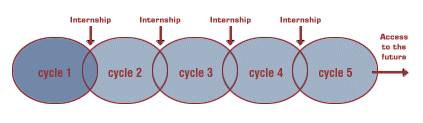
graphic of Deming Scholars internship cycle

The Deming Scholars MBA program at Fordham includes a heavy dose of internships [broken link removed] (“Subject matter is delivered in five integrated learning cycles. Five eight-week sessions of classroom lectures, seminars and study are linked by seven-week internships at participating firms”). Integrating well planned internships can be very valuable to improving learning. By the way if your company would like to host these students you can contact the program to discuss the opportunity.

Curiouscat.com has a web site for locating internships.

Related: Hiring the Right EmployeesIT Talent Shortage, or Management Failure?Young IT Workers DemandsJoel ManagementThe Joy of Work

Posted in Career, Management | Tagged , , , | 2 Comments

Department of Defense Lean Six Sigma

Gordon England, the Deputy Secretary of Defense, signed a directive establishing policy and assigning responsibilities to institutionalize the effort throughout DoD. See a webcast of his speech [the broken link was removed] on lean six sigma to a DoD conference on continuous process improvement.

Leading Business Transformation the “Lean” Way [the broken link was removed]

Since it began employing LSS, the Department of the Navy (DON) has completed 1,700 Black Belt/Green Belt projects and over 2,000 Kaizen events (i.e., action-oriented events designed to improve existing processes). Initial projects were designed to build confidence and gain momentum for success in high-impact core business value streams. The DON’s total of 3,399 trained LSS Green Belts exceeds the Secretary’s goal of 2,000 by the end of 2006, and of the 935 trained LSS Black Belts in the DON, 93 have attained American Society for Quality (ASQ) Black Belt certification.

Naval Air Systems Command (NAVAIR) joined with Raytheon to complete an LSS project, which ultimately saved $133.5M across the 2006 FYDP and $421M over the life of the Joint Standoff Weapon (JSOW) Block II program. The integrated product team developed a three-tier approach to reducing weapon unit cost over a two-year period. Success of the JSOW program has led to development of a follow-on Block III weapon system.

The Marine Corps is applying LSS concepts, analytic techniques, and tools to improve the process for identifying, evaluating and acquiring critically needed warfighting equipment. Initial analysis focused on the evaluation stage, where improvements reduced the time required for this step by 35% – from 131 days to 85 days – and identified savings valued at $135K per year.

The first LSS initiative for Army aviation scheduled maintenance was deemed a success and signals a more efficient future for maintaining the Fort Rucker helicopter fleet. More than 32 days of scheduled maintenance were saved during the first LSS effort for Aviation Unit Maintenance involving UH-60 Black Hawk helicopter scheduled maintenance. The first helicopter inducted into the newly developed process was returned to flying status in just 18 days, which included a four-day break for the Fourth of July weekend. That is a 67% improvement in phase flow efficiency from the previous average time of more than 50 days of phase cycle maintenance for the UH-60.

See: online six sigma resources and lean manufacturing resources from the Curious Cat management improvement web site.

Related: Government Lean Six SigmaPublic Sector Continuous Improvement Site – Transformation Through Lean Six Sigma [the broken link was removed] – Army Business Transformation [the broken link was removed] – History Of Quality Management OnlineMore Lean GovernmentArmy Lean Six Sigma
Doing More With Less in the Public Sector: A Progress Report from Madison, Wisconsin by William G. Hunter, Jan O’Neill, and Carol Wallen, June 1986.

Posted in Lean thinking, Management, Public Sector, Six sigma | Tagged , , , , | Comments Off on Department of Defense Lean Six Sigma