ThedaCare: Lean Healthcare

Area health systems put customer service first [the broken link was removed] by MaryBeth Matzek

In 2005, ThedaCare was able to save $10 million thanks to its lean programs and officials hope to save another $12 million this year, Toussaint said.

ThedaCare’s march toward lean began when Toussaint started looking for a way to improve quality and service while cutting costs. He found what he was looking for in an unlikely place – a factory that produces lawnmowers and snow blowers.

The model Ariens used was adapted from a system put in place by Toyota, the Japanese automotive manufacturer. As part of the system, teams are formed to look at processes and find ways to improve them – whether it’s cutting out an unnecessary step or finding a better way to serve the customer.

Related:

Posted in Health care, Lean thinking, Management Articles | Tagged , , , | 1 Comment

Change is not Improvement

In response to: Why executives order reorgs [the broken link was removed]

We trained hard… but it seemed that every time we were beginning to form up into teams we would be reorganized. I was to learn later in life that we tend to meet any new situation by reorganizing; and a wonderful method it can be for creating the illusion of progress while producing confusion; inefficiency, and demoralization.

These lines, from the Satyricon of Petronius written 2,000 years ago…

Unfortunately it seems this quote is not actually his [the broken link was removed. Peter Scholtes first told me this quote wasn’t accurate, when he was in the process of researching it for his book, The Leader’s Handbook]. Instead apparently someone attributed the quote to him to give it the weight of time. I think that the sentiment expressed rings true speaks to the experience of many.

The Improvement Guide: the Practical Approach to Enhancing Organizational Performance, is an excellent handbook on making changes that are improvements rather than just a way to create the illusion of progress. The book uses three simple questions to frame the improvement strategy.

  • What are we trying accomplish?
  • How will we know that a change is an improvement?
  • What changes can we make that will result in improvement?

The second questions if rarely used. Without that question it is much easier to make vague statements that seem like reasons to change and why it would be an improvement. But if you have to document how you will know the change is successful it makes it more difficult to change for just the appearance of improvement.

Once the organization does that regularly, the next step is to actually measure the results and validate the success or failure of the improvement efforts.

Posted in Deming, Management, quote | Tagged , , , , , | 5 Comments

TPS – Take 2

The cover story in latest issue of Industry Week focuses on what people have missed when applying ideas from the Toyota Production System.

Learning From Toyota — Again [the broken link was removed] by John Teresko:

“Why is it that the TPS tools of lean, agile, TQM, TPM, re-engineering, just-in-time, cellular/continuous workflow and so on — never seem to really pay off big [aside from Toyota]?” asks Michael Paris, president of Hinsdale, Ill.-based Paris:Consulting. His response: “Unless TPS is everywhere in an organization, it is nowhere. Too often managers pushing for performance improvements have a limited vision and scope. They fail to approach the executive team that has responsibility for the entire enterprise and authority over it.”

Continuous Improvement In The Executive Suite [the broken link was removed] by Patricia Panchak:

We’ve watched as Toyota’s strength and market share steadily grew for two decades. We’ve adopted the Toyota Production System (TPS), which we correctly determined is the source of Toyota’s success. But we missed something that is now becoming ever more clear: Continuous improvement is as integral to corporate strategy as it is to production strategy. Executives looking for a long-term competitive edge should take note.

The tools of TQM, lean manufacturing, TPS, six sigma… are useful. But the extraordinary gains are made when the entire system is geared toward improvement.

Related Posts:

Posted in Deming, Lean thinking, Management, Quality tools, Toyota Production System (TPS) | Tagged , , | Comments Off on TPS – Take 2

China now the 5th Largest Economy

China’s Economy Grew 9.9% in 2005, Overtaking France [the broken link was removed]

China’s economy grew 9.9 percent in 2005, overtaking France as the world’s fifth largest, powered by exports and investment in factories, roads and power plants.

Gross domestic product rose to 18.2 trillion yuan ($2.3 trillion) after expanding 10.1 percent in 2004, statistics bureau commissioner Li Deshui said today in Beijing. Investment in urban areas jumped 27.2 percent last year, he said.

2003 data, from Geohive [the broken link was removed] (their source the World Bank):

United States: $10.9 trillion
Japan: $4.3 trillion
Germany: $2.4 trillion
United Kingdom: $1.8 trillion
France: $1.7 trillion
Italy: $1.5 trillion
China: $1.4 trillion
Spain: $.8 trillion
Canada: $.8 trillion
Mexico: $.6 trillion
South Korea: $.6 trillion
India: $.6 trillion

Related posts:

Posted in China, Economics | Tagged , | Comments Off on China now the 5th Largest Economy

Management Excellence

My comments on, Take off the Blinders [the broken link was removed]:

I think the question of what other companies have management practices worth studying is interesting. The answer could be very helpful as others could learn from what those organizations do. There are at least two difficulties in identifying those organizations: 1) defining what set of criteria would indicate successful organizations 2) most often even companies that are doing many things well leave much to be desired (so picking organizations worth studying can be difficult and even once that is done deciding which practices to credit for the success is often mostly a matter of opinion).

Many organizations do some things very well: Google, Dell, Amazon, Ritz-Carlton, Grameen Bank, MIT, Gates Foundation global health, Ameritrade, SAS, the Container Store, Home Depot, Apple, Snap-on tools, Wikipedia, McDonald’s. Southwest Airlines does some things very well (shouldn’t they get extra credit for actually being profitable when all around them go bankrupt). Solectron does some things very well, but they have been doing poorly financially for quite some time.

How do we decide what are good organizations? Inventory turns? Profit margin? Growth? Equitable pay for management and workers? Customer satisfaction? An understanding of lean ideas (either with Lean terms or without)? Use of lean tools? Partnering with suppliers? Elimination of waste from processes. Elimination of waste from the entire product cycle? Impact on society? Sales and/or profit per employee? Low employee turnover? Integrity? Providing ever better products and services at ever lower prices?

Continue reading

Posted in Data, Deming, Lean thinking, Management, quote | Tagged , , , , | 2 Comments

Lean Software Development

Lean Software Development: A Field Guide [the broken link was removed] – the first 3 chapters of this new book are available online. Excellent, recommended for anyone interested in lean thinking ideas.

Lean Software Development: An Agile Toolkit for Software Development Managers by Mary Poppendieck and Tom Poppendieck, 2003.

Articles on lean programming by the Poppendieck’s

Posted in Management Articles | Tagged , | 3 Comments

Toyota’s Early History

via Got Boondogle:

A book that I recently finished is “Quest for the Dawn” by Shoji Kimoto. “Quest for the Dawn” is a fascinating true story set from about 1930 to the mid 1950s of a bold business quest to build an automobile from the ground up. The relentless inventors were Sakichi and Kiichiro Toyoda and, of course, the car manufacturer was the Toyota Motor Company.

Look interesting, so I went on amazon.com and Quest for the Dawn by Shoji Kimoto was available for $1, through a 3rd party, plus $3.49 shipping. I really like many of the things the internet makes easy.

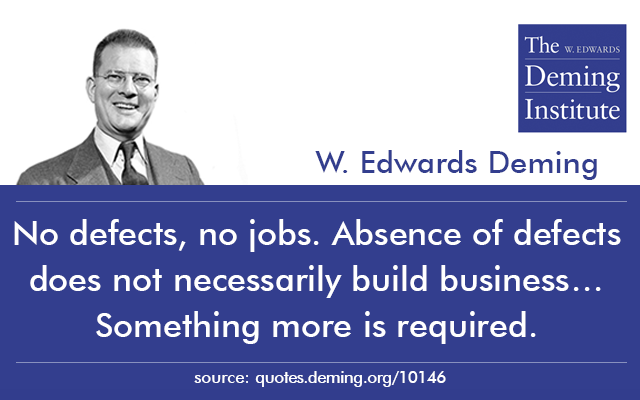
And relating to the zero defects post earlier today. I never thought of it as a defect when I couldn’t order an obscure book, in a minute or two, from home and have it delivered to me. Deming was right that: “Absence of defects does not necessarily build business… Something more is required.

Related: Shigeo Shingo’s Influence on TPS

Posted in Books, Management, Toyota Production System (TPS) | Tagged , , | 4 Comments

Zero Defects

Zero Defects by Norman Bodek:

Do you believe it is possible to have Zero Defects? I am not talking about six sigma at all.

I believe it is possible to have zero defects (in a sense). But I do not believe it is a good management strategy to practice what those I have heard in the past preaching zero defects.

A Dichotomy by Norman Bodek. Wow, you really have to look to find this article after you follow the link [I removed the link – additional site defect is now a completely broken link, violating basic 1998 guidance that web links must live forever]. I think the site could really benefit from improving the usability of the site (similar to lean ideas on making things visible and easy to find):

In truth, you should be making lots of mistakes. We do want you to learn, but for the sake of your customers you should not allow mistakes to become defects. That is the dichotomy! Make mistakes but don’t allow them to become defects.

I know many people talk about this conflict (aiming for zero mistakes means missing the most important ideas – because they might be risky). However, I have never really understood it as a conflict. You want to take risks to try new things to experiment to learn. Doing those things can be done in a manner that doesn’t provide your customers a defect. I suppose there are times when you take a risk your customers may be disappointed, but I don’t see why this need be the case with most experiments.

image of quote: No defects, no jobs. Absence of defects does not necessarily build business… Something more is required.

Continue reading

Posted in Deming, Management, Quality tools, quote, Systems thinking | Tagged , , , , | 2 Comments

Great Charts

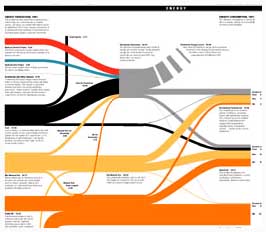
image of chart showing flows of energy

Karl Hartig displays some excellent charts that he created (for the Wall Street Journal) on his web site. The charts seem very similar to what would result from applying Edward Tufte’s ideas. Rarely do I see charts that do such a good job of visually displaying data. The lack of such effective visual display of information is another example of how much improvement could be made just by applying ideas that are already published.

The Energy production consumption chart is especially well done I think – pdf version of the energy chart.

Via, The best charts I’ve ever seen [the broken link was removed].

Edward Tufte’s books are great:

An Interview with Edward R. Tufte by Mark Zachry and Charlotte Thralls
Edward Tufte’s web site

Posted in Data, Management | Tagged , , | 5 Comments

Engines of Democracy

Engines of Democracy [the broken link was removed] by Charles Fishman, Fast Company:

The 170-plus people who work at this plant try to make perfect jet engines. And they come close. On average, one-quarter of the engines that GE/Durham sends to Boeing have just a single defect — something cosmetic, such as a cable not lined up right, or a scratch on a fan case. The other three-quarters are, in fact, perfect.

GE/Durham’s continuous-feedback culture — “We call this the feedback capital of the world,” says Paula Sims — means that while in one sense it’s true that no one here has a boss, the opposite is also true: “I have 15 bosses,” says Keith McKee. “All of my teammates are my bosses.” No one is exempt. “Not long after I started here,” says Sims, “an employee came to me and said, ‘Paula, you realize that you don’t need to follow up with us to make sure we’re doing what we agreed to do. If we say we’ll do something, we’ll do it. You don’t need to micromanage us.’ I sat back and thought, ‘Wow. That’s so simple. I’m sending the message that I don’t trust people, because I always follow up.’ I took that to heart. This was a technician, and I had been at the plant less than 30 days. I appreciated that he felt comfortable enough to tell me this. And I thought, ‘This really is a different place.'”

Posted in Economics, Management Articles | Tagged , | Comments Off on Engines of Democracy