
Eric Schmidt speaks at the Management Lab Summit on May 29, 2008 in Half Moon Bay, California. Conversation with Professor Gary Hamel.
- “The culture can be thought of as a ship and iterate culture with transparency for what people are doing. And that model scales pretty well.”
- “I have two jobs, two roles. The first is to make sure every issue that is important is really debated to find, not the common outcome, but the best decision… second thing is to put pressure to make it happen quick.”
- “it [managing better] starts with listening, it has to do with curiosity“
- “everything has to be based on some fact”
- “It’s only about the people.” [respect for people is critical, Google really acts as though the people are their most important asset – John].
- “What is the number 1 goal of the company? It is end user happiness with search. What is the number 2 goal? It’s end user happiness with advertising. What is the number 3 goal? The construction of the Google network of partners to effectuate the first two. What is the number 4 goal? To grow and scale the business… You will eventually get extraordinary returns for your shareholders and maximize advertiser happiness if all those things happen… There are a lot of business executives that get confused on what the goal is and they think that shareholder value is the goal. Shareholder value is a consequence of the goal.”
Related: Eric Schmidt Podcast on Google Innovation and Entrepreneurship – Interview with Google CEO Eric Schmidt – Innovation at Google – Google: Experiment Quickly and Often – Marissa Mayer Webcast on Google Innovation – Google Management by Gary Hamel – Larry Page and Sergey Brin Interview Webcast
What’s the Value of a Big Bonus?
What’s the Value of a Big Bonus? by Dan Ariely
…
So it turns out that social pressure has the same effect that money has. It motivates people, especially when the tasks at hand require only effort and no skill. But it can provide stress, too, and at some point that stress overwhelms the motivating influence.
When I recently presented these results to a group of banking executives, they assured me that their own work and that of their employees would not follow this pattern. (I pointed out that with the right research budget, and their participation, we could examine this assertion. They weren’t that interested.)
This is an interesting look at an effect of bonuses. We all know monetary bonuses can influence behavior. The problem is the type of behaviors that result. Huge bonuses, for example, create huge incentives to risk the future of the company for the chance at a huge bonus for the executive. Extrinsic motivation leads to many problems.
Problems with bonuses: Losses Covered Up to Protect Bonuses – “Pay for Performance” is a Bad Idea – Problems with Bonuses – Book: Punished By Rewards: The Trouble With Gold Stars, Incentive Plans, A’s, Praise, and Other Bribes by Alfie Kohn – posts on executive pay
The Manager FAQ
This is a great set of answers for programmers on the behavior of managers, that can also be of interest to some non-programmers.
The Manager FAQ by Peter Seebach
The following list is an attempt to cover some of the issues that will invariably come up when hackers without previous experience of the business community first start working in it. Other workers may also find it informative.
DISCLAIMER: The author is a hacker. Bias is inevitable.
Questions and Answers:
Section 1: Basic understanding.
- 1.1: Why doesn’t my manager just do some actual work?
- Management is a kind of work. Just as programs need architecture and design, functional groups of people can need organizing principles. Having a person picked to handle this work can reduce the amount of time spent trying to decide how to make decisions, and can free other people up to do the work they’re best at.
- 1.2: Is it useful for me to have a manager?
- It depends on the kind of job you’re doing. A manager can dramatically improve your performance, both as an individual and as a member of a team, or a manager can get in the way and keep you from working.
Work environments where managers are particularly useful are:
- Large environments, especially with high turnover.
- Jobs where a significant amount of incoming information must be factored into planning.
- Jobs which are prone to substantial obstructions coming between workers and their work.
CMMI and Agile Development
CMMI or Agile: Why Not Embrace Both! is a new report that is worth reading.
on achieving a particular appraisal rating.
In contrast, implementing CMMI is using the model in the same way that engineers and architects use models: as a learning tool, a communication tool, and a means of organizing thoughts. The more implementation-oriented an organization is, the more improvement-centric it is; thus, the focus is on maturing and growing process capabilities rather than ratings.
…
CMMI and Agile can complement each other by creating synergies that benefit the organization using them. Agile methods provide software development how-to’s that are missing from CMMI best practices that work well—especially with small, co-located project teams. CMMI provides the systems engineering practices that help enable an Agile approach on large projects. CMMI also provides the process management and support practices that help deploy, sustain, and continuously improve the deployment of an Agile approach in any organization.
Related: Stretching Agile to fit CMMI Level 3 – Microsoft CMMI – Agile Management
Ford’s Camaçari Plant in Brazil
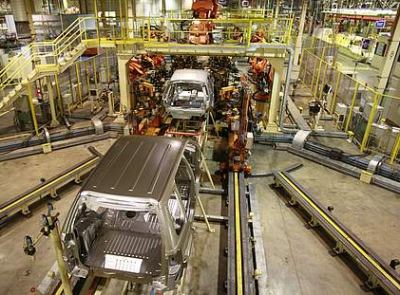
Brazil’s Camaçari plant is model for the future
…
At Camaçari, more than two dozen suppliers operate right inside the Ford complex, in many cases producing components alongside Ford’s main production line. Having those supplier operations on-site allows Ford to take the concept of just-in-time manufacturing to a whole new level. Inventories are kept to a bare minimum, or dispensed with entirely. Components such as dashboard assemblies flow directly into the main Ford assembly line at the precise point and time they are needed.
…
Unlike many U.S. auto plants, where workers’ responsibilities are strictly limited to specific job classifications, workers like Silva dos Santos are encouraged to learn as many different skills as possible.
Here is an interesting video [the broken link was removed] on the plant. It is sad how poor management at GM, Ford and Chrysler has created such a bad situation for those working at those companies, their suppliers, the communities that support their production… GM and Ford had the advice they needed to succeed from Deming in the 1980’s but they chose to focus on the short term, large executive payments, accounting gimmicks instead of continual improvement…
They each have improved over the years, but the standard is not just improving but doing so effectively and enough and they failed at that. The UAW shares some responsibility for failing to successfully lead their workers to a promising future but management is much more responsible for the failure in my opinion (the video and article try to say Ford wants to be innovative in the USA but the UAW won’t let them). It is management’s jobs to focus the organization on cooperation and success for all stakeholders. When management is more concerned with getting themselves huge payoffs (from the pockets of the other stakeholders) and then try to blame one of those other stakeholders for fighting management is disingenuous. Executive’s contempt for other stakeholders leads to the other stakeholders feeling that they should be just as greedy as management.
Related: Ford’s Wrong Turn – Ford and Managing the Supplier Relationship – Global Manufacturing Data 2007 – Toyota’s New Texas Plant – Womack Podcast on GM – VW Phaeton Manufacturing plant
Management Improvement Carnival #47
Read the previous management carnivals. Also see the management Reddit for popular new blog posts to include in future carnivals.
|
- No Excuses by John Shook – “A culture of management seeking where to place the blame — the five whos — will absolutely prevent the flourishing of a culture that fosters ubiquitous use of the five whys”
- Resource Planning by Jurgen Appelo – “Considering that task-switching is bad, the resource planner must seek to minimize the number of different activities per week, per person… Software developers themselves are allowed to reserve a number of academy days. These are days for self-development and training.”
- The Deming Chain Reaction by John Dowd – “According to Deming, quality is not a state to be achieved in manufacturing, but is, rather, an ongoing company-wide effort at continual improvement.”
Lean and Kanban for Software Developers
Lean and Kanban for Software Developers by Clinton Keith
Time-boxing is the first step in beginning to find a balanced flow for our value stream as visualized on our Heijunka board. However, one problem exists. Each stage of effort in the stream will require a different length time-box. This can cause gaps and pileups.
For example, if our level designer can lay out a level in a week, but the high res artist requires two weeks, then a lot of work can pileup for the high res artist. Conversely, if the concept artist requires two weeks to complete the concept art for each zone, the level designer might be waiting for work with nothing to do. We have to find ways to balance this workflow smoothly so that everyone has work to do every day. One way of doing this is to balance the effort on each stage to achieve the same flow through the system.
Related: Lean, Toyota and Deming for Software Development – Kanban In Software Engineering – A Programmers Take on Agile Software Development – Agile Software Development – Six Sigma in Software Development – Curious Cat Management Improvement library
6 Leadership Competencies

At the recent Annual W. Edwards Deming Institute Annual conference (this year held in Madison, Wisconsin) Peter Scholtes gave an excellent speech on the 6 Leadership Competencies from his book: The Leader’s Handbook. Those competencies are:
- The ability to think in terms of systems, and knowing how to lead systems.
- The ability to understand the variability of work in planning an problem solving
- Understanding how we learn, develop and improve. Leading true learning and improvement.
- Understanding people and why they behave as they do.
- Understanding the interdependence and interaction between systems, variation, learning and human behavior. Knowing how each affects the other.
- Giving visions, meaning, direction and focus to the organization.
As those familiar with Dr. Deming will immediately note those are very closely tied to Deming’s 4 areas of management. I am a friend (and manage Peter’s website so I am biased) but as I have said before anyone interested in management should read his book (the competencies are discussed in chapter 2).
The photo shows George Box, John Hunter and Peter Scholtes (from left to right) at the MAQIN reception the night before the conference. Two previous mayors of Madison introduced Peter’s talk: Paul Soglin and Joe Sensenbrenner.
Related: ASQ Deming Medal to Peter Scholtes – Using Books to Ignite Improvement – Management Improvement Leaders – Performance Without Appraisal
ASQ William Hunter Award 2008: Ronald Does
The recipient of the 2008 William G. Hunter Award is Ronald Does. The Statistics Division of the American Society for Quality (ASQ) uses the attributes that characterize Bill Hunter’s (my father – John Hunter) career – consultant, educator for practitioners, communicator, and integrator of statistical thinking into other disciplines to decide the recipient. In his acceptance speech Ronald Does said:
…
For the past 15 years I have been the managing director of the Institute for Business and Industrial Statistics. This is a consultancy firm owned by the University of Amsterdam. The interaction between scientific research and the application of quality technology via our consultancy work is the core operating principle of the institute. This is reflected in the type of people that work for the institute, all of whom are young professionals having strong ambitions in both the academic world and in business and industry.
…
The kickoff conference attracted approximately 80 statisticians and statistical practitioners from all over Europe. ENBIS was officially founded in June 2001 as “an autonomous Society having as its objective the development and improvement of statistical methods, and their application, throughout Europe, all this in the widest sense of the words” Since the first meeting membership has grown to about 1300 from nearly all European countries.
Related: 2007 William G. Hunter Award – The Importance of Management Improvement – Resources on using statistical thinking to improve management


Invest in New Management Methods Not a Failing Company, 1986
Invest in New Management Methods Not a Failing Company by William Hunter, 1986
These competitors are beginning to understand how essential it is to take a long-term view of their businesses. Toyota, for example, took its top 40 managers on a two-day retreat to ponder what their corporation will look like in the 21st century. They are studying totally new methods of management [20 years later large portions of these “new” methods are still ignored by many – John]. These methods take continuous quality improvement as a central, guiding principle.
…
Investing in American Motors now, in any form, is a mistake. If Wisconsin is to become a trend-setter in economic development, we need some long-term thinking in forming wise, creative policies.
It is difficult, I know, for legislators and other elected officials to take a long-term view when the tangible reward is re-election and elections come around quite frequently.
Our founding fathers are remembered for their long-term vision. We need to change the way our democracy works so that long-term visions is an integral part of all important discussions on economic development on the local, state and national level.
Don’t reward shortsightedness by James Cook
It was then, as I began my tenure at the company, that we began with Deming’s concept of Statistical Process Control, later changed to Quality Control, and the practice of Toyota’s kanban cell manufacturing techniques that would enhance the already high-quality standards that had defined the company for decades.
…
If we had listened, if we had followed him, if we had incorporated his thinking not only in the automobile industry but in government, in the ubiquitous economy collapsing around us and in our private lives, we would now be far better for it.
Related: At Ford, Quality Was Our Motto in the 1980s – Ford’s Wrong Turn – Could Toyota Fix GM (2005) – Ford and Managing the Supplier Relationship – No Excessive Senior Executive Pay at Toyota – Creating Jobs