
Management Improvement Carnival #29

Mark Graban is hosting Management Improvement Carnival #29 on the Lean blog, some of the highlights include:

  • Standard Work for Managers = Go to Gemba (Joe Ely, Learning About Lean) “Get to the workplace. Look. Listen.”
  • Designing What’s Right for Customers (David Pogue, NY Times) “So what goes through the minds of executives who don’t sweat the small stuff?”
  • Muda, Mura (and Muri) in Health Care (Mark Rosenthal, Lean Thinker Blog) “Key Point: Separate the routine from the non-routine. Separate normal from abnormal.”
  • Explaining Lean at a Bar (Mark Graban, Lean Blog) “I asked [the bartender] how it would be if the ice were in the far corner of the bar, requiring lots of walking back and forth all day. She said that would be horrible.”
  • JIT and Jidoka are Useless… (Ron Pereira, Lean Six Sigma Academy) “Yes, the two pillars of the Toyota Production System – JIT and Jidoka – are absolutely worthless… if you don’t respect people.”

Read the previous management carnivals.
Posted in Carnival, Management | Comments Off on Management Improvement Carnival #29

Don’t Use Performance Appraisals

I like to continue to push for some things that might not seem achievable to many. It is too easy to accept that things have to stay the way they are. Several of Dr. Deming’s list of Seven Deadly Management Diseases are now accepted as serious problems by most. Performance appraisal is a strange disease: most people agree performance appraisals are not effective and indeed are harmful. Yet, most still don’t think anything can be done about it. But we can, and should, take steps to improve. Just don’t do it.

Managers are from Mars, Performance Appraisals from Venus discusses Mary Poppendieck‘s recent presentation – Appraisals and Compensation: The Elephant in the Room

Mary says that there is no valid research showing benefits of performance appraisals. Simply said, “it doesn’t work”. Her biggest complain is that appraisals target individuals (sometimes teams) rather the system itself. She also condemns judgment rather than feedback (system dynamic).

Mary went over the false assumptions behind individual pay-for-performance (money, motivation, individual assessment), and the negative effects they have on the system.

She finished by a case study done by HP across 13 organizations over a year 4 year period where each division implemented a different type of incentive plan. The results are just mind boggling. They all failed and got canceled.

I strongly suggest chapter 9 (Performance Without Appraisal) of The Leader’s Handbook, by Peter Scholtes, for those thinking about this topic.

Related: Righter Performance AppraisalProblems Caused by Performance AppraisalPerformance Without AppraisalFind the Root Cause Instead of the Person to Blame

Posted in Deming, Management, Performance Appraisal, Psychology, Respect | 5 Comments

New – Different – Better

Comment on New or Different? by Matthew May:

So don’t worry about new and different. Ask yourself: Is this clearly better than what’s out there now? And if you think about it, that’s a question you should never stop asking. Because new and different isn’t always better, but better is always new and different.

I wrote a similar post on my blog awhile back: Better and Different:

The answer, as I see it, is to be better and different (when necessary). In Seth’s post he talks about challenging people to find not just better solutions but different solutions. That is fine, as long as people don’t lose focus on being better. Neither one alone is adequate (at least not always). To achieve great success you must be both better and different.” That is what Toyota does.

Frankly, if you have to choose one, just being better will work most of the time. The problem is (using an example from Deming, page 9 New Economics) when, for example, carburetors are eliminated by innovation (fuel injectors) no matter how well you make them you are out of business.

I agree with Matthew May that it is often easy to see “new things”, when you look from a different perspective, as really just an enhancement of existing things or combining existing things in a somewhat novel way. Especially since so many things are packaged as amazing new breakthroughs when really they are nice enhancements.

Even management ideas are sold this way. And, for management ideas, I think they are most often actually degradations of what Deming, Ohno, Shewhart, Ishikawa, Ackoff… said – not enhancements. See: failures of management consulting advice.

Related: Process Improvement and InnovationToyota, Lean, Consultants…Google InnovationManagement Improvement HistoryDoing the Wrong Things RighterSix Sigma and Innovationleading management thinkers

Posted in Deming, Innovation, Management, Process improvement | Tagged , , , | 4 Comments

Using Books to Ignite Improvement

Leader's Handbook cover graphic

Recommended Reading From an Employee-Owned Company [the broken link has been removed]

Soon after, another Web Industries employee picked up “Kanban Made Simple,” a guide for adopting Kanban, Toyota Motor Corp.’s just-in-time manufacturing process by John M. Gross and Kenneth R. McInnis. Within weeks, other employees were reading it. A group of machine operators used the book’s ideas to slash chronic late deliveries and improve scheduling processes.

In the 18 months since Mr. Quarrey picked up “Ideas Are Free,” he’s gotten back into business books – largely because of his enthusiastic employees. Web Industries, a Hartford, Conn., manufacturer, is a 100% employee-owned company. “It’s a very weird experience to be in your factory and have people comparing business books they’ve read,” he says.

There are excellent books available that would help you improve your organization. I have mentioned some of my favorite management books before but here some are again: The Leader’s Handbook by Peter Scholtes, Toyota Talent by Jeffrey Liker and David Meier, Six Sigma Beyond the Factory Floor by Ron Snee and Roger Hoerl, Lean Solutions by James Womack and Daniel Jones and The New Economics for Industry, Government, and Education by W. Edwards Deming.

My main suggestion is to read excellent books regardless of when they were written. The Human Side of Enterprise by Douglas McGregor, Fourth Generation Management by Brian Joiner, and many others might not be new but they offer more than almost any new books you will find. There is nothing wrong with excellent new books, just don’t think that because a book is 10 or even 30 years old your organization has already adopted most of the good ideas. In my experience, if more than 20% of the books you read for management ideas in the last few years are less than 5 years old you are making a mistake and would benefit a great deal from reading books written earlier.

Related: Curious Cat management article libraryCurious Cat Management Improvement booksWorkplace Management reviewAckoff’s New Book, Management f-Laws

Posted in Books, Lean thinking, Management | Tagged , , | 5 Comments

12 Stocks for 10 Years – Adding Danaher

With Microsoft’s offer for Yahoo I am replacing Yahoo with Danaher in the 12 Stocks for 10 Years portfolio. Other stocks in the portfolio include Google up 137% since purchased, PetroChina up 132%, Amazon up 106% and Toyota up 44%. I have considered Danaher since creating the portfolio and now looks like an attractive time to make the change. Other stocks I like now are Google, PetroChina, Toyota and Tesco. The bias toward companies that practice what I discuss in this blog is very intentional – I believe this stuff works and believe companies that manage using the ideas discussed here will prosper.

Curious Cat Management Improvement Blog previous posts on: DanaherToyota, Tesco and Google.

Related: Curious Cat Investing SearchCurious Cat Investing Blog10 stocks for 10 years

Posted in Investing | Comments Off on 12 Stocks for 10 Years – Adding Danaher

Improvement Through Designed Experiments

The Rationale of Scientific Experimentation by John Dowd explains the value of designed experiments.

Another difficulty in industrial experimentation is the existence of interactions. As has been stated, manufacturing processes are complex with many factors involved. In many processes these factors interact. This is particularly so for continuous processes such as plating or sputtering. Saying that the factors interact means more than that they are related to each other. It means that the effect of one (or more) factors on the response variable(s) changes when one (or more) other factor(s) changes its value.

In order to detect interactions and understand the nature of their effects it is necessary to combine the interacting factors into the same experimental runs. The problem is not necessarily knowing in advance if the interactions exist. Sometimes they are predictable with theory. Sometimes they are discovered when the process behaves ‘strangely’.

In addition to their efficiency, factorial designs also offer the only method of detecting interactions through experimentation. Because numerous factors can be combined in the same series of experimental runs, the interactions can be detected and the nature of their effects can be evaluated when they are present.

The paper also explains analytic and enumerative studies. Dr. Deming stressed the importance of understanding the distinction between the two.

Related: management improvement articlesDesign of Experiments articlesStatistics for Experimenterssearch statistical management improvement sitesUsing Design of Experiments

Posted in Data, Deming, Design of Experiments, Management, Science, Statistics | Comments Off on Improvement Through Designed Experiments

Management Improvement Carnival #28

Please submit your favorite management posts to the carnival. Read the previous management carnivals.
  • Freedom = Success (And not the other way around) by Polly LaBarre – “we’re literally laboring under a myth (namely, time put in + physical presence + elbow grease = RESULTS). Our assumptions about how work works, where we work, and when we work are relics of the industrial age.”
  • The Hidden Factory: Would the Customer Pay for That? by Peter Abilla – “most companies are glad that they do not have to reveal how their product or service is created, for fear of their inefficient processes and wasteful operations revealed to the customer.”
  • We Need More Slogans! by Brian Tingley – “We used to have a slogan a year, sort of a focus on one issue. But now, we produce a new slogan every week. And what’s the result? We have a declining safety record.”
  • Some Questions for Managers by Mark Graban – “Do you label those who speak up and identify problems (those asking for help) as trouble-makers?”
  • Notes from the Book – Four Days with Dr Deming by Scott Hassler – “Special causes can be fixed by the people implementing the process via such things as training. Common causes need to be fixed by changing the process.”
  • Data is like Art by Mike Wroblewski – “I just assumed once data is proven that the data becomes fact and everyone can move forward in agreement… Facts are facts, right? Not so fast, my friends. It is not that simple.”
  • Continue reading

Posted in Carnival, Management | Comments Off on Management Improvement Carnival #28

Enrich Society

Jim Press and Toyota, Setting Sights on No. 1 former president of Toyota Motor North America

The Toyota family, very strongly, still has their name on the building and [have] a big influence in the company. The original founding [principal] of the company was to enrich society.

The Purpose of an Organization as stated by W. Edwards Deming described the purpose of an organization in New Economics, on page 51, as:

The aim proposed here for any organization is for everybody to gain – stockholders, employees, suppliers, customers, community, the environment – over the long term.

This is obviously not the view most people have, but I believe Dr. Deming was right.

Related: Jim Press, Toyota N. American President, Moves to ChryslerNo Excessive Senior Executive Pay at Toyota

Posted in Management, Toyota Production System (TPS), webcast | 1 Comment

Giving Away Your Service for Free on Weekends

Copilot is a cool application that lets you control someone else’s computer. So you can receive technical support remotely. You let someone access your computer and copilot takes care of the sometimes very complex task of linking the two computers up (getting through firewalls, etc.). You can use it to fix your parents computer after you move away… or you can can have your kid fix your computer for while you pay for part of their college… (I am not sure which description fits you). Copilot is now free on weekends by Joel Spolsky:

Well, recently we figured out that we’re paying for a lot of bandwidth over the weekends that we don’t need, so we decided to make Copilot absolutely free on weekends. Yep, that’s right… free as in zero dollars, free, no cost, no credit card, no email address, nothing.

While he doesn’t mention it I am sure they figured out this is a great marketing tool also. If you try this product there is a good chance you will find it very helpful. Fogcreek Software is looking for a Summer interns in NYC. I have posted about Joel many times, including: Management Training ProgramJoel ManagementThe IT Iceberg SecretSeven Steps to Remarkable Customer Service

Related: Dangers of Extrinsic Motivationengineering internships

Posted in Creativity, IT, Management, Systems thinking | Tagged , , | 3 Comments

Nice Design Example, the eco-cook

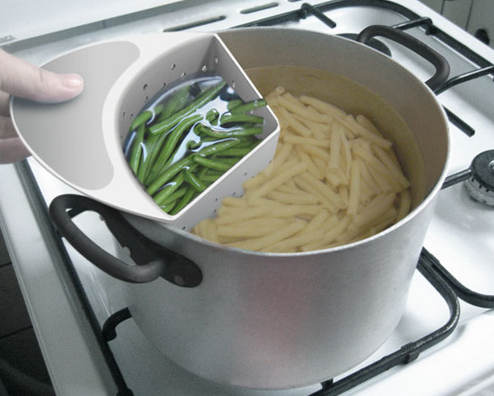
sub compartment cookware photo

dining in 2015

Basically I just think this is cool. I could try and explain how it shows creativity and reducing waste… but really I just like it. From the designer:

My eco-cook is an object that helps to save water, energy and time. Everyday, everyone, has to cook pasta, rice or various vegetable. Therefore different pots are needed. In a unique pot, the eco-cook enables to divide 2 or 3 space and to boil different food at the same time. Thereby, water and gas or electricity is saved. Moreover when food is taken out the eco-cook, it will automatically drain out, allowing to win precious time. In 2015 I also believe that most people will always be in a hurry. The eco-cook design permits to help 2015 people that pay close attention to energy and time.

The website should link to more designers homepage… It really is time for the linking ability of the web to be used more consistently. Far too often people discuss some person, book, center, term, report… and don’t take advantage of links to add value to the content presented (I don’t know if the designer, kechenyi camille, even has a web site but the failure to provide useful links is a very common waste) so that advice stands whether it is useful in this case or not.

Related: Simple Solutions That WorkEngineering Gadgets and GiftsNice Looking ToasterCheap Creativity

Posted in Creativity, Management | Comments Off on Nice Design Example, the eco-cook