
Malcolm Gladwell – Synchronicity

Today I had lunch with a friend of mine, Sean Stickle [the broken link was removed], who continually provides me with interesting ideas to contemplate. One of the things he mentioned during lunch was a story in the New Yorker about the current college admission process.

On the way home I listened to a podcast. I have been meaning to write about what a nice addition listening to podcasts has been to my commute, but I always seem to have more important things to do (or write about). The podcasts I have listened to so far, while somewhat interesting (for those interested in management improvement) have been heavily focused on those also interested in software development.

Well the podcast today was, “Human Nature,” and discussed the flaws of relying on customer surveys. It reminded me exactly of Deming’s warning against the dangers of relying on surveys. Obviously there are good things to learn from surveying and talking to your customers, but Deming understood that asking customers about what innovations they would like was dangerous. Well that is basically what the speaker talked about. And he gave some excellent detailed examples (New Coke and Aeron Chairs). So again, I thought really should post about the benefit of listening to these podcasts. But I didn’t.

Tonight, I stumbled across a blog post: The Business Model of Business Schools:

A great article by Malcolm Gladwell called the “the social logic of ivy league admissions” [the broken link was removed] in the New Yorker magazine is linked to. This is a must read.

In looking at that article, I realized it was the exact article Sean had mentioned at lunch. I then went to the authors web site and noticed he also wrote The Tipping Point. At which time I realized the podcast I listened to on the way home was by the same guy: Malcolm Gladwell. And I decided it was time to write a post.

The podcast really is worth listening to, Human Nature:

Malcolm explores why we can’t trust people’s opinions — because we don’t have the language to express our feelings. His examples include the story of New Coke and how Coke’s market research misled them, and the development of Herman-Miller’s Aeron chair, the best-selling chair in the history of office chairs, which succeeded in spite of research that suggested it would fail.

IT Conversations has excellent podcasts by leading thinkers including Jeff Bezos, Paul Graham and Clayton Christensen (Sean also introduced me into Graham and Christensen).

I’ll try to post something more on podcasts and good sources for those interested in management improvement but there is also tons of information online for those who don’t want to wait for me to get around to posting. I figure those reading this blog, might, like me, be a bit behind the leading gadget users. Many might actually own iPods. But I figure many may not have taken the time to discover that they can not only listen to great music, but also listen to great thinkers present their ideas using mp3 players.

Malcolm Gladwell’s new book is Blink.
Posted in Management | Tagged | 2 Comments

Lean Consumption: the Customer’s Perspective

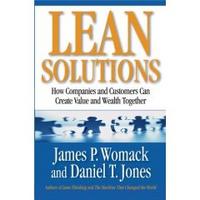
Lean Solutions book cover image
Lean Consumption: Defining Value from the Customer’s Perspective [the broken link was removed], AutoAsia magazine.

The recently released, Lean Solutions, as well as, The Toyota Way Fieldbook, are required reading for anyone serious about applying lean concepts. And truly both should be read by anyone interested in management improvement (even those who are not lean experts or even that familiar with lean ideas).

A short portion of the full article (exploring the ideas James Womack and Daniel Jones write about in their new book) is available online (without subscription). The short abstract packs in all sorts of good info. The new book, Lean Solutions: How Companies and Customers Can Create Value and Wealth Together by James P. Womack, Daniel T. Jones is no doubt the catalyst behind this article. From the article:

The concepts underlying lean consumption boil down to six simple principles that correspond closely with those of lean production.

  1. Solve the customer’s problem completely by making sure that all the goods and services work together to do so.
  2. Don’t waste the customer’s (or the provider’s) time.
  3. Provide exactly what the customer wants.
  4. Provide value where it’s wanted.
  5. Provide value when it’s wanted.
  6. Continually aggregate solutions to reduce the customer’s time and hassle.

For those interested in reading up on lean thinking concepts we have gathered links to lean articles available online.

Posted in Management | Tagged | 1 Comment

Box on Quality

Bill Hunter and George Box

Dr. George Box is not as well known in the general management community as his ideas merit (in my biased opinion – photo of Bill Hunter and George Box). He is well know in the statistics field as one of the leading statistical minds. Box on Quality is an excellent book that gathers his essays from his 65th to 80th year. The book has just been issued in paperback (which helps as the hardback was pricey).

While some of the essays are aimed at a reader with an advanced understanding of statistics, many of the articles are aimed at any manager attempting to apply Quality Management principles (SPC, Deming, process improvement, six sigma, etc.). An except from the book provides a table of contents and an introduction.

Some of the articles from the book are available online. I encourage you to take a look at several of the articles and then go ahead and add this book to your prized management resources, if you find them worthwhile.

Posted in Books, Design of Experiments, Management, Management Articles, Statistics | Tagged , , , , , , | 3 Comments

The Quick Fix

The Fall 2005 issue of the Deming Institute newsletter (I removed the broken link) includes a copy of a letter Dr. Deming sent to Time magazine in 1981.

Dear Sir,

Your article about Japan in TIME for 30 March 1981 is excellent, but the paragraph concerning my work is ridiculous and can do a lot of harm to American industry at the very time when they need guidance. Dr. Deming did not just give a lecture in 1950. He gave 35 lectures in the summer of 1950 to engineers and to top management. Six months later he was there again, and six months after that yet again. He has made 19 trips to Japan. One trouble with American industry today is that top management supposes that one lecture or one day will do it. “Come, spend a day with us, and do for us what you did for Japan, that we too may be saved.”

It is not so simple. Few people in top management in America understand their responsibilities and know that they must serve a life term on quality and productivity from now on, under competent leadership.

W. Edwards Deming

Many still search for simple quick answers. Management improvement most often requires a great deal of thought, study, experimentation and effort.

Posted in Deming, Management | Tagged , , , | 7 Comments

Innovation in Organizations

Assessing Your Organization’s Innovation Capabilities [the broken link was removed] by Clayton M. Christensen:

Three classes of factors affect what an organization can and cannot do: its resources, its processes, and its values. When asking what sorts of innovations their organizations are and are not likely to be able to implement successfully, managers can learn a lot about capabilities by sorting their answers into these three categories.

Innovation is one of the areas of management improvement that is not given sufficient attention. However, innovation is critical to the success of organizations and to the Deming management philosophy. Deming however, never had much specific advice on how to innovate. The management strategies he proposed do support innovation: truly knowing your customers, constancy of purpose, truly knowing your business, understanding your purpose, etc..

One of the most important findings in the research summarized in The Innovator’s Dilemma relates to the differences in companies’ track records at making effective use of sustaining and disruptive technologies.

I have been reading Clayton Christensen’s books recently and his concepts of managing disruptive technology is very interesting.

Continue reading

Posted in Books, Creativity, Deming, Innovation, Management, quote | Tagged , , , | 1 Comment

30 Year Fixed Rate Mortgage Rates

Fairly frequently I am asked, by friends, for investing advice. One topic I am asked about frequently is mortgages (locking in rates, etc.). Often they are concerned about what a Federal Reserve decision to raise or lower rates will effect the 30 year fixed mortgage rate. Essentially the decision by the Fed won’t have any predictable impact (this is not the complete truth but close enough for the question being asked – this article has more, though it still just provides a cursory view of the situation).

The chart here, shows 30 year fixed mortgage rates from 2000-2005 versus the federal funds rate. I don’t see any evidence that increases or decreases of the Fed Funds rate have a predictable impact on the 30 year fixed rate mortgage. For a larger chart and charts from 1980-1999 see 30 Year Fixed Mortgage Rates are Not Correlated with Federal Funds Rates.

I actually looked around for such charts online (to show a friend last week) but couldn’t find any (I sure they must be there but still I couldn’t find them). So I decided to create them myself. I used data from the Federal Reserve on historical rates. I was convinced the data would back up my belief but it is good idea to verify the data supports your beliefs (or learn that it doesn’t so you can update your beliefs).

More investment info:

Posted in Economics, Investing | 1 Comment

Education Improvement

Pattillo Tutors Granville School on Teaching Method [unfortunately the newspaper broke the link so I removed it] by Natalie Jordan, Rocky Mount Telegram (North Carolina, USA):

The model uses a PDSA – plan, do, study and act – component. “Plan” clarifies the purpose; “do” is when an action plan is made and done; “study” involves analyzing results; and “act” is to make improvements.

Through core values and strategic categories, the model is improving the way teachers teach and students learn, Olmsted said.

Education is another area where applying management improvement concepts can be difficult. The Education area does require special care but management improvement concepts can work very well in Education.

David Langford has done some great work in this area. He wrote a book, Orchestrating Learning With Quality, which while I would definitely recommend it for anyone planning on applying these concepts, it does not really capture the power of his contributions in my opinion.

The Quality in Our Schools [new link to related site also by Ivan on School Improvement] site (by Ivan Webb in Australia) also is a good resource.

Posted in Education, Management | Tagged | Comments Off on Education Improvement

Management Improvement in Healthcare

Thinking out-of-the-box Helps Alexandra Hospital Reduce Patient Waiting Time, Singapore News, via Panta Rei.

Another example of lean principles being used by government:

When looking for solutions to cut patients’ waiting time, Alexandra Hospital took an out-of-the-box approach and looked at a factory’s production line. More specifically, the Toyota production line.

While a team of 12 staff used to screen 22 patients per hour, the same team can now screen 70 patients per hour – a 400-per-cent increase in productivity

This… is how hospitals should look for new ways to deliver better healthcare at a lower cost. To encourage this, the Ministry of Health has set up the Healthcare Quality Improvement Fund which will provide seed money to fund projects which would improve the quality of patient care.

Continue reading

Posted in Health care, Lean thinking, Management | Tagged , , , | 3 Comments

Measuring and Managing Performance in Organizations

Forward [the broken link was removed] (by Tom DeMarco and Timothy Lister) to Measuring and Managing Performance in Organizations:

measurement is almost always part of an effort to achieve some goal. You can’t always measure all aspects of progress against the goal, so you settle for some surrogate parameter, one that seems to represent the goal closely and is simple enough to measure. So, for example, if the goal is long-term profitability, you may seek to achieve that goal by measuring and tracking productivity. What you’re doing, in the abstract, is this:

measure [parameter] in the hopes of improving [goal]

When dysfunction occurs, the values of [parameter] go up comfortingly, but the values of [goal] get worse.

Previous post on this topic:

Tom DeMarco and Timothy Lister are authors of the excellent Peopleware: Productive Projects and Teams

Posted in Data, Management | Tagged , , , | 2 Comments

More Lean Government

Lean thinking ideas are about eliminating waste. Some who believe the government should just be smaller, talk about a lean government, but that is not the same thing as a government that applies the concepts of lean thinking.

Toyota is very lean and very large. Most business apply lean concepts with the goal of growing the size of their organization as they are better able to serve customers and compete in the marketplace.

The first Public Sector Shingo Prizes [the broken link was removed] have been awarded by the Shingo Prize for Excellence in Manufacturing.

The gold recipient is Robins Air Force Base, Warner Robins Air Logistics Center:

C-5 began its Lean journey in 2001, and the successful Lean implementation has produced dramatic results in quality, cost, and delivery. Flow days have been reduced by 30%, while defects per aircraft dropped dramatically. In 2004 and 2005, C-5 PDM accomplished 100% on-time delivery, while increasing the number of aircraft produced.

Continue reading

Posted in Lean thinking, Management, Public Sector | Tagged , | 1 Comment