Hospitals, Heal Thyselves

Hospitals, Heal Thyselves by Cal Thomas:

This proven system does not require more staff or expensive consultants and it certainly does not need another bureaucratic, costly and inefficient government agency, which can only make things worse. Improvements can be made, says Mr. Dobyns, starting today and in every hospital in the country. Costs will decline. “So the question now becomes, can we afford not to heal our hospitals? We can, if we want, not do anything. But if we decide not to do anything, we have to accept that every day — every day — 500 people will die in hospitals in the United States who did not have to. You and I might be among them.”

via Great Exposure for the “Good News” DVD

Posted in Deming, Health care, Lean thinking, Management, Systems thinking | Comments Off on Hospitals, Heal Thyselves

More on Obscene CEO Pay

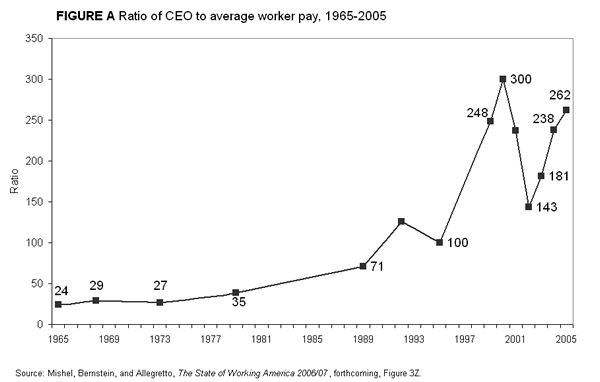
graph of excessive CEO pay

Study site: CEO-worker pay imbalance grows [the broken link has been removed] includes the graph above.

Unfortunately this reverse robin hood (steal from the workers, stock holder, customers…) and give to the CEO tale continues. Hopefully someday soon we can at least turn the momentum in the right direction (stopping these incredibly excessive “pay” packages). Even then it will take quite a deal of reducing these ridiculous “pay” packages to reach some sense of decency. CNN article based on the report: CEO Paycheck: $42,000 a day by Jeanne Sahadi:

Put another way, the average worker — who earned $41,861 in 2005 — made about $400 less last year than what the average large-company CEO made in one day. That assumes 260 days of pay (52 weeks x 5 days a week).

The CEO-to-worker pay differential in 2005 was the second highest on record. The highest was 2000, when the average CEO earned 300 times what the average worker made.

In 2002, the differential fell to 143 as the bear market took its toll on stock-related compensation. Nevertheless, between 2000 and 2005, median CEO pay rose 84 percent to $6.05 million on an inflation-adjusted basis, according to EPI.

Missing link: CEO pay and results [the broken link has been removed]

Continue reading

Posted in Management | Tagged , , , , , , , , | 12 Comments

Edward Tufte’s new book: Beautiful Evidence

Cover image of Beautiful Evidence

Beautiful Evidence by Edward Tufte is now available. Beautiful is the right word. Tufte’s books are an example of what can be created when someone truly loves what they do and takes pride in every detail of their work. His books are excellent.

In Beautiful Evidence, Tufte explores how to best display evidence looking at: mapped pictures; sparklines; links and causal arrows; words, numbers and pictures together; the fundamental principles of analytical design; corruption of evidence; and more. Continue reading

Posted in Books, Data, Management | 3 Comments

Dr. Shigeo Shingo

Norman Bodek responds to, Shigeo Shingo’s Influence on TPS by Art Smalley, with: Dr. Shigeo Shingo – The Greatest Manufacturing Consultant. As the title shows this article focuses on the contributions of Dr. Shingo. I still find the original article interesting and valuable. I don’t think the original article denigrates Dr. Shingo. It is true the emphasis is different in the two articles however it seems to me the difference is not that large in truth. The largest difference is to what extent Dr. Shingo’s contributions (which it seems to me are stated pretty similarly) are admired, it seems to me.

Both support the idea that Dr. Shingo offered valuable contributions. Norman Bodek obviously believes Dr. Shingo deserves more credit than the original article. At least to me though the differences between the articles is much less than the agreements.

Posted in Management, Management Articles, Toyota Production System (TPS) | 1 Comment

Curious Cat Science and Engineering Blog

We have updated the design of the Curious Cat Science and Engineering Blog. Please share your comments on the design: we plan on moving this blog to a similar design. Continue reading

Posted in curiouscat.com, Science | Comments Off on Curious Cat Science and Engineering Blog

Health Care Crisis

Probe finds nation’s emergency care system at ‘breaking point’ (the San Jose Mercury News broke the link so I removed it – poor usabilty on their part) by Lauran Neegaard:

It’s a sobering symptom of how the nation’s emergency-care system is overcrowded and overwhelmed, “at its breaking point,” concludes an investigation by the Institute of Medicine.

The spate of similar articles reminded me of the recent post by Mark Graban: Stop calling it “ER Congestion”. He states: “It’s not an ER problem, it’s a systemic hospital problem.” I agree. The health care system is broken and has been for a long time. Symptoms like the huge cost of health care, medical errors, ER problems etc. are all related. Continue reading

Posted in Health care, Lean thinking, Management, Public Sector, Systems thinking | Tagged , , | 3 Comments

Thinking About the Future

In Thinking About the Future Russ Ackoff does his usual great job of providing insightful ideas while not being afraid to be controversial. In this speech Dr. Ackoff discusses his thoughts on the issue of global development at the occasion of his receipt of the Tallberg Foundation / Swedbank Leadership Award:

So much time is currently spent in worrying about the future that the present is allowed to go to hell. Unless we correct some of the world’s current systemic deficiencies now, the future is condemned to be as disappointing as the present.My preoccupation is with where we would ideally like to be right now. Knowing this, we can act now so as constantly to reduce the gap between where we are and where we want to be. Then, to a large extent, the future is created by what we do now. Now is the only time in which we can act.

via: Thinking about the Future and Globalization

Posted in Economics, Management, Systems thinking | Comments Off on Thinking About the Future

Lean National Health System

A presentation today, Lean Thinking For the NHS, by Dan Jones is getting press coverage in England.NHS should embrace lean times:

The improvements came through examining the patient’s whole experience, and removing the sometimes-fatal delays in getting them into the operating theatre, such as creating a faster process for radiology and removing unnecessary paperwork.These changes also lessen staff frustrations by allowing them to spend more time helping patients. Also, by cutting length of stay and complications, costs should also start to fall, although Mr Fillingham – former director of the NHS Modernisation Agency – said it will take several years for the savings to become substantial.

This is an example of focusing on improving the system which will then result in improved measures (cost savings for example). This systems approach contrasts with cutting costs by cutting every budget by 5% across the board which often fails. Without improvements in the system reducing budgets just reduces capability.

Continue reading

Posted in Health care, Lean thinking, Management, Management Articles, Systems thinking, UK | Tagged , , , | 1 Comment

Brainstorming Under Attack

Brainstorming under attack: 8 errors in the WSJ [the broken link was removed]. The WSJ has their content behind a wall [the broken link was removed] so their content is not part of the web and so I have not seen their article.

The blog post makes good points about mistaken impressions of brainstorming:

People do better on their own than they do in brainstorming sessions. This is really daft. I like to think of myself as a pretty creative guy, but I am never more creative than when I am a small piece loosely joined with other small pieces in the generative circumstances of a brain storming group.

I think both have their place. You pretty much can come up with your own ideas all day long (though it is true we often are too busy doing something to take any time to think but that is a time management choice). Brainstorming is about creating an opportunity to bring new ideas the forefront.

There are other useful tools such as the affinity diagram which can serve as another option (or can serve as a tool to work with the results of brainstorming).

And Edward DeBono has excellent creativity tools, like his 6 thinking hats. Brainstorming is a useful tool when applied properly but it is only one tool and other tools should be used also.

Posted in Creativity, Management, Quality tools | Tagged , , , , | Comments Off on Brainstorming Under Attack

More Kaizen

More Kaizen – Why Not Eleven? [the broken link was removed]:

We also talk about lean production and Toyota methods and how far you have to go. He tells me about a course he did where the company took him out of work for a couple of days and sent him to another plant where they showed him how to work an assembly line station, then set him to come up with 5 improvements for the process before lunchtime.When he delivered they said, what about another 5. Then it was come back in the morning with 10 more. When he delivered 10 they said, “why not 11?” Then he got it. Kaizen is not just taking millions of little steps, it is not just doing it because the boss says so, it is not even because you take pride in your work and you want to do the best job you can, its because you do everything with your customers and their needs in mind.

I really like how the idea of always looking to improve was presented here: Kaizen Means Thinking “Now Things are the Worst Ever” [the broken link was removed]:

In order to do kaizen and keep working towards becoming Lean, you need everyone to think “The current situation is the worst. I can’t stand it. I need to make it better.” This is a significant culture change for most of us.

It is difficult to do this in an organization that has not accepted lean principles. You have to be careful to not be seen as negative and just focusing on problems when so many others are trying to cover up problems and focus on what makes them look good (they have to think about their next performance appraisal after all).

Posted in Lean thinking, Quality tools | Tagged , | 1 Comment