Once again the USA was the leading country in manufacturing for 2008. And once again China grew their manufacturing output amazingly. In a change with recent trends Japan grew output significantly. Of course, the 2009 data is going to show the impact of a very severe worldwide recession.
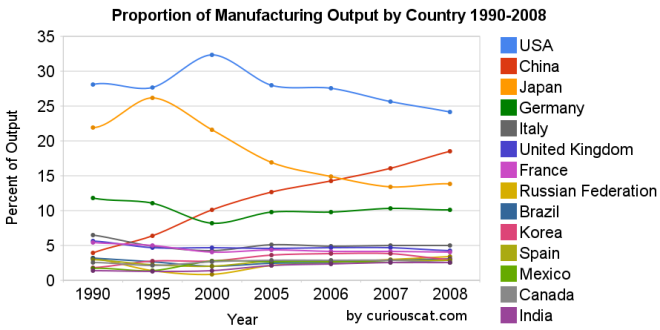
Chart showing the percentage output of top manufacturing countries from 1990-2008 by Curious Cat Management Blog,
Creative Commons Attribution.
The first chart shows the USA’s share of the manufacturing output, of the countries that manufactured over $185 billion in 2008, at 28.1% in 1990, 27.7% in 1995, 32% in 2000, 28% in 2005, 28% in 2006, 26% in 2007 and 24% in 2008. China’s share has grown from 4% in 1990, 6% in 1995, 10% in 2000, 13% in 2005, 14% in 2006, 16% in 2007 to 18% in 2008. Japan’s share has fallen from 22% in 1990 to 14% in 2008. The USA has about 4.5% of the world population, China about 20%. See Curious Cat Investment blog post” Data on the Largest Manufacturing Countries in 2008.
Even with just this data, it is obvious the belief in a decades long steep decline in USA manufacturing is not in evidence. And, in fact the USA’s output has grown substantially over this period. It has just grown more slowly than that of China (as has every other country), and so while output in the USA has grown the percentage with China has shrunk. The percentage of manufacturing output by the USA (excluding output from China) was 29.3% in 1990 and 29.6% in 2008. The second chart shows manufacturing output over time.
The 2008 China data is not provided for manufacturing alone (the latest UN Data, for global manufacturing, in billions of current USA dollars). The percentage of manufacturing (to manufacturing, mining and utilities) was 78% for 2005-2007 (I used 78% of the manufacturing, mining and utilities figure provided in the 2008 data). There is a good chance this overstates China manufacturing output in 2008 (due to very high commodity prices in 2008).
Hopefully these charts provide some evidence of what is really going on with global manufacturing and counteracts the hype, to some extent. Global economic data is not perfect. These figures are an attempt to capture the economic reality in the world but they are not a perfect proxy. This data is shown in 2008 USA dollars which is good in the sense that it shows all countries in the same light and we can compare the 1995 USA figure to 2005 without worrying about inflation. However foreign exchange fluctuations over time can show a country, for example, having a decline in manufacturing output in some year when in fact the output increased (just the decline against the USA dollar that year results in the data showing a decrease – which is accurate when measured in terms of USA dollars).
If the dollar declines substantially between when the 2008 data was calculated and the 2009 data is calculated that will give result in the data showing a substantial increase in those countries that had a currency strengthen against the USA dollar. At this time the Chinese Renminbi has not strengthened while most other currencies have – the Chinese government is retaining a peg to a specific exchange rate.
Korea (1.8% in 1990, 3% in 2008), Mexico (1.7% to 2.6%) and India (1.4% to 2.5%) were the only countries to increase their percentage of manufacturing output (other than China, of course, which grew from 3.9% to 18.5%).
Related: posts on manufacturing – Global Manufacturing Data 2007 – Global Manufacturing Employment Data – 1979 to 2007 – Top 10 Manufacturing Countries 2006 – Top 10 Manufacturing Countries 2005 – lean manufacturing resources

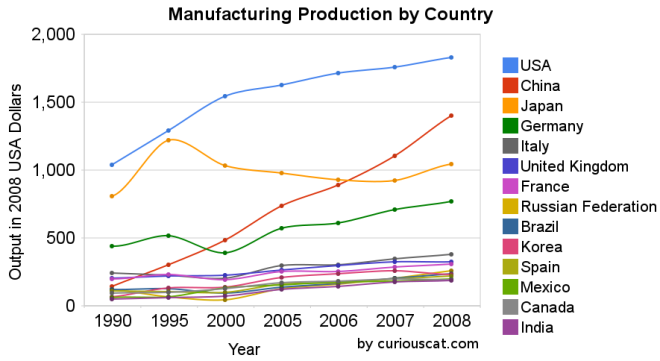 Chart showing the output of the top manufacturing countries from 1990-2008 by Curious Cat Management Blog,
  Photo of sunset in

No More Executive Bonuses!
Henry Mintzberg, wrote an excellent article for the Wall Street Journal today, No More Executive Bonuses!
This may sound extreme. But when you look at the way the compensation game is played – and the assumptions that are made by those who want to reform it – you can come to no other conclusion. The system simply can’t be fixed. Executive bonuses – especially in the form of stock and option grants—represent the most prominent form of legal corruption that has been undermining our large corporations and bringing down the global economy. Get rid of them and we will all be better off for it.
…
So, again, there is but one solution: Eliminate bonuses. Period. Pay people, including the CEO, fairly. As an executive, if you want a bonus, buy the stock, like everyone else. Bet on your company for real, personally.
…
All this compensation madness is not about markets or talents or incentives, but rather about insiders hijacking established institutions for their personal benefit.
Too many large corporations today are starved for leadership – true leadership, meaning engaged leadership embedded in concerned management. And the global economy desperately needs renewed enterprise, embedded in the belief that companies are communities. Getting rid of executive bonuses, and the gambling games that accompany them, is the place to start.
It is an great article on bad pay systems that let a few top executives (and their hand picked board members) in many companies to loot the treasury of the company. I have written about this problem many times, including: CEOs Plundering Corporate Coffers – Excessive Executive Pay (2005) – Narcissistic Cadre of Senior Executives – The Best Leadership Is Good Management – Another Year of CEO’s Taking Hugely Excessive Pay – More on Obscene CEO Pay – More on Failed Executives
There are executives that don’t act like corrupt dictators looting their country, unfortunately they are less common than those that act like looters. And they all seem to have built cultures that taking respect for people is more important that feeding a few bloated egos. Akio Toyoda’s Message Shows Real Leadership, Tony Hsieh, the Zappo’s CEO – Warren Buffett – Honda has Never had Layoffs and has been Profitable Every Year
The obscene pay is not just a matter of people taking a tens of millions of dollars they don’t deserve. Companies whole management systems are distorted in ways that lead the company to risk all the other stakeholders future for the potential gain of a few senior executives.