2009 Annual Management Blog Review Part 3 of 3

The 2009 annual management improvement blog carnival continues with more bloggers posting highlights from some of their favorite management blogs. Also see 2009 Annual Management Blog Review Part 1 and part 2.

Mark Graban’s review took a Boston theme covering Chasing the Rabbit, Running a Hospital, Gemba Coach and John Shook’s Management Column. Highlights include:

In the 3rd carnival post on the Stats Made Easy blog Mark J. Anderson took a look at Seth Godin’s blog and among other things liked: Godin suggests that under the bright light of the internet being generous and fair in business dealings pays off now more than ever.

Bryan Lund found some inspiration from the Three Star Leadership Blog, Process Rants, Capable People? and the Leadership Styles Blog. Highlights include:

And I covered, Training Within Industry, Visual Management Blog and Making IT Clear to bring the annual management carnival to a close. Highlights include:

This year 10 blogs took a look back at excellent post from 34 management blogs in 2009, providing some great idea to help managers improve. Don’t forget to visit each carnival post and find some excellent ideas you can use and perhaps some new blogs to add to your RSS reader.

Related: Management blog directory2008 Annual management blog review

Posted in Carnival | Tagged , , , | Comments Off on 2009 Annual Management Blog Review Part 3 of 3

Undercover Boss – Will They Really Change?

[removed video that is no longer available]

I am skeptical that this reality show (Undercover Boss) will actually do any good but the webclip looks fun. It will premier right after the Super Bowl on CBS.

The concept, if done right, could actually be interesting. But even in that case, I would be skeptical it would do much good. I may be wrong, but I would think we will get a whole bunch of thoughts based on one single data point (no appreciation of a system, no understanding variation, no understanding psychology – just playing to psychology, and no understanding of how we form beliefs). My guess is the show will largely be having fun with making bosses actually do physical and customer service work. And probably the bosses trying to appeal to the common working man with admiration about how hard this work is.

They then will go back to their overinflated salaries and continue to limit the rewards for those they spoke so highly of while TV cameras rolled, and in general practice disrespect for people not respect for people. If it actually gets a few MBAs to stop managing by spreadsheet and start actually managing with an understanding the business systems they manage that would be great.

Going to the Gemba, where the rubber meets the road is great. But unless the management systems are in place to improve it is more like a site-seeing trip than a management tool. More like those people that go to a working ranch for a vacation (where they work on a ranch) to experience something new before returning to their normal life.

via: Dan McCarthy, How to be an “Undercover Leader”. He is more hopeful than I am about the show.

Related: Management Advice FailuresHow to ImproveThe CEO is Only One PersonManagement Improvement

Posted in Creativity, Management, Psychology, quote, Respect | Tagged , , , | 7 Comments

2009 Curious Cat Management Blog Carnival

10 management blogs are participating in the 2009 Management Blog Carnival. Be sure to check out all the great posts. Here we are looking at some exceptional posts on the , Training Within Industry and Making IT Clear. The quotes below are taken from blog posts on these blogs (and include links to the posts they are taken from)

Visual Management Blog by Xavier Quesada Allue
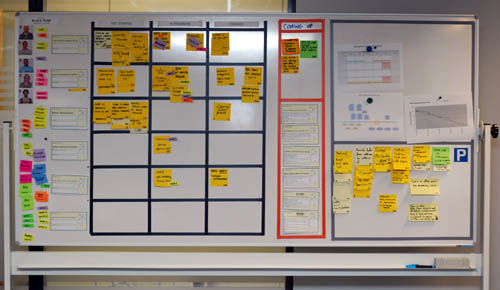
photo of a software development task board

“Visual Management is the practice of using information visualization techniques to manage work. A simple example is using sticky notes on a wall to manage a list of tasks, a better (and more complex) example is kanban.”

Agile and lean management both stress to the importance of making work in process visible. With agile software development workload is often managed using short iterations to create software code and deploy it (similar to continuous flow). “The goal is that any team can do any story in the backlog. You should stress that the ‘real’ Team is the big one. Sub-teams are just created for communication and coordination purposes. In my opinion, they should not develop too strong a team identity. For example, I would not measure sub-team velocity, and I would make sure people rotate from sub-team to sub-team a lot.”

Short software development iterations “require both soft and hard commitments from team members. The team is required to work as a team (for which soft commitment is required) and to commit to finishing a certain amount of work in one Sprint.”

Training Within Industry by Bryan Lund

Another method of making in process work clear is to make clear what the process is.
Building up Standard Work Using Job Instruction explains why job instruction is critical skill that supports standardized work, in that training is used as a countermeasure against variability. An important idea that is far to often ignored.

“The primary purpose of a Job Breakdown Sheet is to serve as a trainer’s aid. It is not meant to be read by the trainee.” and “My experience is that Work Instructions are used so a number of objectives may be achieved”: reduce training time, have trainees more directly involved with training and compliance and accountability through a a chain of approvals.

Early in the year Bryan included a series of lean comics, including:
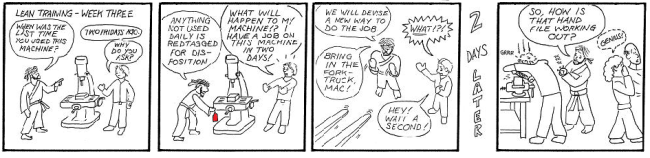
Remove clutter comic by Bryan Lund

Making IT Clear by Harwell Thrasher

Harwell Thrasher focuses on explaining IT issues to a business audience, and giving business people advice on how to improve the effectiveness of their IT organizations. “IT doesn’t succeed because of technology — it succeeds because of its contribution to the business.”

He has several posts with straight forward ideas for managers such as How to Become a Manager – 13 Skills You’ll Need: “Obstacle Removal… Part of your job is to remove the obstacles that are preventing your employees from doing their best.” Managers responsibility to intervene in the system to remove obstacle preventing people from doing their best is a big key to management I believe. One great thing about agile software development is how clearly this is shown to be a project managers responsibility.

As he says in The 7 Biggest Challenges of a Manager “If you ever get to the point where you honestly have no idea how to improve things further, then you should either (a) seek outside advice, or (b) look for another job. There’s always a better way, and you have to keep looking for it.”

“Most technical people who become managers do so because they want more scope and control… perhaps most important, you don’t become a good manager by being good technically – you become a good manager by being able to get things accomplished through other people.

Take a look at the full list of posts pointing to excellent posts from over 30 management blogs from 2009.

Related: 2008 Curious Cat Management CarnivalManagement RedditCurious Cat Management Search

Posted in Carnival, Management | Tagged , , | 3 Comments

Lean Manufacturing Simulation (webcast)

This webcast, from the MIT Open Courseware initiative, shows a simulation (with legos). And in doing so explores the advantages of lean manufacturing methods.

Related: Red Bead Experiment Webcastone-piece flowApplied Quality Engineering EducationThe Lean MBA

Posted in Education, Lean thinking, webcast | Tagged , , , | 1 Comment

2009 Annual Management Blog Review Part 2

The 2009 annual management improvement blog carnival continues with more bloggers posting highlights from some of their favorite management blogs (see 2009 Annual Management Blog Review Part 1). Kevin Meyer looked back through the posts from TimeBack Management, Lean Six Sigma Academy, Curious Cat Management Improvement, A Lean Journey, and Stats Made Easy and found some gems, including

Dan Markovitz reviewed the Lean blog, Evolving Excellence and Jason Yip’s blog. Highlights include:

Hank Anderson has highlighted posts from the Hexawise blog for Stats Made Easy. Mark Anderson has reviewed Work Matters and will be reviewing Seth Godin in an upcoming post. Highlights from the Hexawise blog include: What Else Can Software Development and Testing Learn from Manufacturing? Don’t Forget Design of Experiments (DoE) by Justin Hunter, my brother.
Continue reading

Posted in Management | Tagged , , | Comments Off on 2009 Annual Management Blog Review Part 2

Worse Hotel Service the More You Pay

The more you pay for your hotel room the more likely they will charge to provide decent WiFi in your room. Whether a company tries to rip you off with exorbitant prices, or lousy service, is just a function of their lack of respect for customers. Obviously it is cheap to provide decent WiFi (as staying at numerous cheap hotels shows – nearly all offer WiFi completely free).

Most expensive hotels show they do not respect their customers. Some actually do rise to the level of a typical budget, and cheaper, hotels and motels so it isn’t all expensive hotels that fail to meet this low standard. The management of those hotels come from the same school of management thought that produces our bankers.

Jeff Bezos captures one difference between poor managers (prevalent in many spreadsheet focused managers) and lean manufacturing managers with the quote: “There are two kinds of companies, those that work to try to charge more and those that work to charge less.”

Thoughts on: Hotel WiFi Should Be a Right, Not a Luxury

Related: Making Life Difficult for CustomersVerizon Provides Lousy Service = Dog Bites ManIs Poor Service the Industry Standard?

Posted in Customer focus, Deming, Lean thinking, Management | Tagged , , , | 4 Comments

2009 Annual Management Blog Review Part 1

The 2009 annual management improvement blog review is underway. Jamie Flinchbaugh found excellent posts from In Pursuit of Elegance, Shmula blog and Got Boondoggle? Those posts include:

Mark J. Anderson has highlighted posts from Work Matters and will be reviewing Seth Godin and the Hexawise blog in upcoming posts. Highlights from Bob Sutton include: Intuition vs. Data-Driven Decision-Making: Some Rough Ideas.

Jon Miller scoured the Lean is Good, Daily Kaizen and Jamie Flinchbaugh and has posted valuable highlights, including:

Be sure to check out each carnival post and each of the posts they highlight. The review shows how much excellent material is published on management blogs. 2009 Management Improvement Blog Carnival provides links to the carnival posts noted above, and will include others as they are posted. This is the second year we have posted an annual management blog review: 2008 management blog review.

Reading these posts will give you plenty of ideas to help you make the new year a happy year.

Posted in Carnival, Management | Tagged , , | 2 Comments

Systemic Health Care Failure: Small Business Coverage

There are many significant problems with the medical care system in the USA. It makes sense that a system that costs over 50% more than other countries and has no better outcomes, from all that extra spending, suffers from many failures. Coverage for small business is one of the problems we face now – When Health Insurers Dump Small Companies:

In June testimony before the Senate Commerce Committee, Potter said insurers “dump small businesses whose employees’ medical claims exceed what insurance underwriters expected. All it takes is one illness or accident among employees at a small business to prompt an insurance company to hike the next year’s premiums so high that the employer has to cut benefits, shop for another carrier, or stop offering coverage altogether – leaving workers uninsured.”

Joy Mosley, COO of Biotest Laboratories, a 77-person medical testing company in Minneapolis, recently got such a “requote” from her insurer, Medica, after an employee was diagnosed with pancreatic cancer. Medica covered the million-dollar treatment, but then said the large claim warranted $156,000 in additional premiums – a 72% increase.

Not all entrepreneurs are equally vulnerable. About a dozen states prohibit insurers from basing premiums for businesses with 50 or fewer employees on workers’ health status. But in roughly three-fourths of the country, so-called ratings bands allow for considerable flexibility in pricing. In states with loose ratings bands, such as Texas and Nevada, one small company can be charged nearly 70% more than another. In Pennsylvania and Virginia, there are no ratings restrictions. No matter what state you’re in, ratings bands don’t apply to companies with more than 50 employees.

Just from an insurance perspective the companies are not providing what is needed. They are quick to say you can’t have healthy people remain uncovered and wait to buy insurance once for example, “their house is on fire” (they are sick). They are right. Well you also can’t have the insurance company cancel coverage during the fire and have a system that works.
Continue reading

Posted in Economics, Health care, Innovation, Systems thinking | Tagged , | 2 Comments

Soren Bisgaard

photo of Soren Bisgaard

Soren Bisgaard died earlier this month of cancer. Soren was a student of my father’s who shared the commitment to making a difference in people’s lives by using applied statistics properly. I know this seem odd to many (I tried to describe this idea previously, also read his acceptance of the 2002 William G. Hunter award). Soren served as the director of the director of the Center for Quality and Productivity Improvement at the University of Wisconsin-Madison (founded by William Hunter and George Box) for several years.

Most recently Soren Bisgaard, Ph.D. was Professor of technology management at Eugene M. Isenberg School of Management at the University of Massachusetts – Amherst. He was an ASQ Fellow; recipient of Shewart Medal, Hunter Award, George Box Medal, among many others awards.

I will remember the passion he brought to his work. He reminded me of my father in his desire to improve how things are done and allow people to have better lives. Those that bring passion to their work in management improvement are unsung heroes. It seems odd, to many, to see that you can bring improvement to people’s lives through work. But we spend huge amounts of our time at work. And by improving the systems we work in we can improve people’s lives. Soren will be missed, by those who knew him and those who didn’t (even if they never realize it).

Contributions in honor of Søren may be made to The International Mesothelioma Program or to the European Network for Business and Industrial Statistics. Read more articles by Søren Bisgaard.

The Future of Quality Technology: From a Manufacturing to a Knowledge Economy and From Defects to Innovations (pdf) by Soren Bisgaard

Related: The Work of Peter ScholtesManagement Improvement LeadersThe Scientific Context of Quality Improvement by George Box and Soren Bisgaard, 1987 – Obituary Søren Bisgaard at ENBISObituary: Soren Bisgaard, Isenberg Professor in Integrative Studies

Posted in Psychology, Six sigma, Statistics | Tagged , , , , , , | 4 Comments

2009 Annual Management Blog Review

Over the next 2 weeks several management blogs will be posting their contributions to the 2009 year in review of management blogs. Posts will highlight some of the best posts on other management blogs in the last year.

The home page of the 2009 review of management blogs will be updated as new posts are added.

The hosts of the 2009 management blog carnival include the: Lean Blog,
Jamie Flinchbaugh, Stats Made Easy, Gemba Panta Rei and Lean Reflections.

See the 2008 year in review for management blogs. See management improvement carnival posts.

Posted in Carnival, Management | Tagged , | Comments Off on 2009 Annual Management Blog Review