Top 25: Influential Business Leaders

Top 25: Influential Business Leaders [the broken link was removed]

Leaders like Warren Buffett (No. 4), CEO of Berkshire Hathaway; chairman of the Federal Reserve Board Alan Greenspan (No. 9) and business consultant W. Edwards Deming (No. 22) changed the ways we do business.

Deming, using his theories of management and quality control, helped turn Japan into a manufacturing powerhouse.

Lists such as this don’t have much value. However, I do think they have a little value in getting people to think about some important innovations in business. But honestly, I wouldn’t be writing about it except that they lists Dr. W. Edwards Deming in this list, along with the likes of Gates, Grove, Welch, Dell, Walton and Bezos. I hope that encourages some people to take a look at Deming’s ideas or perhaps encourages some to discuss Deming’s ideas. For more on Deming’s ideas see the Curious Cat Deming Web. I am glad they recognized his contributions, I think things will be better if Deming’s ideas are kept alive and mentions, such as this list, keep his ideas alive to the general public.

Posted in Management | Comments Off on Top 25: Influential Business Leaders

BBC Radio Program on Deming

BBC radio has an online podcast of a discussion of W. Edwards Deming‘s ideas. As far as I can tell the program is available for downloading just for the next couple days [link broken, so it was removed. Re-found a working link, who know how long it will work] (I am exploring if we can find a way to make the program available online permanently – if anyone has experience working with BBC and has some helpful info please let me know).

The program is “In Business” on BBC 4. Peter Day moderates the discussion with guests:

Norman Speirs
European Director, Management Wisdom [the broken link was removed]

Hazel Cannon
Leader of the Deming Forum

Jane Seddon
Process Management International

Debbie Ray
Good Samaritan Hospital Dayton, Ohio

Myron Tribus
former professor MIT and Dartmouth Universities in America

David Wormald
Managing Director, Raflatac

Nick Baxter
Chief Executive and Founder of Cornerstone International

I definitely encourage those interested in Deming’s ideas to listen to the podcast. The discussion provides a good overview of the basic concepts (exploring why Deming’s ideas are not “that Quality stuff that we did years ago”), a short history of Deming ideas and the state of affairs now. It is not an advanced tutorial for those who have been working with these ideas and now what to know how to solve specific issues they have run across. For those interested in applying Deming’s ideas, as always, I suggest: The Leadership Handbook, Fourth Generation Management and the Improvement Guide (for more see: books to start with).

Posted in Deming, Management, UK, webcast | Tagged | Comments Off on BBC Radio Program on Deming

National Parks

I just returned from several weeks visiting National Parks in the Northwest USA: Olympic, Mount Saint Helens, North Cascades, Glacier and Mount Rainer. I will post photos of the parks to the Curious Cat Travels section as I have time.

A CNN.com article, from yesterday, discusses the use of National parks and comments on camping declining at the parks. I have always preferred to hike around during the day and then eat good food, sleep in a warm bed and take a warm shower. So maybe I am ahead of the trend the article argues is taking place. I found the most interesting part of the article to be:

There were 276.9 million visits to the National Park System last year… By comparison, combined attendance at Major League Baseball, National Football League and National Basketball Association games last season was about 110 million.

One of the surprising things about my recent trip was the lack of foreigners. Often, of past visits (Yellowstone, Grand Canyon, Rocky Mountains, etc.) close to half the people I see hiking seem to be foreigners . This time I would estimate less than 10%. My guess is this is just an anomaly of the time and places I visited but it was interesting.

New (added 2015): Curious Cat travel photos – National Parks

Posted in curiouscat.com, Travel photos | Tagged , , | Comments Off on National Parks

Targets Distorting the System

I still remember Dr. Brian Joiner speaking about process improvement and the role of data well over a decade ago. He spoke of 3 ways to improve the figures: distort the data, distort the system and improve the system. Improving the system is the most difficult.

There is an interesting article on the effects of distorting the system: Tony Blair says he will ensure NHS targets do not stop people from seeing their GPs when they want to, from BBC News.

The promise follows claims that some GPs’ surgeries are refusing to set appointments more than two days in advance because of the targets.

In order to make the data meet the targets the system is distorted to achieve the target, rather than to serve the customer.

From Peter Scholtes‘ article published in National Productivity Review in 1993, Total Quality or Performance Appraisal: Choose One:

Continue reading

Posted in Data, Deming, Management, Systems thinking | Tagged , , , , | 6 Comments

From Mechanistic to Social Systemic Thinking

The Ackoff Center has posted a presentation, From Mechanistic to Social Systemic Thinking (pdf format), given by Russell Ackoff in November 1993 at the Systems Thinking in Action Conference. As usual he presents many great ideas well. And ten years later the ideas presented are still fresh and worth reading. The ideas are more familiar than they were in 1993 but are still powerful. The presentation concluded with

Now, I don’t want to take any more of your time, but it’s easy to show that the interest in design, quality, and learning all derive from the same transformation in our concept of the nature of reality.

Russell Ackoff Biography and links to more of his papers and resources on his ideas.

Posted in Management, Systems thinking | 2 Comments

Dilbert and Deming

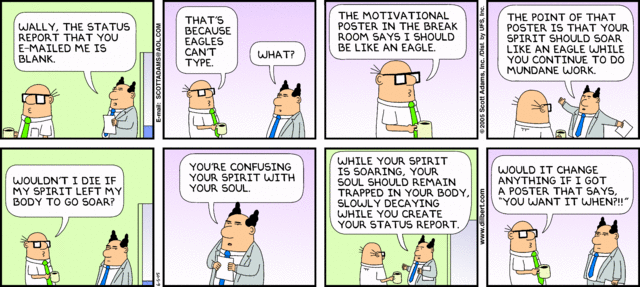
5 June 2005 Dilbert Strip on motivational posters – [update – well the pointy haired bosses running the site removed the page so we removed the link] New update the phb has been overthrown. Here is the strip:

motivational poster, Dilbert comic

The point of that poster is your spirit should soar like an eagle while you continue to do mundane work

Dilbert can show the silliness that is common place in many workplaces, as just that – silly. Point 10 of Deming’s 14 points called on management to eliminate slogans. Deming refined the wording as he learned: the text from the Deming Institute site (another site broke their link, so it was removed) now states:

Eliminate slogans, exhortations, and targets asking for zero defects or new levels of productivity. Such exhortations only create adversarial relationships, as the bulk of the causes of low quality and low productivity belong to the system and thus lie beyond the power of the work force.

That text works well for me, but I think Dilbert provides a great service in pointing out the same idea that such slogans are silly and even harmful in a way many others find more accessible. Of course most managers don’t seem to notice when Dilbert points out that a management “tool” they use lacks value – that the “emperor has no clothes” (The Emperor’s New Suit by Hans Christian Andersen, 1837).

Posted in Deming, Management, Psychology | Tagged , , , | 3 Comments

Marketers Are Embracing Statistical Design of Experiments

Marketers Are Embracing Statistical Design of Experiments (site broke link so I removed it) by Richard Burnham.

Crayola® conducts an e-mail marketing DOE to attract parents and teachers to their new Internet site. The company discovers a combination of factors that makes their new e-mail pitch three-and-a-half times more effective than the control. (Harvard Business Review, October 2001, “Boost Your Marketing ROI with Experimental Design,” Almquist, Wyner.)

Marketers can’t always be certain what triggers buyers to respond. In the past, we were always admonished to test-test-test, but only one factor at a time – relying on our gut feelings and uncertain hopes. With DOE, marketers have replaced voodoo with the science of statistics.

For more on Design of Experiments see:

Posted in Design of Experiments, Management Articles, Six sigma, Statistics | Tagged , , | 2 Comments

A Lean Walk Through History

A Lean Walk Through History [link broken, so it was removed] by Jim Womack
author of Lean Thinking Banish Waste and Create Wealth in Your Corporation by James P. Womack and Daniel T. Jones, 2003 and The Machine That Changed the World The Story of Lean Production by James P. Womack, Daniel T. Jones and Daniel Roos, 1991.

Once you are sensitized to the depth of lean history, along with its many advances and setbacks, it’s easy to begin filling in some of the other milestones:

By 1765, French general Jean-Baptiste de Gribeauval had grasped the significance of standardized designs and interchangeable parts to facilitate battlefield repairs. (Actually doing this cost-effectively in practice was another matter and required another 125 years.)

By 1807 Marc Brunel in England had devised equipment for making simple wooden items like rope blocks for the Royal Navy using 22 kinds of machines that produced identical items in process sequence one at a time.

By 1822 Thomas Blanchard at the Springfield Armory in the U.S. had devised a set of 14 machines and laid them out in a cellular arrangement that made it possible to make more complex shapes like gunstocks for rifles. A block of wood was placed in the first machine, the lever was thrown, and the water-powered machine automatically removed some of the wood using a profile tracer on a reference piece.

Posted in Management Articles | Tagged , | Comments Off on A Lean Walk Through History

Six Sigma and the Evolution of Statistical Management Methods

Six-Sigma: the Evolution of 100 Years of Business Improvement Methodology (pointy haired bosses broke the link so I removed it) by Ronald D. Snee.

The article includes a nice very quick summary of the development of statistical methods to aid management improvement in the last 100 years. Then the article gives a good overview of Six Sigma.

There are four aspects of the Six-Sigma method…

First, Six-Sigma places a clear focus on getting bottomline results…

Next, Six-Sigma builds on improvement methods that have been shown to be effective and integrates the human and process elements of improvement…

The third key characteristic of Six-Sigma is that it sequences and links the improvement tools into an overall approach…

The fourth key characteristic is that Six-Sigma creates an infrastructure of
Champions, Master Black Belts (MBB), Black Belts (BB) and Green Belts (GB) that
lead, deploy and implement the approach…

Six-Sigma is based on the scientific method, utilising statistical thinking and methods (Hoerl and Snee, 2002). Statistical thinking, therefore, is fundamental to the methodology because Six-Sigma is action-oriented, focuses on processes used to serve customers, and defect reduction through variation reduction and improvement goals.

And the article closes with a case study.

Posted in Management Articles, Six sigma | Tagged | Comments Off on Six Sigma and the Evolution of Statistical Management Methods

Open Source Management Terms

Statistical Method Helps Boost Bottom Lines, Batting Averages [the broken link was removed] by Jon Van, Chicago Tribune:

Using statistical techniques embraced by quality guru W. Edwards Deming, Holland has worked for a generation guiding enterprises large and small to boost efficiency.

Yet getting management support for an MVT project is vital, Holland said, because experience shows that only 25 percent of ideas intended to improve a process will have a positive effect. The others will either have no effect or will hurt. Managers hate to see experimental results shoot down ideas they were certain would help, he said.

The article also mentions:

While Holland claims MVT as his own, others say it is really just a variation of strategies widely used in business.

“Multifactor experiments have been around for a long time,” said Ajit Tamhane, Northwestern University professor of statistics and industrial engineering and management sciences.

David Coit, a Rutgers University professor of industrial systems engineering, said that Holland’s MVT is very much like a quality-enhancing scheme called design of experiments.

So often we seem to focus on proprietary solutions. Instead it seems to me, most often what is needed is to do a good job of applying the ideas that have been known for decades. Deming ideas, design of experiments, lean thinking, experimentation, etc. are not secrets. There is a long history of how to apply these ideas to improve organizational performance.

QualPro obviously does well marketing itself (see press clippings from their web site) selling the concept of proprietary solutions to press organizations. Raising the question of whether the proprietary solutions really offers unique ideas, as the The Tribune article did was uncommon in my experience.

I like those encouraging the adoption of statistical tools to improve management but I find the practice of trademarking terms like Six Sigma and MVT a bad way to encourage innovation in the practice of management. While it is nice to see Six Sigma efforts and others use statistical tools (such as design of experiments) I would encourage people to stay with “open source” management terms and remain part of a community looking to improve the practice of management.

Update: Also see – Management Advice Failures

Posted in Design of Experiments, Management | Tagged , , | 5 Comments