Gary Hamel on Management Innovation

I have mentioned before that I think Gary Hamel is one of the leading management thinkers on innovation. Here is an interesting interview (via: brisebois blog) with him – Gary Hamel: management innovation

Management innovation is innovation in management principles and processes that ultimately changes the practice of what managers do, and how they do it. It is different from operational innovation; which is about how the work of transforming inputs into outputs actually gets done.

The management innovation lab is an experiment in itself. For the sake of simplicity, there are two hypotheses. The first is that we can invent a methodology that will allow us to be much more purposeful about management innovation, and that will allow us to dramatically accelerate the evolution of management itself.

The second hypothesis is that we can help organisations learn how to experiment with new management principles and processes in ways that won’t disrupt current success.

Related: Gary Hamel’s Idea HatcheryGoogle ManagementEffective InnovationManaging InnovationProcess Improvement and InnovationManagement Innovation Lab web site

Posted in Innovation, Management | 1 Comment

Management by Walking Around

Management by walking around (MBWA) is based on the concept that a manager needs to actually understand what is really going on – not just view reports in an office. By seeing the actual state of affairs they can better understand what management improvements are actually doing where work is being done. Lean thinking includes a great deal on the importance of going to the gemba to make decisions. Anyone interested in MBWA should look at some of that material (as often MBWA is too superficial to do much good). Knowing what is to be accomplished by MBWA is important and I think often those that say they do MBWA are not clear on what that is.

In a similar way a manager needs to see how their web site works, if the web is of importance to their organizations (true for most organization but…). Just visiting it and trying to accomplish tasks (purchase an item, find information) would be a good step. In Is Management by Walking Around still relevant for retail furniture stores in a cyber-based culture? by Larry Mullins he discusses this idea (and the idea that yes MBWA is still important):

The message to take home is: set aside a day and walk around. Visit your website and spend some time with it. A neglected website is much like a neglected back end. It is easy to hide if the boss never comes around. And not only is it a golden opportunity lost in permission advertising, it could very well be a source of annoyance if information is out-of-date and inaccurate.

Related: Ohno Circlemanagement improvement searchInformation Technology related postsGemba Kaizen by Imai

Posted in IT, Lean thinking, Management | 4 Comments

Management Improvement Carnival #15

Please submit your favorite management posts to the carnival.

  • John Kotter on Change Management by Lauchlan Mackinnon – “Kotter therefore suggests an 8-stage process for managing organisational change that addresses each one of these concerns and turns them around to a key stage in the successful management of change”
  • Six Sigma and Innovation by James Todhunter – “while classical Six Sigma is primarily a statistically driven approach to system performance optimization, there are opportunities at every phase within the methodology to augment the process with innovation best practices.”
  • 8 Tips to Better Meetings by Ron Pereira – “Summarize. Throughout the meeting remind the participants what has been accomplished by restating things a bit. Also, if any ideas or solutions have been discussed summarize those as well.”
  • Top 10 Improvement Tools Named After Lean Sensei by Jon Miller – “Kano Model – The chart below illustrates how there is the Voice of the Customer (spoken needs) as well as what is sometimes called Mind of the Customer (latent or unspoken needs).”
  • Communicate And Train To Foster Innovation – “Contrary to what some may think, ‘innovation process’ is not an oxymoron.” [This is so true, innovation and process improvement are not contrary ideas – John]
  • Ten Questions with Jeffrey Pfeffer by Guy Kawasaki – “many companies presume that incentives are the answer to everything, and have a very mechanistic model of human behavior. That is also incorrect.”
  • Continue reading

Posted in Carnival, Management | Comments Off on Management Improvement Carnival #15

The Joy of Work

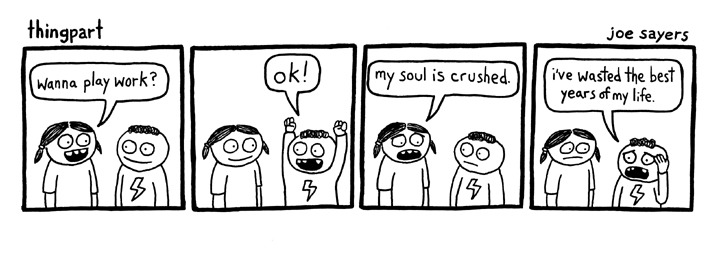
Comic by Joe Sayers, Wanna play work?

Wanna play work - comic

A good laugh, but also a reminder of an important idea. We spend much of our life at work: we deserve to have pride in what we do and even enjoy it (shocking I know). Read the respect for people posts for some ideas on how to make your workplace better. If you think a new job might be the answer – find management improvement jobs via Curious Cat Career Connections.

People are entitled to joy in workDr. W. Edwards Deming

Related: What Business Can Learn from Open SourceStop Demotivating Employees

Posted in Career, Deming, Fun, Management, Psychology, Respect | 5 Comments

Respect for People – Understanding Psychology

Process improvement tools offer great resources to improve results. Dr. Deming included understanding psychology as one of the 4 areas of his management system. He understood organizations where not machines but systems made up of people. Therefore management needs to reflect that reality. -Lee Fried discusses these ideas in It is All About the People:

We may organize and teach around the process, but it is the people that we really need to change if we want to show long-term sustainable improvement. This is exactly why every organization that treats Lean as a process improvement methodology or a set of tools fails in their efforts.

I know now that in the early stages of Lean transformation improvement should not be measured by project charts or number of improvement events. The foundational work of changing the way people think and behave needs to be done first, done correctly and done at the rate it can be absorbed by those that are doing the work in the first place.

I see building improvement capacity of the organization, which largely means building the capacity of the people, as an extremely important focus of improvement efforts. It is, at times, important to slow down the pace of change to ensure that people can adopt and incorporate the new concepts fully. If not, the improvements tend to only take effect on the surface.

Improvements in results are important but it is also critical to have management improvement concepts adopted as the natural way of doing business. And reaching that point most likely requires a focus on making that happen as well as improving processes. This split focus may seem to dilute effort but it is the most effective long term strategy (the time invested today in building capacity will make the management changes much more likely to sustain over the long term and will improve results over the long term).

Related: How to ImprovePeople are Our Most Important AssetManagement Recipearticles on process improvement

Posted in Management, Process improvement, Psychology, Respect | Tagged , , , , , , | 6 Comments

From Lean Tools to Lean Management

From lean tools to lean management [the broken link was removed] by Jim Womack:

The attraction of tools is that they can be employed at many points within an organization, often by staff improvement teams or external consultants. Even better, they can be applied in isolation without tackling the difficult task of changing the organization and the fundamental approach to management. I often say that managers will try anything easy that doesn’t work before they will try anything hard that does, and this may be a fair summary of what happened in the Tool Age

Teach all managers to ask questions about their value streams (rather than giving answers and orders from higher levels). Turn these questions into experiments using Plan-Do-Check-Act.

Only management by science through constant experimentation to answer questions can produce sustainable improvements in value streams. ( Toyota’s A3 is a wonderful management tool for putting science to work.)

He is right. The tools are useful. The much more significant changes are in the management suite not on the shop floor (or cubicle farm). Even on the shop floor there is room for huge amounts of improvement. In the c-suite I don’t know how to explain the amount of work left to do. Lets say this – there is much much much more improvement left to do than has been done so far.

Related: articles by Jim WomackDeming on Management

Posted in Lean thinking, Management, Quality tools | Tagged , , , | Comments Off on From Lean Tools to Lean Management

Dell Providing Computers Without Bloatware

The Art Of Listening: Dell Converts Customer Requests Into Exclusive Vostro Brand For Small Business

Dell today extended its commitment to customers with a new brand of notebook and desktop computers designed for small businesses. The Vostro branded products feature no trialware and simple to use tools that address top-of-mind problems such as data back-up, PC performance and health, and specialized networking support for customers without dedicated IT staff.

A good step (if quite late) on this issue we addressed 15 months ago in – Dell, Reddit and Customer Focus.

Related: Dell InnovationDell Falls ShortDesigning In ErrorsUsability Failures12 Stocks for 10 Years (Jun 2007 Update)

Posted in Customer focus, IT, Management | Comments Off on Dell Providing Computers Without Bloatware

Good Customer Service Example

IRA Toyota – Milford; Great Service [the broken link was removed]

I was pleasantly surprised to find a “Service wizard” available. You create an account, specify the standard details about the car (make, model, year, mileage). If you add the VIN, they will be able to provide and maintain additional details.

The slickest part of the wizard was the capability to pick a service and schedule a date. Depending upon what service you picked, the calendar changed. This wasn’t any old calendar. This was dynamic. Clearly, they had predefined the capability of handling some number of services per day. It was likely also interactive depending upon what was already scheduled for that day. This all makes wonderful sense but I had not seen this before.

I went ahead and scheduled the service for Monday AM planning to drop the car off Sunday night. Saturday, we received an email reminding us of the service scheduled for the car. Sunday, Allison and I drive over to their location, pull into the lot following the “Service” sign and find lanes specially marked for night drop off. There were already some cars in the lanes so we found a spot. The box on the wall had a pen and several forms. We filled out one and put the keys in the envelop through the clearly marked “key drop” slot. This group has figured out service and seems to have thought of everything. The drive home continued the conversation on how well they have planned for service; web site wizard, email reminders, lanes for drop off, etc. Well done!

I think the lean folks will like the level loading the dynamic calendar facilitates (and all the other ways the process provided value to the customer). This strategy levels the load by pushing around demand a bit (rather than just accommodating whatever demand exists – real world conditions can make this the correct strategy). For example, if special machines are needed for certain jobs and the long term demand supports one of each such machine and if you can adjust the flow to level out the demand doing so is a good strategy. As this example shows, customers have flexibility in scheduling preventative maintenance; therefore take advantage of that in your system design.
Continue reading

Posted in Creativity, Customer focus, IT, Management, Quality tools, Systems thinking | Tagged , , | 1 Comment

New Articles on Toyota Management

Harvard Business Review has a new article on Toyota that both the Elegant Solutions blog (by Matthew E. May author of Elegant Solutions: Toyota’s Formula for Mastering Innovation – via: lean blog) and Got Boondoggle, have raved about.

Amazing HBR Interview with Toyota President Watanabe on Elegant Solutions:

Pick up the latest issue of Harvard Business Review (July/August double issue) for a real treat: a fantastic interview with Toyota President Katsuaki Watanabe. This is a ground-breaking piece of journalism and revelation from the traditionally tight-lipped Toyota leadership, and Thomas Stewart does a truly masterful job of asking all the right questions. My hat’s off to him. And to President Watanabe, for truly candid answers. Rarely do you find leaders this frank, honest, and accountable.

What’s Next for Toyota?, Got Boondoogle:

The new manufacturing process at Takaota will completely change the way Toyota makes cars. We call them the “simple, slim, and speedy” production system. Right now our processes are complicated, so when a problem occurs, it is difficult to identify the cause.

We will have more flexibility than ever before: Each line at Takaota will be able to produce eight different models, so the plant will produce 16 models on two lines compared with the four or five it used to produce on three lines. In the old plan we used to make 220,000 vehicles a year on each line; now we will be able to make 250,000 units on each line. Toyota needs such radical changes today.

For those people thinking they were catching up on Toyota that might not be good news. I suppose you could hope that Toyota will fail, but that doesn’t seem likely given past experience (and there continued vigilance). I don’t think we will see them spend $40 billion on robots and then decide they can’t make it work (GM in the 1980’s). But it is much easier to fail that succeed, so it is possible.
Continue reading

Posted in Lean thinking, Management, Management Articles, Manufacturing, Toyota Production System (TPS) | 2 Comments

Health Care the Toyota Way

Clare Crawford-Mason produced the 1980 NBC news white paper on W. Edwards Deming that sparked a movement to improve management. She produced the Deming library tapes to help reach those taking steps to improve management and looking for more help. Last year she teamed up with Lloyd Dobbins on a new documentary – Good News – How Hospitals Heal Themselves.

Better Questions, Wiser Answers by Clare Crawford-Mason

For example, doctors and nurses from SSM Health Care, a Midwest system, with 22,000 employees and the Pittsburgh Regional Health Initiative, a group of 40 competing hospitals, report how they did their best in the past, working overtime, while hospital conditions worsened. They were initially dubious and then delighted to learn systems thinking and Toyota methods to improve patient care dramatically and reduce unnecessary deaths, suffering, errors, infections and costs without additional resources or government regulations.

The Deming-Toyota-Baldrige method and systems thinking can improve schools, government agencies or any organization, even military invasions and occupations, because it offers new ways to look at the bigger picture. It allows an organization to be greater than the sum of its parts as the people in the system learn to work together more effectively.

One thing more. The doctors and nurses in the successful hospitals frankly say the patient has been lost amidst new technology, regulations, reimbursements, etc. They say the Toyota approach allows the medical staff to spend more time with patients and deliver more effective care. So the solution is not computers or information. It is a new way of seeing and thinking.

I agree. Related: blog posts on the Toyota Production Systemarticles on improving health careFixing Healthcare from the InsideChange Health Care

Posted in Deming, Health care, Management, Toyota Production System (TPS) | Comments Off on Health Care the Toyota Way