
Google: Experiment Quickly and Often

Google Thinks Small by Quentin Hardy, Forbes:

Brin and Page have created a corporate organism that tackles most big projects in small, tightly focused teams, setting them up in an instant and breaking them down weeks later without remorse. “Their view is that there is much greater progress if you have many small teams going out at once,” Schmidt says. The mission overall: to collect “all the world’s information” and make it accessible to everyone. “It’s a cause.”

Hundreds of projects go on at the same time. Most teams throw out new software in six weeks or less and look at how users respond hours later.

Google has advantages in making this work for them (it is easy to find reasons it won’t work elsewhere). However, this is basically piloting changes on a small scale, analyzing the results and repeating that quickly. Quick, frequent experimentation with iteration is a tactic all organizations would benefit from.

The clear visible mission is also helpful. When an organization has an organizing principle everyone can understand then action can be guided by individual aim toward that purpose. When the understanding is missing organizations often have to rely on top down instruction and having far too many issues passed up the hierarchy for a decision.

And getting a small group of people to make things work quickly is also great. Many organizations get bogged down with byzantine management structures that slow action to a crawl.

Posted in Creativity, Data, Google, Innovation, Management, Process improvement, quote, Software Development | Tagged , , | 12 Comments

ToC Conference Recap

Thoughts on TOCICO [the broken link was removed] by David Anderson:

“Subordination happens first!” In the 5 focusing steps, the third step is to subordinate the rest of the system to the decision made in step 2 to fully exploit the capacity constrained resource. I had observed in my work with the XIT Sustained Engineering group (the subject of my paper for the conference), that the subordination actions always had to happen first before the constraint could be fully exploited. However, this is counter-intuitive given the order of the steps. As Eli reminded the audience, step 2 is “Decide what (and how) to exploit.” This then leads to a set of subordination decisions which make exploitation possible. Subordination always happens first.

Related Posts:

Posted in Management Articles, Software Development, Theory of Constraints | Tagged , | Comments Off on ToC Conference Recap

2005 Baldrige Award

The 2005 Baldrige Award recipients are:

  • Sunny Fresh Foods, Inc., Monticello, Minn. (manufacturing) [the broken link was removed]
  • Product rejections for SFF at all four plants have continuously declined. Reducing rework can provide significant productivity improvements: SFF’s rework reduction percentage was measured at 15 percent from 2001 to 2002, 61 percent from 2002 to 2003, and 75 percent from 2003 to 2004.
  • DynMcDermott Petroleum Operations, New Orleans, La. (service) [the broken link was removed]
    • The storage cost per barrel was $3.00 for Japanese Oil Reserves, $2.40 for U.S. industry storage, $1.60 for the European Oil Stockpile and $.20 for the Strategic Petroleum Reserve, managed by DynMcDermott.
  • Park Place Lexus, Plano, Texas (small business) [the broken link was removed]
    • Park Place Lexus Grapevine location had a New Car Client Satisfaction Index (CSI) of 99.8 percent in 2004 making it the highest rated Lexus dealership in the nation

    Continue reading

    Posted in Education | 1 Comment

    Lean Forest Products

    On The Move NRRI Forest Products promotes ‘lean’ manufacturing processes [the broken link was removed] by Chuck Watson:

    “Since U.S. furniture manufacturers typically had lead times greater than four to eight weeks, China could build and ship products to the U.S. within that same timeframe, for less cost.”

    His project team focuses on wood materials innovation and manufacturing, improvement in this vital industry, employing the lean manufacturing model initiated by Taiichi Ohno (Toyota)

    A one-week “Kaizen Blitz” (overhaul) restructured the entire facility, he said. “We reduced the amount of floor space necessary by restructuring, retooling and discovering more efficient use of space,” Benson said. “It changed the way we thought about our business.”

    Posted in Management Articles | Tagged | Comments Off on Lean Forest Products

    Carnival of Lean Leadership #3

    Carnival of Lean Leadership #3 [the broken link was removed] from Evolving Excellence once again does a great job of collection links to posts worth reading, including:

    • A big welcome to Norman Bodek, who has started his own blog, Kaikaku. Norman is well known for his Shingo Prize winning books. His first post is on Kaikaku and Kaizen as the “twin sisters” that can drive world class competitiveness.
    • Six Sigma Blog adds to the holiday cheer with a post on “Thanksgiving Design of Experiments” [the broken link was removed] … what is the most effective way to pop your popcorn?
    • Curious Cat has a similarly themed post on productivity improvement from R&D and innovation.
    • Slacker Manager has a post on “the Drucker paradox” [the broken link was removed]… why are his ideas so widely read but so rarely practiced?

    Each of the lean carnivals offer some great posts and reinforce the idea that there are great ideas being shared online. I also find it interesting how well represented lean manufacturing and lean thinking are. In the lean carnival that is not surprising but in the worthwhile management information online I have long been frustrated with how little good management improvement information was online.

    The influence of the lean blogs in the last year has been remarkable. Prior to that there really was a small set of sites that provided excellent content and they often were lacking in various ways. The Center for Quality and Productivity Improvement (which my father, Bill Hunter, co-founded with George Box – so I am biased) has great reports [they deleted the reports so here a link to some of the reports by George Box and Bill Hunter] but the site itself is not good.

    Continue reading

    Posted in Lean thinking, Management, Management Articles | Comments Off on Carnival of Lean Leadership #3

    Be Thankful for Lean Thinking

    graph
    Topics: Management Improvement and Economics

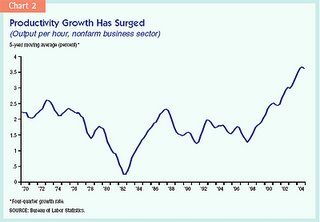
    The Dallas Federal Reserve white paper, Supply Chain Management: The Science of Better, Faster, Cheaper [the broken link was removed] by Thomas F. Siems provides a macroeconmic view of what to be thankful due to the practice of lean thinking:

    Through better information engineering, supply chain improvements have resulted in a reduced bullwhip effect, lower inventory levels, reduced logistics costs, and streamlined payments. These improvements appear to have helped produce macroeconomic benefits such as more stable economic output and higher productivity growth.

    Mass Production Era. In the early 1900s, Henry Ford created the first moving assembly line. This reduced the time required to build a Model T from 728 hours to 1.5 hours and ushered in the mass production era. Over the next 60 years, American manufacturers became adept at mass production and streamlined supply chains with the help of scientific management methods and operations research techniques.

    Lean Manufacturing Era. But in the 1970s, U.S. manufacturing’s superiority was challenged. Foreign firms in many industries made higher quality products at lower costs. Global competition forced U.S. manufacturers to concentrate on improving quality by reducing defects in their supply chains.

    Starting in the early 1970s, Japanese manufacturers like Toyota changed the rules of production from mass to lean. Lean manufacturing focuses on flexibility and quality more than on efficiency and quantity. Significant lean manufacturing ideas include six-sigma quality control, just-in-time inventory and total quality management.

    Continue reading

    Posted in Economics, Lean thinking, Management, Six sigma | Tagged , , | 1 Comment

    Performance Transformation

    Six steps to success – How to drive performance transformation by Gautam Kumra (India):

    Other companies encourage “lean” thinking, which began as an automotive-inspired and assembly-oriented methodology but which today is as established in many financial processes, service industries and parts of the public sector. “Lean” projects depend not just on rolling out new techniques but on changing basic ways of working.

    Posted in India, Lean thinking, Management Articles | Comments Off on Performance Transformation

    Innovation and Research and Development

    Innovation and R&D [the broken link was removed] by John Hagel:

    From a competitive viewpoint, what matters is the relative rate of productivity improvement. R&D spending and patent filings will matter little if they do not translate into faster productivity improvement -– in fact, they can be a significant distraction. Those who understand this will have a significant edge as competition intensifies in the global economy.

    I would argue innovation can be related to productivity improvement or it can be completely unrelated. A company could innovate with an ideas like the remote control for televisions (or microlending or air bags). That innovation may not contribute in any way to manufacturing televisions more productively.
    Continue reading

    Posted in Economics, Innovation, Management | Tagged , | Comments Off on Innovation and Research and Development

    Process Leadership

    Process Leadership [the broken link was removed] by Daniel T Jones:

    the most promising approach is to create a small team, led by a high potential executive, operating initially outside the normal departmental structure and reporting to the top. They must be free to challenge the conventional wisdom, the firm’s current assets and relationships. Their job is to evaluate the core value creating processes of the organisation from the standpoint of the customer, and to work out how to flow value to the customer smoothly and with minimum effort.

    More lean thinking articles

    Posted in Lean thinking, Management Articles, Process improvement | Tagged | Comments Off on Process Leadership

    The Economist on Drucker

    Trusting the teacher in the grey-flannel suit:

    He was a harsh critic of the assembly-line system of production that then dominated the manufacturing sector – —partly because assembly lines moved at the speed of the slowest and partly because they failed to engage the creativity of individual workers.

    The biggest problem with evaluating Mr Drucker’s influence is that so many of his ideas have passed into conventional wisdom “in other words, that he is the victim of his own success. His writings on the importance of knowledge workers and empowerment may sound a little banal today.

    I look forward to the day when this next idea is conventional wisdom, and the practice stops:

    In the late 1990s he turned into one of America’s leading critics of soaring executive pay, warning that “in the next economic downturn, there will be an outbreak of bitterness and contempt for the super-corporate chieftains who pay themselves millions.”

    Posted in Management | Tagged , | 6 Comments