
Lean Manufacturing Success

Oshkosh Truck Driven to Succeed [the broken link was removed] by Arlen Boardman:

Wuest said this reduced the order-to-delivery time from 12 to 16 weeks to seven days. It made better use of manufacturing space and reduced inventory-holding costs. He said it does many more things, like create an orderly work area, so tools are where they’re supposed to be, and parts are made when needed, one at a time.

“The goal is to turn an order into cash as quickly as you can,” he said.

Specialists in lean manufacturing systems were hired to help at Oshkosh Truck, including ones from General Motors and Ford Motor, among other big-name companies. This specialized team instills a belief in the changes and then conducts the training for the workers.

Not only is this a nice story but it is one small example of the good people working at GM and Ford. The problem is not the individual workers it is management. It is too bad that those companies, that did take great strides in the 1980 and early 1990s to improve (starting with Deming’s Management ideas) let those efforts fade away.

Continue reading

Posted in Deming, Lean thinking, Management, Management Articles, Manufacturing | Tagged | Comments Off on Lean Manufacturing Success

Problems with Bonuses

What sort of bonuses should we pay? by Seth Godin:

Money, it’s been shown time and time again, is a demotivator. I’m not talking about a fair or even generous salary. Being a cheapskate is no way to find a great employee. But once people have joined your team, incremental money–bonuses and the like–usually demotivate people.

He is right. Why salary bonus and other incentives fail to meet their objectives by Dale Asberry.

Lean Manufacturing Visionary Jim Womack On Frontiers Of Lean Thinking [the broken link was removed] by Jim Womack Continue reading

Posted in Deming, Management, Performance Appraisal, Psychology, Systems thinking | Tagged , , , , , | 5 Comments

A Company’s Purpose is to be Useful to Society

Toyota powers to the front [the broken link was removed]

(Toyota President, Katsuaki Watanabe) eschews the normal management mantra of shareholder value above all. A company’s purpose, Watanabe insists, is to be useful to society.

W. Edwards Deming described the purpose of an organization in New Economics, on page 51, as:

The aim proposed here for any organization is for everybody to gain – stockholders, employees, suppliers, customers, community, the environment – over the long term.

More from our previous post on the purpose of an organization

More lean thinking (Toyota Production System) articles.

Related: The Customer is the Purpose of Our Work

Posted in Deming, Lean thinking, Management, Toyota Production System (TPS) | Tagged , , , , , , | 1 Comment

US Manufacturing Plant Construction

Breaking Ground [the broken link was removed] by Jeff Moad:

Last year, according to figures from the U.S. Department of Commerce, investment in new manufacturing plant construction increased 25%. That compares to a decline of 6.5% in 2003 and an increase in 2004 of 9.7%

As we have noted earlier, the United States is by far the leading manufacturer in the world: Global Manufacturing Data by Country and Manufacturing and the Economy (Japan is second and China third and growing rapidly).

The mini-revival in new-plant development has been enough to slow what until recently had been a prolonged decline in the number of manufacturing plants operating in the U.S. Between 1997 and 2004, according to the U.S. Department of Labor (DOL), the number of plants operating in the U.S. dropped by 10%. In 2005, however, according to DOL figures, the number of plants stabilized at around 336,000.

Even though the US manufacturing output has continued to increase those gains have come largely from improved efficiency as fewer workers (and fewer plants) are producing the increased output. The decrease in employment is a worldwide phenomonon: Manufacturing Job Losses: USA 2 million, China 15 million.

Posted in Economics, Manufacturing | Tagged , | 4 Comments

People: Team Members or Costs

Inside TPS at Toyota, Georgetown, Kentucky [the broken link was removed] by Ralph Rio:

Toyota believes people need to be intimately involved with the process to understand how to improve it. The team member writes the standardized work they use because the person performing the work is the true expert. People are trusted to understand the process and improve it.

Automation is used but is seen as a tool for helping people manage the process. This can be contrasted with the effort by GM in the 1990’s to spend billions of dollars on robots to save personnel costs.

Both Toyota and GM seek to use technology to improve but Toyota sees the technology as useful to help people to be more efficient, eliminate menial repetitive tasks, eliminate tasks that cause injury… and it seems to me GM saw technology as a way to eliminate people. The action showed a company that viewed people as a cost to be eliminated. GM did not act as though people were their “most important assets” as we so often hear, but see so little evidence of in the action of companies.

Continue reading

Posted in Deming, Management, Systems thinking, Toyota Production System (TPS) | Tagged , , , , , , , | 4 Comments

Lean Aerospace Initiative

The Lean Aerospace Initiative [the broken link was removed] at MIT has a large number of reports, case studies and articles available online.

The Initiative was formally launched as the Lean Aircraft Initiative in 1993 when leaders from the U.S. Air Force, MIT, labor unions, and defense aerospace businesses forged a trail-blazing partnership to transform the industry, reinvigorate the workplace, and reinvest in America using a philosophy called “lean.”

The Initiative’s stated mission is to research, develop, and promulgate practices, tools, and knowledge that enable and accelerate the envisioned transformation of the greater United States aerospace enterprise through people and processes.

Posted in Lean thinking | Comments Off on Lean Aerospace Initiative

Lean, Mean Business Machine

Lean, mean business machine [the broken link was removed], from New Zealand:

But it is wasted effort that is the main focus, Mr Shook says. The lean philosophy is about first making waste visible, then acting on every level in a company, from large to small, to eliminate it.

This point is often overlooked – making waste visible is critical.

Posted in Lean thinking | Tagged , | Comments Off on Lean, Mean Business Machine

What Innovation Means to Tesco

What innovation means to Tesco [the broken link was removed] by Sir Terry Leahy (Chief Executive of Tesco):

Innovators are all around us; innovation is after all just another word for an idea and we can all have those. Businesses must learn to harness the creativity of their workforce and encourage staff to come forward with ideas. It’s not always easy as some good ideas will fail but companies have to be comfortable with that if they are to avoid stifling innovation.

Posted in Lean thinking, Respect, Systems thinking, UK | Tagged | 1 Comment

What makes Toyota tick?

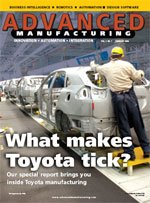
image of magazine cover

Advanced Manufacturing magazine continues the focus on Toyota with a cover article, What Makes Toyota Tick? [the broken link was removed] by Vanessa Chris

“Toyota has been coined ‘the most feared automaker in the industry.'” Just a few days ago I posted on: Fear Remains a Toyota Motivator. No matter what Toyota continues to be the focus of attention.

Every aspect of the assembly process flows flawlessly into the next – making the plant’s 157 processes seem like one. Parts from suppliers are delivered on racks that attach seamlessly onto Toyota’s assembly cells. When an assembly line is short on parts, sensors send messages to a team member’s wireless PDA, so he or she knows exactly when and what type of part is needed. Every team member here is recertified in six month intervals, to ensure optimal performance. And digital andon boards hanging throughout the facility report issues and the day’s progress – as well as any problems – in real time.

Continue reading

Posted in Lean thinking, Management, Manufacturing, Toyota Production System (TPS) | Tagged | Comments Off on What makes Toyota tick?

Indian Deming Prize Winner Expanding

Lucas TVS on Global and Local Expansion Mode

A delegation of top officials from leading Japanese industries — mostly comprising Toyota group and its suppliers — had also visited the Lucas TVS’ Chennai plant. The delegation is part of the central Japan Quality Control Association, an organisation promoting quality control in cooperation of the Union of Japanese Scientists and Engineers (JUSE).

The purpose of the visit was to introduce the delegation to the best practices amongst the member companies and also outside Japan. In 2004, Lucas TVS had won the prestigious Deming medal…

According to Balaji the Japanese delegation led by Tadashi Onishi, JTEKT Corporation, said that quality is not a magic solution but a systematic practice, and quality should not be measured by the absence of defect. A company should reach a condition where it innovates in quality. Further, all the stakeholders-employees, suppliers and others- should be involved in quality control. “The delegation also told us that quality systems should be at all levels of management and not only at the shop floor level,” Balaji said.

Continue reading

Posted in Deming, India, Management Articles, Manufacturing | Comments Off on Indian Deming Prize Winner Expanding