
Your Online Presence

Web anonymity can sink your job search [the broken link was removed]:

In today’s job market, turning up missing on the Web may not be a fatal flaw, and it’s probably better than having a search result in a photo of you in a hula skirt. But over time, the lack of a Web presence – particularly for IT professionals – may well turn from a neutral to a negative, says Tim Bray, director of Web technologies at Sun Microsystems Inc. “Particularly because we’re a core technology provider, if someone came looking for a senior-level job and had left no mark on the Internet, I’d see that as a big negative,” he says.

And it’s not just about technology, Bray says. “Most companies would rather have somebody who has demonstrated the propensity to contribute, and one [sign] of that is going out and getting involved, joining in the discussion.”

I think that is exactly right. For certain jobs the need for an online presence is not as critical, however, knowledge workers can really help out their prospects with a good online presence. Creating such a presence can be a big job or it can be a fairly simple site with a few articles with your ideas on topics that interest you. Creating your own blog can also be an effective strategy. Guest blog posts on another blog can also be useful.
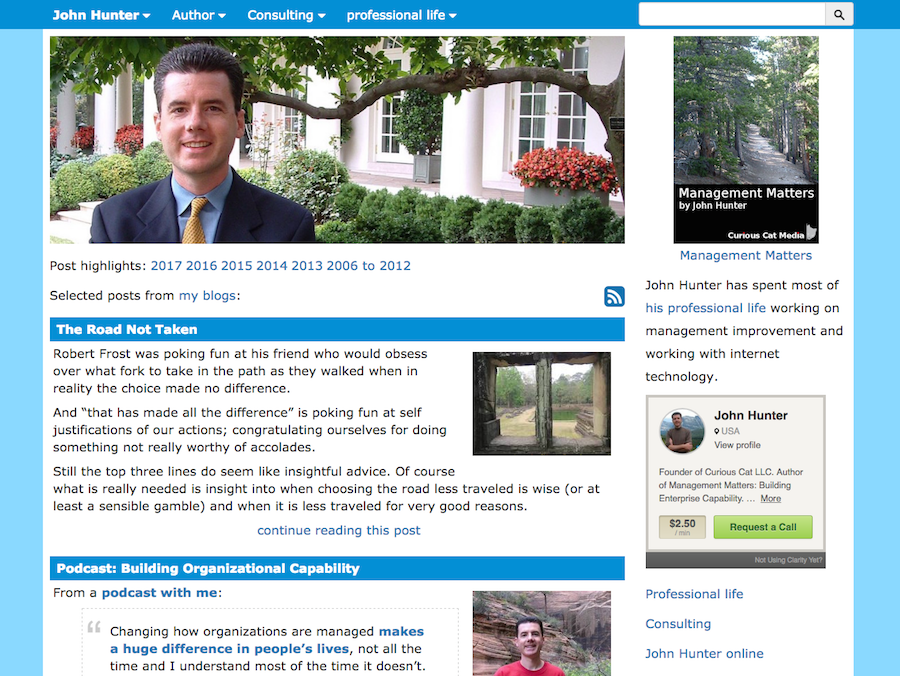
An image of the johnhunter.com home page

[I added this image after the blog post – from my post: New JohnHunter.com Website]

Your own web site that can serve as the long term address is a very good idea (and getting a web site with your name is a good idea, if possible, even if you don’t use it right away, for example: johnhunter.com). Then you can link to various efforts (guest posts on blogs, articles at various sites, podcasts…).

Related: Blogging is Good for YouYour Online IdentityInterviews with John HunterCurious Cat Management Improvement Articles

Posted in Career | Tagged , | 5 Comments

GM Lacrosse: China and the USA

Made in China, an article exploring the new GM LaCrosse:

The redesign was pitch perfect, so well targeted that the Chinese LaCrosse is on track to sell nearly 110,000 units in its second year in production. (In the United States, the LaCrosse isn’t expected to approach the 100,000-unit mark, ever.) Now, with that success still fresh, Qiu and the China design team face a critical test. They will design the next Buick LaCrosse, due out at the end of the decade, for the entire world.

I wonder how much value there is to designing cars to be world cars? Occasionally that might make sense and standardizing parts and even design processes… makes sense to me (as much as practical). The key it seems to me is “so well targeted” and local manufacturing.

Their plan, unprecedented within GM, was to pit teams of designers from around the world against each other.

I don’t like that idea. As much as possible they should cooperate with each other.

Posted in Management | Comments Off on GM Lacrosse: China and the USA

Using Google to Eliminate Some IT Costs

Computer Science 101: A Case Study In Google Applications [the broken link was removed]:

Sannier plans to shut down the university’s own e-mail servers later this spring. When that happens, thousands more will move over. The portal provides access to other functions of Google Apps, including calendar (which users can now share online, something they couldn’t do before), instant messaging, and search. Within the next two months, Sannier expects to offer personalized home pages and Google’s Docs & Spreadsheets applications combo.

The cost to ASU: zero. The university had been spending a half-million dollars a year on servers and storage for its open source e-mail system, including administrative support costs. More important is the faster pace of innovation. “Now we’re on Google’s development curve, not ours,” Sannier says.

Google’s efforts with Google Apps have fairly quietly become quite significant. I find gmail excellent (and Google talk and Google calendar are good but hopefully will be improved significantly). I must say I find Open Office very good and so don’t quite see the value in Google docs but maybe I am missing something (for those few documents that benefit from collaboration Google’s model sounds interesting – though a wiki seem like the best option in that case). Seems very possible Google Apps are an example of Clayton Christensen’s concept of disruptive innovation.

Posted in Google, Innovation, IT, Management | Tagged , , , , | Comments Off on Using Google to Eliminate Some IT Costs

Exposing CEO Pay Excesses

The politics of pay from The Economist:

Although barely one-tenth of the 2,000 biggest American companies have yet reported under the new rules, the tally of negative headlines is already mounting. “There are already plenty of examples of firms reporting chief-executive pay packages of millions of dollars more than expected,” says Paul Hodgson of the Corporate Library, a research firm. He reckons that the firms that have already reported are a representative sample likely to provide a good indication of the overall trend.

Thankfully, more of the ludicrous pay packages details are being made public and shame will force some changes (those approving these pay packages have to justify such reckless spending). Of course, some feel no shame no matter how egregious the situation. As I mentioned earlier, I would add excessive executive pay to Deming’s seven deadly diseases of western management. We need to drastically role back the luducrous pay packages.

Related: More on Obscene CEO PayExcessive Executive PayToyota’s CEO pay under $1 millionWarren Buffett on Excessive CEO PayCompensation at Whole FoodsBloated CEO salaries, subsidized by taxpayers, undermine American valuesCEO Compensation: A Problem That Just Gets Worse

Posted in Deming, Management, Respect, Systems thinking | Tagged , , | 4 Comments

Making Suits in the USA

Trying On Toyota’s Methods (site broke link so I removed it):

Keeping Abboud’s suit manufacturing in the United States has advantages, such as reduced shipping time, he said. He also believes overseas workers can’t beat the quality and price of the suits Abboud produces in New Bedford, which sell in Nordstrom Inc. and Bloomingdale’s for $700 to $1,000.

Abboud says its sales are about $400 million a year. The company is doing fine, but management says the U.S. factory has to improve constantly to justify the higher salaries its workers make, compared with foreign rivals. The average wage in the factory is $12 an hour, plus union benefits. That’s three or four times what workers in Mexico make, Sapienza said.

“It’s one thing to do it in 2007,” he said. “Are we going to be able to do it in 2010? In 2012? … In the final analysis, if Toyota can make a car in 13 hours, there’s no reason we shouldn’t be able to make a suit in a much reduced period of time.”

Related: Made in the USAJoseph Abboud: Lean ManufacturerMore on Joseph Abboud

Posted in Economics, Lean thinking, Management | Comments Off on Making Suits in the USA

Eric Schmidt Podcast – Google Innovation and Entrepreneurship

iinnovate podcast interview with Eric Schmidt, the CEO of Google.

“Normal sales quotas” – oops maybe Google can learn from others in this area. I found it interesting that Eric Schmidt teaches at Standford even while being the CEO of Google, because as he says he learns from students questions. The podcast series, done by 2 Stanford students, has quite an impressive list of, I guess, visiting speakers at Stanford: Andy Grove, Alex Counts, David Kelley…

via: Eric Schmidt Interviewed On Entrepreneurship, Management and More

Related: Innovation at GoogleGoogle Shifts FocusChaos Management (by design) at Google

Posted in Google, Innovation, IT, Management, webcast | 1 Comment

Errors in Thinking

photo of Jerome Groopman

The Doctor’s In, But Is He Listening?, text and podcast from NPR:

Jerome Groopman (photo) is a doctor who discovered that he needed a doctor. When his hand was hurt, he went to six prominent surgeons and got four different opinions about what was wrong. Groopman was advised to have unnecessary surgery and got a seemingly made-up diagnosis for a nonexistent condition. Groopman, who holds a chair in medicine at Harvard Medical School, eventually found a doctor who helped…

“Usually doctors are right, but conservatively about 15 percent of all people are misdiagnosed. Some experts think it’s as high as 20 to 25 percent,” Groopman tells Steve Inskeep. “And in half of those cases, there is serious injury or even death to the patient.”

Errors in thinking: We use shortcuts. Most doctors, within the first 18 seconds of seeing a patient, will interrupt him telling his story and also generate an idea in his mind [of] what’s wrong. And too often, we make what’s called an anchoring mistake – we fix on that snap judgment.

An understanding of theory of knowledge is helpful to counteract errors in thinking. How we think is not perfect, and an understanding the weaknesses and faulty conclusions we are susceptible to making is helpful. That can help avoid jumping to conclusions that are faulty and to design systems that counteract such behavior.

Related: Epidemic of DiagnosesWrite it DownThe Illusion of UnderstandingIllusions – Optical and Otherhealth care improvement posts

Read an exceprt [the broken link was removed] from the book: How Doctors Think by Jerome Groopman .

Posted in Health care, Management, webcast | Tagged , , | Comments Off on Errors in Thinking

Experiment and Learn

Experimenting with milkshakes?

I have been on a mission to convince firms to do simple experiments that will give them feedback regarding the decisions that they make. Just as with people (as Anders Ericsson studies), firms cannot learn with feedback. It turns out, however, that it is not easy for people in companies to see the wisdom in experiments.

Experiments are useful and underused. PDSA and design of experiments are two concepts that aid in experimenting successfully.

Related: Google: Experiment Quickly and OftenWhy Use Designed Factorial Experiments?Using Design of Experimentstheory of knowledge

Posted in Customer focus, Deming, Design of Experiments, Management, Quality tools | Tagged , , | Comments Off on Experiment and Learn

Deming Institute Seminar

The Deming Institute is sponsoring, How to Create Unethical, Ineffective Organizations That Go Out of Business [the broken link was removed], 23-25 April, 2007 in Lansing, Michigan. I will be co-presenting the seminar.

Twenty-seven faulty management and corporate governance practices create most of the problems in any organization. These practices will be identified, and better practices recommended. It will be shown that as better practices are introduced, quality of products and services increases, costs decline, and you create a globally competitive advantage for your organization.

Learn how governance practice leads to the heaviest losses, how inconsistencies between policy and strategy create sub-optimal outcomes, how mismanagement of people leads to unethical and ineffective behavior, and how to overcome these problems. Study the theory and practice of management. Not quality management, not good management, not excellent management, not knowledge management, not risk management, not process management, not performance management, not supply or asset management, not technology management, not time management, not emergency management, just plain management.

Related: Deming Seminar and ConferenceDeming Institute Conference

Posted in curiouscat.com, Deming, Education, Management | Comments Off on Deming Institute Seminar

Best Buy Rethinks the Time Clock

Best Buy Rethinks the Time Clock [the broken link was removed]:

With a classic flextime structure, workers arrange their schedules with their boss in advance. But under a program called Rowe, for “results-only work environment,” the boss has no say in scheduling and can judge employees only on tasks successfully completed – even if none were done in the office. The five-year-old plan now covers 60 percent of the employees at Best Buy’s corporate headquarters near Minneapolis.

And by all accounts, it’s working. Employee productivity has increased an average of 35 percent in departments covered by the program. Rowe “has forced managers and employees to be really clear about what needs to be accomplished,” says spokes-woman Dawn Bryant.

In defense of bosses from hell

Flush with the success of Rowe in its white-collar world, Best Buy is about to start testing the program in select retail stores. The company won’t release any details on this pilot project, and skeptics abound. “It’s pretty tough to ‘phone it in’ or work on your own independent schedule in retail,” says Susan Seitel, president of Minnesota-based Work Life & Human Capital Solutions.

Quite a contrast to: Wal-Mart Scheduling and Respect for People – One More Reason Not to Shop at Wal-Mart [the broken link was removed]. I can see some challenges trying to make this work, in fact it seems like the wrong way to do it to me but I support trying creative ideas even when I am skeptical (just pilot it on a small scale and assess the results). Why can’t you trust your managers to be sensible when they approve a schedule?

Posted in Creativity, Respect | Tagged , | Comments Off on Best Buy Rethinks the Time Clock