
Lean Manufacturing: The 3rd Generation

Lean Manufacturing: The 3rd Generation [the broken link was removed] by David Drickhamer:

A Toyota executive recently attributed the company’s long-term success to “brilliant process management.” Such processes are everywhere in business, including office and administrative work, areas where Toyota itself is working on how to extend TPS thinking. This is where Couch invokes TPS2, or “business-process kaizen,” and the challenge of dealing with non-physical inputs and outputs and much longer time frames than on the shop floor, such as the three-year product development cycle. Just as kanban cards are a method for transforming intangible information into a physical form, office applications of lean make work and information flow more visible.
Posted in Lean thinking, Management Articles, Toyota Production System (TPS) | Comments Off on Lean Manufacturing: The 3rd Generation

Lean Manufacturing in Forest Products

Lean Manufacturing – An Idea Whose Time is Coming to Forest Products? [the broken link was removed] by Thomas G. Dolan

In fact, while many understand the basic concepts and have tried various implementations as quick fixes to problems, most miss its full and lasting potential. The full capability of the lean philosophy involves creating a culture of observing and learning and an ability to implement, to innovate, and to continuously improve.

More lean thinking articles.

Posted in Management Articles | Comments Off on Lean Manufacturing in Forest Products

Interview with Jim Womack

Lean Solutions book cover image

Q&A With Jim Womack by Mark Graban:

The whole idea of lean solutions is to start with today’s customer in today’s circumstances and ask what the customer really wants. When we do this, the first thing to note is that manufactured goods have gotten vastly better, somewhat cheaper

James Womack also lists the six principles of Lean Solutions which seems to be boil down to one of the principles: “Get me exactly what I want” (though the way he describes this seems to be different than I read those words – “The proposition of retailers and other providers of goods from stock is that you can always find any of the items they have on offer”). That concept in then clarified by explaining what people want, such as: “don’t waste my time,” “Solve my problem completely,” give it to me when and where I want…

Continue reading

Posted in Lean thinking, Management | Tagged , | Comments Off on Interview with Jim Womack

Dell’s Supply Chain

Two articles on Dell’s supply chain.

Living in Dell Time by Joshua Lutz:

The aftershocks of the port closings reverberated for weeks. Many companies began to question the wisdom of running so lean in an uncertain world, and demand for warehouse space soared as they piled up buffer inventory to insure against labor unrest, natural disasters, and terrorist attacks. But for Dell, the episode only reinforced the value of living on the knife’s edge.

Inventory Decisions in Dell’s Supply Chain [the broken link was removed] by Roman Kapuscinski, Rachel Q. Zhang, Paul Carbonneau, Robert Moore and Bill Reeves:

Many components lose 0.5 to 2.0 percent of their value per week, and a supply chain packed with yesterday’s technology is nearly worthless. With its direct sales, however, Dell carries very little inventory: the whole organization concentrates on speeding components and products through its supply chain. Dell delivers new products to market faster than its competitors and does not have to sell old products at a discount, because it has none.

Dell’s stock has been taking a beating recently, but I remain positive on the second to worst performer 10 stocks for 10 years post. Just over 6 months since the post Google leads the pack up 77% (Toyota is next up 27%) while Pfizer and Dell are down 19% and 17% respectively (the only other decliner is Cisco down .5%).

Posted in Management Articles | Comments Off on Dell’s Supply Chain

Lean Information Technology

Topic: Management Improvement

A new Lean Blog, Compound Thinking, focuses on Information Technology. It has started off with some interesting posts, including – Compound Thinking: Lean Manufacturing Principles — Trust the Team [the broken link was removed]:

If you aren’t trusting your people, you are slowly but surely sapping their morale. Even worse, you are cutting yourself from the source of real ground-floor process innovation.

And Lean Manufacturing Practices — Kaizan [the broken link was removed]:

IT Departments need Kaizan events, new technology is coming at them faster than they can manage, processes aren’t automated just because nobody has a free couple of hours, and things can get messy very quickly.

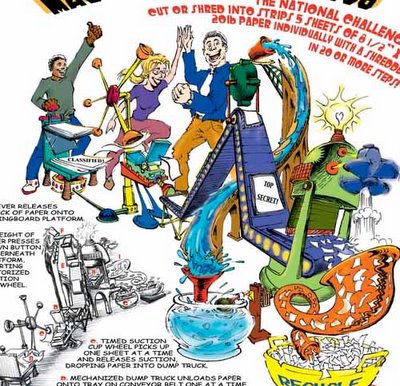
image of a complex contraption
I agree. It is very easy for waste to be hidden in IT. I think it is more difficult to notice the inefficiencies in IT because much of the work is done in virtual space, not real space. I think that can make it more difficult to see the waste. Or perhaps I am just using that as an excuse.

IT people also can hack something to meet today’s need and add it to the code base. It would normally be much more difficult to modify production machines. While this is an advantage (more flexibility) it often leads to sloppy systems. Instead of taking the time to design these properly something is created quickly, for today. If the code had a physical existence I think much of it would look like a rube Goldberg contraption.

Image from Rube Goldberg contest site [the broken link was removed]

Posted in Management | 2 Comments