
Conclusion of Jim Womack Interview

Interview with Jim Womack part 5 of 5 has been posted by the Lean manufacturing blog. Each part provide valuable insights, from part 4:

Toyota has recently said that it will now make a major effort to apply process thinking to dealer networks, probably beginning in Europe, and all of us who buy cars should wish them every success. We are making a major effort in this book to show how a totally different system of sales and service would work and we hope that a few dealers and then a lot will drink the Cool-aid.
Continue reading

Posted in Lean thinking, Management, Management Articles | Comments Off on Conclusion of Jim Womack Interview

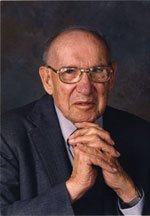
Management Pioneer Peter Drucker 1909 – 2005

Peter Drucker

Management expert Peter Drucker passed away at age 95. See: Peter F. Drucker Information from Claremount University [the broken link was removed] and our previous post.

Here we list links to some of his work.

There is an excellent podcast of an interview with him on NPR (Peter Drucker – podcast interview [the broken link was removed]) on management, the state of the world today and where we are headed. A profound view from Peter Drucker in his 95th year.

cover of Effective Executive

His revised edition of the Effective Executive is due out in January.

Post-Capitalist interview with Peter Drucker in Wired, 1993 (Post-Capitalist Society book by Peter Drucker):

International economic theory is obsolete. The traditional factors of production – land, labor, and capital – are becoming restraints rather than driving forces. Knowledge is becoming the one critical factor of production. It has two incarnations: Knowledge applied to existing processes, services, and products is productivity; knowledge applied to the new is innovation.

When you look at it that way, the last 40 years of economic history begins to make some sense.

Continue reading

Posted in Management, Management Articles, quote | Tagged | 1 Comment

Management Guru Peter Drucker 1909-2005

Peter Drucker
Management expert Peter Drucker passed away at age 95. Peter F. Drucker Information from Claremount University [the broken link was removed].

In 2002, Peter Ferdinand Drucker was awarded the United States Presidential Medal of Freedom.

Drucker, was born in Vienna, Austria, in 1909 and moved to the United States in 1937. He taught at New York University as Professor of Management from 1950 to 1971. From 1971 through 2002 he taught at Claremont University. The university’s School of Management was named for him in 1987.

He has written influential works about management since the 1940s. He has written about 30 books, and from 1975 to 1995 he was an editorial columnist for the Wall Street Journal.

He consulted for businesses and non-profit organizations. In 1990 he founded what is now the Leader to Leader Foundation [the broken link was removed]. Curious Cat Peter Drucker Biography.

Continue reading

Posted in Management, Management Articles | Tagged | 1 Comment

ToC in UK Surgery

UK surgeon uses TOC approach to double capacity and eliminate waiting lists [the broken link was removed] by Clarke Ching via Carnival of Lean Leadership II [the broken link was removed]

First, he has identified himself – or surgeons in general – as the current system constraint:

Second, he’s figured out how to exploit himself as the constraint – i.e. how to make him as efficient as possible:

Third, he’s subordinated the other resources in the process to make sure he is as busy as possible

Excellent post illustrating how Theory of Constraints can be used to analyze why an improvement is effective.

Posted in Management | Tagged , , | Comments Off on ToC in UK Surgery

Government Lean Six Sigma

Deep Thinkers [the broken link was removed] by Kimberly Palmer, GovExec.com:

“This is not a fad that will die out. It’s been tried, it’s been tested, it’s true. If you look at the best-run companies in industry, this is part of the heart and soul that’s making them successful,” says Mark Price, president of George Group Federal Services, part of Dallas-based George Group Consulting.

Unfortunately I would have to say the article does strike me as talking about fadish behavior ,not true transformation in management approaches. I was involved in management improvement efforts in government for years and the government does have examples of very well managed organizations (as well as poorly managed organizations). And too often superficial improvements were seen as a significant achievement. The article talks about things that are fine but just touch the surface of the needed improvements.

Continue reading

Posted in Economics, Management, Public Sector, quote, Six sigma | Tagged , , | 3 Comments

Dell Ranked as Top Supply Chain – Toyota Sixth

The Top 25 Supply Chains for 2005 [the broken link was removed], AMR Research:

Supply chain leaders are able to shape demand, instantly respond to market changes, and crush their competitors. According to AMR Research benchmarking data, leaders carry 15% less inventory, are 60% faster to market, and complete 17% more perfect orders.

The first component of the ranking is publicly available financial data, which comprises 60% of the total score: return on assets and inventory turns each accounts for 25%, and trailing 12 months’ growth accounts for 10%. The second component of the ranking is AMR Research’s opinion, which is 40% of the total score.

Related post: Dell’s Supply Chain

Posted in Management | Comments Off on Dell Ranked as Top Supply Chain – Toyota Sixth

Womack and Jones Webinar

The Lean Enterprise Institute is offering a free 1 hour webinar with James Womack and Dan Jones on November 15th at 2 PM (US Eastern Time).

Jim will deconstruct this broken consumer-provider-manufacturer model and show how to repair it using the six principles of lean consumption. The principles will be illustrated with examples of companies already leading the way from the age of mass consumption to the age of lean consumption and lean solutions.

Jim will also describe how the familiar value-stream mapping tool can be applied to consumption and provision streams to identify and remove enormous amounts of wasted time, human effort, and resources. It’s simply a matter of teaching everyone involved how to see the current state and how to envision a much better future state.

Related:

Posted in Management | Comments Off on Womack and Jones Webinar

Eight Essential Tools for Six Sigma

Eight Essential Tools (link broken, so I removed the link) by Ron Snee, Quality Progress:

In my experience, eight tools are used most frequently in Six Sigma projects – all eight use statistical thinking and methods. The tools are: process maps, cause and effect matrices (CE), failure mode and effects analysis (FMEA), measurement system analysis (MSA), process capability studies, multi-vari studies, design of experiments (DOE) and process control plans.

Ron is the co-author of 2 excellent books on Six Sigma:

and many articles:

Posted in Management | Tagged | Comments Off on Eight Essential Tools for Six Sigma

Lean Hospitals

Hospitals Turning Into Lean Machines by Megan Myers (broken link removed):

The push toward adopting more efficient strategies in health care largely stems from a crucial need to reduce health care costs.

In 2002, health care expenditures in the United States were $1.6 trillion, or 14.9 percent of the nation’s gross domestic product.

Meanwhile, studies have estimated between 30 percent and 60 percent of the costs of providing health care services is waste.

To cut that waste, hospitals are looking at their organizations from a patient’s perspective. That means breaking down the systems and starting fresh.

Posted in Health care, Lean thinking | Tagged | Comments Off on Lean Hospitals

Communication Failures Impact Quality

Outsourcing Communication Impacts Quality [the broken link was removed] by Kevin Meyer:

She immediately knew what I was talking about, and said that it has been a problem for about six months. The margin at the bottom of the statement is about an eighth to a quarter inch too wide, thereby pushing the address upwards. Unfortunately she didn’t know if and when it was going to be resolved, but after some friendly prodding she gave me a number at their corporate customer service center in the United States.

Read the rest of the post [the broken link was removed], it is a good reminder of the failures that are far too common in companies today. Even with improvements there is still so much poor service that those helping companies manage more effectively are nowhere near running out of opportunities to improve.

Posted in Management | Comments Off on Communication Failures Impact Quality