
Blogging is Good for You

Blogs ‘essential’ to a good career [the article has been moved behind an expensive paywall and is not even close to worth 1/100th of the cost so I removed the link. I added some links to related content at the end of the post.]

For those with blogs this is a nice article to read – good positive reinforcement. It is probably a good marketing move to write an article that bloggers will like. Many will then post their thoughts on your article on their blog.

The article is a bit overly enthusiastic still it includes some good points. And these points are especially valuable for those interested a creating a career in management consulting: particularly as an individual or part of a small firm where the focused marketing can make a difference. Marketing is often one of the most difficult parts of making a successful career as a consultant. As the article says:

You can’t make it on your own unless you’re good at selling yourself. One of the most cost-effective and efficient ways of marketing yourself is with a blog.

Related: The Benefits of Blogging (2014)Your Online Presence (2007)Hire Me to Manage Your Blog or Web Presence (2015)
Posted in Career | Tagged , | 3 Comments

Lean Accounting: What’s It All About?

Lean Accounting: What’s It All About? [the broken link was removed] by Brian H. Maskell and Bruce L. Baggaley:

Companies using Lean Accounting have better information for decision-making, have simple and timely reports that are clearly understood by everyone in the company, they understand the true financial impact of lean changes, they focus the business around the value created for the customers, and Lean Accounting actively drives the lean transformation. This helps the company to grow, to add more value for the customers, and to increase cash flow and value for the stock-holders and owners.

This article reviews the thoughts presented at the 2005 lean accounting summit. The 2006 summit [the broken link was removed] takes place in September. Jim Womack, Norman Bodek and Richard Schonberger are presenting at the conference.

Posted in Lean thinking, Management Articles | Tagged | 1 Comment

Toyota in the US Economy

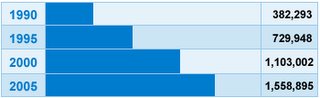
Some figures on Toyota’s economic impact in the USA. Toyota North American vehicle manufacturing totals:

graph of Toyota North American production

From Toyota’s web site: Toyota Manufacturing in the USA [the broken link was removed]: by 2008, Toyota will have the annual capacity to build 1.81 million cars and trucks, 1.44 million engines, and 600,000 automatic transmissions in North America.

The company’s direct employment in North America is more than 38,000 and direct investment is nearly $16.8 billion with annual purchasing of parts, materials, goods and services from North American suppliers totaling an additional $26 billion.

Toyota Touts Impact on U.S. in Billboards [the broken link was removed] :

The messages highlight numbers, such as 13 — “Donuts in a baker’s dozen; Toyota’s U.S. investment, in billions,” and 386,000 — “Kilometers to the moon; U.S. jobs created by Toyota.” The billboards are in some two dozen U.S. markets where Toyota has factories or supplier operations, from Fremont, Calif., where Toyota partners with GM at an automaking plant, to Huntsville, Ala., where Toyota makes engines.

Overview of Toyota’s North American Engineering and Manufacturing

Posted in Management, Manufacturing, Toyota Production System (TPS) | Tagged , | 4 Comments

Quality and Costs

Finding the balance between quality and cost [the broken link was removed] by Thomas Nolan Maureen Bisognano

One of the steps toward a system for improving value is recognizing that waste removal is an essential component of that system, not just a by-product of defect reduction. To alleviate discomfort with setting aims for cost reduction, senior leaders should:

Set aims for cost reduction while also mandating that quality must be maintained or improved by the effort.

In the article they discuss the view provided by Kano’s model of customer satisfaction – read more about it.

Deming explained that increasing quality decreases costs. Page 3 of Out of the Crisis: Improve Quality –> Costs decrease because of less rework, fewer mistakes, fewer delays…

Like most models this does not explain everything. Achieving some quality desires does cost more. And the article examines how to look at the issue of cost reduction in health care, where the view that higher quality costs more persists to a larger extent than elsewhere. There is significant room in health care for adopting improvement that will improve quality and reduce costs because the systems are so poorly designed they are both increasing costs and decreasing quality over what could be achieved.

Related:

Posted in Deming, Management, Management Articles, Quality tools | Tagged , | Comments Off on Quality and Costs

China’s Manufacturing Economy

Brad Setser posts on manufacturing comparisons: Have China’s manufacturing powers been exaggerated? [the broken link was removed]

I am all for pushing against over-generalizations that get repeated so often that they become conventional wisdom. The oft-stated argument that France isn’t growing is one example. In fact, France has grown faster than either Germany or Italy over the past few years, and France grew for the same reason the US grew: soaring real estate prices have pumped up domestic demand.

But I would submit that the real story here is the growth in China’s conventional wisdom to improve our understanding of the real situation. I agree with him that the growth in China’s manufacturing sector is the most important story.

But, to me, that story is so over-reported that many get the wrong impression. The constant mention of the eroding manufacturing sector on the USA I believe leads many to think it is shrinking and small. Yet output continues to increase and the share of worldwide manufacturing output is holding steady. China is gaining substantial ground but the Chinese increase has largely come from Japan and Europe. To me this understanding is important because of my felling about the misperceptions of many. But this is nothing more than my judgement.

Continue reading

Posted in China, Economics, Manufacturing, Popular | Tagged , , , | 3 Comments

The World’s Most Innovative Companies

The World’s Most Innovative Companies [the broken link was removed] :

Today, innovation is about much more than new products. It is about reinventing business processes and building entirely new markets that meet untapped customer needs. Most important, as the Internet and globalization widen the pool of new ideas, it’s about selecting and executing the right ideas and bringing them to market in record time.

Consumers increasingly are doing the innovation themselves. Consider Google Inc. (GOOG), our No. 2 innovator, and its mapping technology, which it opened to the public. This produced a myriad of “mash-ups” in which programmers combine Google’s maps with anything from real estate listings to local poker game sites.

Google’s mash-ups are just one example of the escalating phenomenon of open innovation. These days the world is your R&D lab. Customers are co-opting technology and morphing products into their own inventions.

Posted in Innovation, Management Articles | Tagged | Comments Off on The World’s Most Innovative Companies

Dell, Reddit and Customer Focus

Reddit is a site for what’s new and popular on the web (votes by the user community rate web links). That user community is highly skewed toward software engineers who are a bit irreverent (as some of the language in this post shows).

Today Reddit linked to: Introducing the Dell De-Crapifier… [the broken link was removed] which is essentially a tool to help you get rid of all the extra software you get with the Dell computer. Dell gets paid by software companies to pre-install software on the computer (Google may pay $1 billion over 3 years).

It’s a very dissatifiying experience to pull a brand new computer out of the box and be spammed with a bunch of trial software. After removing all of the crap, ([which] took a significant amount of time) it booted much faster and performed like it should. I kept thinking it would be nice to have an automated way to remove all this stuff. Thus was born the Dell De-Crapifier script.

Now, to be fair, I know most all of the major PC manufacturers have similar practices of installing trialware. I would suspect they don’t make any profit on the hardware (or even a loss) and they make their money on the kickbacks from the software companies. I don’t know.

The comments to the post are full of gems like:

Why not demand a better product from OEMs rather than cleanin up their crap for them and letting them continue to give customers what they don’t want?

It’s the OS that sucks.

Try a Linux machine that doesn’t need this crap.

Reddit is full of software people who don’t like Windows (Linux is their OS of choice). They take every opportunity to disparage Windows.

How do you use this? I just bought an Inspiron 6000 and want to murder it but then I came across this program.

Yeah the tool is not something most can really use easily.

Anything similar available for a Hewlett Packard. I’ve got tonnes of pre-installed stuff on it and boot time is paaaaaaaaainful.

Continue reading

Posted in Customer focus, IT, Management | Tagged , , | 10 Comments

Lean Education Academic Network Spring Meeting

The Lean Education Academic Network (LEAN) is having their Spring meeting [the broken link was removed] at the University of Kentucky in Lexington May 10th – May 12th. This is targeted at educators and students (a fairly small slice of our audience): still it looks interesting so here are some details.

The agenda [the broken link was removed] includes:

Tour Summit Polymer, considered by the Toyota Supplier Support Center to be the leanest manufacturing facility in the US. And a tour of the Lean Boot Camp in groups, meet with students, see learning factories.

The LEAN site includes some presentations from the winter meeting [the broken link was removed].

I will be co-presenting the How to Create Unethical, Ineffective Organizations That Go Out of Business [the broken link was removed] seminar sponsored by the Deming Institute coming up in Boston April 24th to 26th.

Jussi Kyllonen, John Hunter and Joyce Orsini (President of The W. Edwards Deming Institute, and Director of The Deming Scholars MBA Program at Fordham University) will facilitate the seminar. Louis E. Lataif, Dean of Boston University’s School of Management, former President of Ford Europe, and a leader in transformation will present a session titled: “Every management system is perfectly designed (to get what it’s getting).”

Posted in Education, Lean thinking, Management | 1 Comment

Why You Need a Roth IRA

Why You Need a Roth IRA [the broken link was removed] by Erin Burt:

If a 25-year-old contributes $4,000 each year until she retires and makes an average annual return of 8% on her investment, she’ll have more than $1.1 million saved by the time she retires at age 65. And the money is all hers — she won’t have to give the IRS a cent of it if she waits until retirement to cash out.

If that same 25-year-old invested that same $4,000 a year in a regular taxable account earning the same 8% return, she’d only have about $802,000 after 40 years if her earnings were taxed at 15%. That’s more than one-fourth less money than if she’d gone with the Roth.

And the second figure would be less, if the tax rate were higher than 15%. The Roth IRA is a great way to save money. With a Roth IRA you pay taxes on the money you put in (unlike a traditional IRA), but you pay no taxes on the money you take out (once you reach retirement age). The tax benefit of avoiding taxes on the accumulated funds is much greater than the tax deduction up front (if you have a long period of time to invest and your return is good: you also have to consider the difference in tax rates today versus at retirement).

Which IRA Is Best? [the broken link was removed] – short article from Smart Money.

Along with matching contributions from an employer on a 401k plan (where you can get an immediate 100% return and accumulate gain tax deferred) the Roth IRA is where you should invest if at all possible (see more on articles on investing for retirement).

Posted in Investing | Comments Off on Why You Need a Roth IRA

Lean Material Handling

Don’t Ignore your Water Spider a great post by Mike Wroblewski:

The second night was little better and I quickly evaluated the improvements from the night before. Later that second night, I made more improvements. Each day, I continued the cycle of experimenting with the improvements and making adjustments to see what worked best. By the end of the week, my pedometer reading hit only 10,000 steps or five miles and not one line operator had to get their own parts or screamed for me the entire shift.

More lean manufacturing articles.

Posted in Lean thinking, Management, Management Articles, Manufacturing | Comments Off on Lean Material Handling