
Peter F. Drucker on a Functioning Society

Peter F. Drucker on a Functioning Society by Joseph A. Maciariello:

Drucker’s concern that the institutions of society function for the common good has led him to be critical of business practice from time to time and to take on the preaching role of a prophet. For example, some of the ratios between the compensation of top executives and those of the frontline worker are well above 500 to 1… To Drucker this is shameful and sends the wrong message to employees and to the public about the ethics of executive conduct. It represents a lack of concern for the welfare of employees and society. There are public corporations that have been very successful over long periods of time who also have maintained, by policy or practice, a much lower ratio between those at the top and those at the bottom.

The Next Society, The Economist:

The next society will be a knowledge society. Knowledge will be its key resource, and knowledge workers will be the dominant group in its workforce. Its three main characteristics will be:

  • Borderlessness, because knowledge travels even more effortlessly than money.
  • Upward mobility, available to everyone through easily acquired formal education.
  • The potential for failure as well as success. Anyone can acquire the “means of production”, ie, the knowledge required for the job, but not everyone can win.

on Drucker’s ideas in his book, Managing in the Next Society.
Posted in Management Articles | Comments Off on Peter F. Drucker on a Functioning Society

The Toyota Way Fieldbook

Topic: Management Improvement

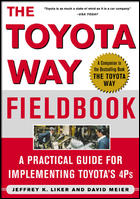
The Toyota Way Fieldbook – a Practical Guide to implementing Toyota’s 4Ps by Jeffrey Liker has just been released. For this book he is joined by David Meier, and they delve into applying the concepts from his excellent book: The Toyota Way. Toyota’s 4Ps: Philosophy, Processes, People, and Partners.

“The Toyota Way Fieldbook details the language, concepts, and tools that managers need to use Toyota’s success-proven practices in any organization. Readers are given valuable insights into the company’s system and culture along with diagnostic tools, work sheets, and exercises–many adapted directly from Toyota originals.”

Jeffrey Liker’s web site
Lean Thinking articles

Posted in Books, Lean thinking, Management, Toyota Production System (TPS) | Comments Off on The Toyota Way Fieldbook

Toyota and the Art of Continuous Improvement

Oh, What A Company! [the broken link was removed] by by Gary S. Vasilash

TPS is not for those who are looking for the fast solution. While implementing any single element of TPS will undoubtedly bring some rather startling results in comparatively short order, it is only through the continuous, persistent application of the principles that fundamental change is realized.

Very true.

Posted in Management Articles, Toyota Production System (TPS) | Comments Off on Toyota and the Art of Continuous Improvement

Deming Institute Conference

Topic: Management Improvement

For those who might be interested in meeting in person, I will be in Indiana for the Deming Institute Conference [the broken link was removed] and the seminar, How to Create Unethical, Ineffective Organizations That Go Out of Business [the broken link was removed], this month.

Feel free to drop me a note if you want to try and meet. I look forward to seeing some of you.

Posted in Management | Comments Off on Deming Institute Conference

Innovation in Software Development Process

Innovation in MSF v4.0 [the broken link was removed]

The Work Remaining report uses a cumulative flow chart developed for Lean Manufacturing. Work-in-progress and queuing can be monitored with this report in order to identify bottlenecks and address issues which are affecting throughput and reducing capacity.

MSF takes advantage of trustworthy transparency by focusing on the use of reports to drive objective, rational management decisions and interventions. MSF metrics have been selected to be simple, self-generating, relevant and leading (or predictive) indicators of project health. Trustworthy transparency leads to realistic schedules, reliable estimates, sustainable pace of work, and professional maturity rather than a reliance on heroic efforts.

MSF is the Microsoft Solutions Framework [the broken link was removed].
Continue reading

Posted in Deming, IT, Software Development | Tagged | Comments Off on Innovation in Software Development Process

Navy Six Sigma Results

Feds Train to Achieve Six Sigma Results [the broken link was removed] by Sara Michael, Federal Computer Week:

For Navsea, responsible for maintaining naval ships and weapons, the Six Sigma-inspired approach encourages managers to closely examine a business operation, such as contracting or information technology support, and look for ways to streamline procedures and deliver better service.

Navsea has introduced Lean Six Sigma programs in 30 of its organizations. In the first year, Brice said, the program is producing tangible effects by saving a total of $200 million on 500 projects.

Lean Government post on Curious Cat Management Improvement Blog

Posted in Management Articles | Comments Off on Navy Six Sigma Results

Lean Government

Making Government Work [the broken link was removed] by Tom Vilsack via Panta Rei [the broken link was removed]:

We redesigned the child welfare system to place greater focus on the complex and hard cases that people live out every day. We cut down paperwork so workers would have more time to spend helping children. That effort was part of our charter agency effort, which the Kennedy School at Harvard and the Ash Institute recently recognized as an Innovation of the Year award winner.

We committed ourselves to reconfiguring the way permitting and other processes worked in our government. By using Kaizen and other forward-thinking management techniques, we cut down the amount of time and staff used in the permitting process without sacrificing quality.

All of these efforts and results are outlined in our results website, at resultsiowa.org [the broken link was removed].

The Innovation Awards [the broken link was removed] have long been a good source for learning about some of the good work done in government.

Continue reading

Posted in Deming, Lean thinking, Management, Public Sector | Tagged , , , | 2 Comments

The Dramatic Spread of Lean Thinking

Topic: Management Improvement and Economics

The Dramatic Spread of Lean Thinking [the broken link was removed] by Jim Womack:

Currently we are experiencing an explosion of interest in applying lean thinking to practically every process in every corner of the world. And it is causing all of us in the Lean Community to think about how we can best serve the needs we are hearing about.

I am delighted with the spread of lean thinking far beyond the factory and far beyond the high-wage economies to every corner of the world and to every value-creating activity. My greatest concern is that we bring the best methods to bear and create the maximum amount of knowledge exchange across the global Lean Community so these initiatives will all succeed. Life will be better for all of us if they do.

Life indeed will be better for all of us with the improvement of management. The benefits of economic success are large. Good jobs are desired everywhere: USA, India, Germany, Singapore… Those jobs provide positive externalities that create a reinforcing loop of improving conditions.
Continue reading

Posted in Lean thinking, Management | Tagged , , | 1 Comment

Solectron Drives Lean Six Sigma Manufacturing to its Suppliers


Solectron Drives Lean Six Sigma Manufacturing to its Suppliers

“Lean has fundamentally changed the manufacturing landscape, led by Toyota,” said Jim Womack. “The future of the EMS industry is found in Kaizen, and Solectron is leading the way. But to reap the full value and benefits of Lean, Kaizen must permeate up and down the supply chain — from OEMs to suppliers.”
Posted in Management | Comments Off on Solectron Drives Lean Six Sigma Manufacturing to its Suppliers

Statistical Techniques for Quality

A new book, Quality Engineering Applications of Statistical Design, by T. N. Goh [the broken link was removed], was recently published by Wiley. Links to three previous articles by the author are provided below.

Improving on the Six Sigma Paradigm [the broken link was removed]

As six sigma has taken the business world by storm in the past 15 years, many organizations have focused on acquiring and implementing the DMAIC methodology with performance benchmarks defined by “sigma levels”. However, after perhaps proclaiming the “six sigma organization” label for the company, it is important for the business leaders to look beyond immediate concerns, i.e. those issues embodied in black belt projects, and adopt holistic and forward-looking perspectives in seriously advancing organizational interests.

Statistical Techniques for Quality [the broken link was removed] by T.N. Goh and M. Xie:

Statistical process control techniques and their role in process improvement are first discussed and some issues related to the interpretation and use of experimental design techniques are also summarised. The focus will be on continuous quality improvement using statistical techniques.

Perspectives on Statistical Quality Engineering [the broken link was removed] by T.N. Goh:

“How is statistical quality engineering related to Six Sigma?” The concepts, techniques and illustrations, explained in a non-mathematical language, are useful to both management and technical personnel interested in strategies and tools for cost-effective quality improvement.

Statistical quality engineering constitutes the backbone of the Improve phase, where design of experiments is used to identify the critical parameters (the “vital few” among the “trivial many”) in a process or product. It can be said that a Six Sigma program will make or break depending on the success of deployment of statistical quality engineering during the Improve phase.

Posted in Books, Six sigma | Tagged , | Comments Off on Statistical Techniques for Quality