6 New Kiva Loans to Manufacturing Entrepreneurs

I have been a big fan of Kiva for quite some time, and have written about it previously: Kiva – Giving Entrepreneurs an Opportunity to Succeed, Thanksgiving: Micro-financing Entrepreneurs. I made 6 new loans today to manufacturing entrepreneurs in the USA (and Mexico); Tajikistan; Nicaragua; Armenia; and 2 in El Salvador. The webcast above shows Armen Tsaghikyan in Armenia. It does seem like his process maybe could use a benefit from a bit of application of lean manufacturing ideas.

It is great to be able to help out people whether it is providing useful information (like I hope my web site and blog do) or a small loan of capital that allows some capital improvements. Many of the loans through Kiva amount to providing a loan to get additional supplies (often they have very limited capital). But my favorite loans are those that allow for purchases of new equipment that will make them more efficient.

It is easy to help out yourself; you can loan as a little as $25. The 10 members of the Curious Cat team have made 292 loans for a total of $12,000. Comment with the link to your Kiva page and I will add a link on Curious Cat Kivans.

Related: Kiva Fellows Blog: Nepalese Entrepreneur SuccessMore Kiva Entrepreneur Loans: Kenya, Honduras, Armenia…100th Entrepreneur Loan

Posted in Investing, Manufacturing | Tagged , , , | Comments Off on 6 New Kiva Loans to Manufacturing Entrepreneurs

Management Improvement Carnival #137

photo of Petronas Towers in Kuala Lumpur, Malaysia.

Petronas Towers, Kuala Lumpur, Malaysia by John Hunter. View from my hotel room.

The Curious Cat management blog carnival is published 3 times a month with select recent management blog posts. I also collect management improvement articles through Curious Cat Management Articles, you can subscribe via RSS to new article additions. Photo is the view I see as I post this issue of the carnival.

  • The importance of understanding variation or how to avoid treating all contractors as thieves by Benjamin Mitchell – “The fix for common cause variation (and most variation is common cause) is to go and study the situation, experiment and try and look for patterns or trends in the data before making a change to the system.”
  • Deming’s 14 Points by David Joyce – “The 14 points are not a menu you can pick and choose from. Deming intended you use all 14. They are one philosophy.”
  • Misconceptions about Self-Organizing Teams by Esther Derby – “Like all teams, they need a compelling goal, skills, information, and enough time to form and perform. And they still need managers to create a supportive context, set appropriate boundaries and constraints and connect the team to the organization.”
  • New York City Halts Teacher Bonus Program: Another Blow to Evidence-Resistant Ideology by Bob Sutton – “The decision was made in light of a study that found the bonuses had no positive effect on either student performance or teachers’ attitudes toward their jobs.”
  • Agile Prioritisation by Mike Griffiths – “There is no single best way to always prioritise; instead, try to diagnose issues arising in the prioritisation process, be it “lack of involvement” or “too many priority 1’s”, and then try approaches such as Monopoly money, MoSCoW or a pure list to assist if the problems cannot be resolved via dialogue. The goal is to understand where features lie in relation to others as opposed to assigning a category label.”
  • Continue reading

Posted in Carnival, Management | Tagged , | Comments Off on Management Improvement Carnival #137

Touring Factories on Vacation When I Was Young

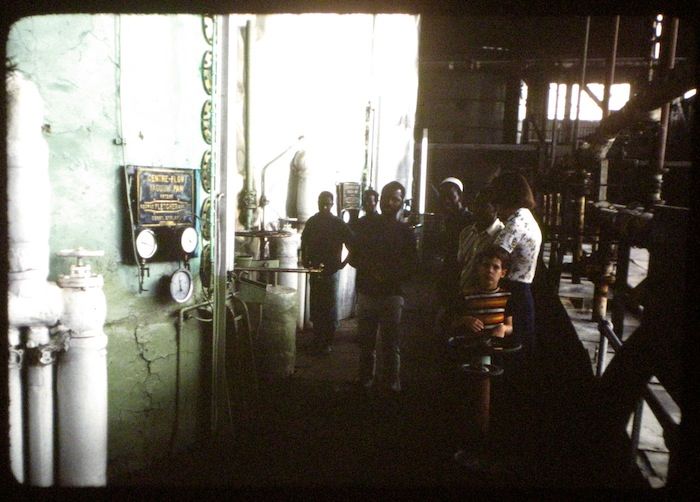
Growing up, occasionally, a family vacation would include a factory tour related to my Dad’s work. He was providing some management or engineering consulting and took the opportunity to check in on progress and visit the gemba. Here is a photo from one of those tours (in Nigeria, I think). My brother and Mom are visible in the photo.

The tours (which were not a very common occurrence) were quite enjoyable and interesting. Though I really didn’t like how noisy the factories were. Seeing all the machines and vast scale of the systems was quite a change of pace and added some excitement to the vacations (that often were already pretty exciting). I remember we also visited some factories in Kenya (in between seeing the game parks).

photo of factory tour with my family when I was a kid

Factory in Nigeria (I think) that my family toured


On this tour we found a bit of visual management showing which side of a crate should be on the top.
Continue reading

Posted in Lean thinking, Manufacturing | Tagged , , , , | 2 Comments

Management Improvement Carnival #136

The Curious Cat Management blog carnival highlights recent management blog posts 3 times each month. The posts generally focus on the areas I have focused on in the Curious Cat Management Guide since 1996 (Deming, leadership, agile software development, lean manufacturing, continual improvement…).

  • The Purpose of a Business is not Customer Value by Jurgen Appelo – “Every business is a complex adaptive system of stakeholders working together in order to create value for everyone involved… Unfortunately, again and again, management fads and hypes try to reduce this systemic view on organizations into a simplistic view, with dumb suggestions such as “maximize shareholder value” or ‘delight your customer’.” [Curious Cat on the purpose of organizations – John]
  • Line of Sight, Employee Engagement, and Daily Kaizen [the broken link has been removed] by Mark Hamel – “Perhaps the toughest transformational challenge is flipping the organizational pyramid “upside down” so that the leaders become enablers, not bottlenecks.”
  • Should You Let People Go, or Keep People and Reduce Salaries? by Harwell Thrasher – “When faced with the choice between layoffs and reducing salaries across the board, most businesses and governments follow the logic I’ve outlined above, and they go with layoffs. It’s the easy choice, but as I’ve noted in my list of three exceptions, it’s not always the best choice.”
  • Thoughts on Exceptional Leaders [the broken link has been removed] by Wally Bock – “Exceptional leaders constantly work at getting better.”
  • Continue reading

Posted in Carnival, Management | Tagged , , , | 1 Comment

Management Improvement Carnival #135

The Curious Cat Management blog carnival highlights recent management blog posts 3 times each month. The posts generally focus on the areas I have focused on in the Curious Cat Management Guide since 1996 (Lean manufacturing, Deming, agile software development, systems thinking, customer focus, six sigma, leadership…).

  • Go See, Ask Why, Show Respect by John Shook – “Go see, ask why, show respect is the way we turn the philosophy of scientific empiricism into actual behavior. We go observe what is really happening (at the gemba where the work takes place), while showing respect to the people involved”
  • Don’t delegate unless by Wally Bock – “Can the team member do the work you want to delegate? If they can’t you need to give them the training or resources they need to do what you assign. If you’re not sure, you should delegate but monitor.
    Will the team member pitch in and do the work when you’re not checking?”
  • The Seeds of Legendary by Mark Riffey – “To me, the folks that deliver legendary service offer consistency, little surprises, thoughtful, caring service. Not just nice, but more than you expect. Above and beyond. More than that, they set expectations by sharing with you that you’re about to experience the extraordinary – and then they deliver that and more. Talk isn’t enough. Delivery is critical.”
  • My Week with Mr. Masaaki Imai by Ron Pereira – “The thing that I most taken aback by was how kind and humble Mr. Imai was (and is). Many of the so-called lean gurus of our time are not always the most humble and kind… in fact, some of them are flat out arrogant and hard to listen to.”
  • Continue reading

Posted in Carnival, Management | Tagged | 1 Comment

I Will Co-Facilitate a Deming Seminar in Singapore July 25-27

image of the Deming medal

The W. Edwards Deming Institute is working with the NTUC LearningHub to offer management seminars in Singapore. I will be co-facilitating a Deming 2 1/2 day seminar in Singapore with Kelly Allan in July.

The 2 1/2 day Seminar, Deming’s New Philosophy of Management, is open for registration to the public.

In the seminar you will learn the way of thinking taught by Dr. W. Edwards Deming. Those ideas have been used by leading companies around the world and the value of these management ideas is as high today as it has ever been. Applying these ideas will allow your organization to achieve higher quality, lower costs and increased productivity. As regular readers of this blog know I often write about these ideas here.

Seminar Overview
Application of Dr. Deming’s “New Philosophy of Management” gives you the insight to remove barriers to success, increase efficiencies, reduce waste, boost motivation, stimulate innovation and understand your organization and its real capabilities. Some improvements are as simple as stopping current practices and enjoying productivity increases. Others require learning and understanding the four key components of the “New Philosophy of Management:”
Continue reading

Posted in Career, Deming, Management | Tagged , , , , , , | Comments Off on I Will Co-Facilitate a Deming Seminar in Singapore July 25-27

Management Improvement Carnival #134

snow pack on trail in North Cascade National Park

Snow pack on the Helitrope Ridge Trail in North Cascade National Park. Photo by John Hunter.

The Curious Cat Management Improvement Carnival has been published since 2006. We find great management blog posts and share them with you. We hope you find these post interesting and find some new blogs to start reading. You may submitted a post to the management subreddit to have it considered for the next carnival. See more photos from North Cascade National Park, Washington, USA.

  • To Change Culture, Change the System by David Joyce – “Deming learned it’s not a problem of the people it’s a problem of the system that people work within. He found that if you want to change behaviour, then you need to change the system, and change management thinking that creates it. Doing so, culture change is then free.”
  • Customer Engagement is Employee Engagement (and vice versa) by Julian Birkinshaw and Simon Caulkin – “And that was the conclusion: putting every employee in the customer loop on a regular basis could strengthen the entire culture of the company. Every time a Roche employee met with a customer, the employee would leave more engaged in the work of the company.”
  • Looting Factories For Fun and Profit by Bill Waddell – “These sorts of leveraged buyout games have made investment bankers millionaires, and destroyed tens of thousands of manufacturing companies over the last thirty years. It is a legal way to suck all of the value others have created from a company without adding anything.”
  • Why? Such a powerful question by Mishkin Berteig – “This communication is paramount during the Sprint or Cycle but is absolutely mandatory during the planning meeting. A team cannot simply be given a list of instructions to follow. The team needs to understand what their Goal is.”
  • Whoever Experiments Fastest, Wins by Mike Rother – “our current management paradigm tends to seek certainty. How rarely do we hear, ‘I don’t know,’ ‘Let’s observe what happens,’ ‘Not sure yet,’ ‘We’re testing that.’ (it is a shame when people are afraid of saying “I don’t know”John)
  • Continue reading

Posted in Carnival, Management | Tagged , | Comments Off on Management Improvement Carnival #134

Avoiding Tragedy of the Commons for Software Development

Kanban and Tragedy of the Commons

The “Tragedy of the Commons” archetype often manifests itself through “Shared Services”, when a small number of people with specific skills, work across different teams. Each team in isolation gets benefit from the Shared Service, but when demand for the service exceeds its capacity, then nobody benefits. At a smaller scale, a team with a low “bus factor”, or a hero, can also suffer from a tragedy of the commons, when too much work is dependent on a single person.

One of the comments on this post suggested that the tragedy of the commons wasn’t an accurate description. My comment:

I think the “tragedy of the commons” analogy works. As long as the users don’t have pay for use (or decide to prioritize) the danger exists for the abuse. So if you have a developer team and everyone just gets to dump tickets on to them and then whine if they don’t get what they want, when they want, I see the analogy as accurate. If people can just treat a resource as though it was suppose to just serve them and the resource is overwhelmed I see that as tragedy of the commons.

There are many ways to manage that problem (some manager deciding the priority for example). Then you may have other problems, but may avoid the tragedy of the commons scenario (in reality this setup is often done, but most don’t accept the prioritizations and just expect the development team to get everything done – which means you don’t avoid the tragedy of the commons problem).
Continue reading

Posted in Management, Software Development, Systems thinking | Tagged , , , , , | 2 Comments

The aim of leadership is not merely to find and record failures of men

The aim of leadership should be to improve the performance of man and machine, to improve quality, to increase output, and simultaneously to bring pride of workmanship to people. Put in a negative way, the aim of leadership is not merely to find and record failures of men, but to remove the causes of failure: to help people to do a better job with less effort.

W. Edwards Deming, page 248, Out of the Crisis

This is a great quote, from Deming’s classic Out of the Crisis. He continues with the following lines:

Actually, most of this book is involved with leadership. Nearly every page heretofore and hereafter states a principles of good leadership of man and machine or shows an example of good or bad leadership.

I recommend Out of the Crisis for those that are serious about improving management. The book isn’t as easy to read as some management books, but the value within its covers is enormous. Deming’s 14 points for management are meant to help tie together various ideas (they not meant to be complete as a stand alone list). The 14 points were included in Out of the Crisis. He evolved to explaining his management ideas using the system of profound knowledge as a better way to capture the systemic nature of the management system. Dr. Deming’s point number 7 (in his 14 points) was to “Adopt and institute leadership for the management of people, recognizing their different abilities, capabilities, and aspiration.” His quote above explains that leadership was not some idea of being charismatic or commanding or the like but leading a system of people using all the ideas laid out in Out of the Crisis (many of which people don’t usually think of when thinking of leadership – such as using control charts).

Far too many leaders think their role is to hold people accountable. Such thinking shows much that is wrong with those that seek simple answers instead of improvement.

Related: Management and Leadership quotes by Dr. Deming The Best Leadership Is Good ManagementProblems with Management and Business BooksLeadership is the act of making others effective in achieving an aim.The Leader’s Handbook

Posted in Books, Deming, Management | Tagged , , | 8 Comments

Management Improvement Carnival #133

photo of Tree at the Clifton Gorge State Nature Preserve The Curious Cat management blog carnival is published 3 times a month with select recent management blog posts. I also collect management improvement articles through Curious Cat Management Articles, you can subscribe via RSS to new article additions.

  • Why I can’t convince executives to invest in UX (and neither can you) by Jared Spool “Neither I, you, nor anybody else can convince an executive to invest in user experience… You’ll need to do something custom. Something specific to their current focus. And if that doesn’t work, maybe it’s time for you to find someplace else to work. Someplace where the executives are already convinced and want to make the investment.” [You can substitute “lean, six sigma, customer focus or any other wise management strategy for UX in the quote above. – John Hunter]
  • Jeff Bezos on innovation at Amazon – Jeff Bezos: “If you invent frequently and are willing to fail, then you never get to that point where you really need to bet the whole company… We are stubborn on vision. We are flexible on details…. We don’t give up on things easily. Our third-party seller business is an example of that. It took us three tries to get the third-party seller business to work. We didn’t give up.”
  • Kanban and Shifting the Burden by Karl Scotland – “The Containment action is the symptomatic solution taken to resolve the problem quickly. Then, after root cause analysis, the Countermeasure action is the fundamental solution to prevent repeated recurrence.”
  • The Iceberg That Sinks Performance by Dan Markovitz – “Time management ‘problems’ are really just manifestations of dysfunction in one or more of the following areas: strategy; priorities; internal systems and processes; corporate cultural expectations; or individual skills.”
  • About that bus … by Wally Bock – “This is the kind of guru advice where the principle (get the best people you can) is good, but to use it you have to deal with reality that’s a lot messier than it seems in the books. “
  • Drucker and Executive Compensation – Are CEOs Paid Too Much? by Robert Swaim – “Few people- and probably no one outside the executive suite – sees much reason for these very large executive compensations. There is little correlation between them and company performance.” Peter F. Drucker, The Frontiers of Management, 1986.
  • Continue reading

Posted in Carnival, Management | Tagged , , | Comments Off on Management Improvement Carnival #133